Best Gas Pole Saw 2026: Reach, Power and Balance for Thick Limbs
When you buy through the Amazon links on this page, we may earn a commission at no extra cost to you. Learn more
Last updated October 31, 2026
The Echo PPT-2620 is the best gas pole saw for most buyers: a 25.4 cc engine, a 12 in bar and a telescoping shaft that reaches 12.1 ft, backed by a 5-year consumer warranty. It has the reach and the filtration that thick-limb work on mature trees demands.
Gas buys you runtime, torque and balance, because the engine rides at your hands and not at the cutting head. You pay for it in fuel mixing, noise and regular maintenance. The Husqvarna 122LKP suits lighter work and attachment-minded owners.
The best gas pole saws of 2026

Echo PPT-2620 pole saw
See on Amazon
Husqvarna 122LKP
See on Amazon
PROYAMA PPS430 pole saw
See on AmazonModel comparison
| Model | Price | Rating | Engine displacement | Bar length | Weight | Best for | |
|---|---|---|---|---|---|---|---|
| | Echo PPT-2620 pole saw | $676.49 as of 10/31 See on Amazon | ★ 4.5 (90+ ratings) | 25.4 cc | 12 in | 17.4 lb | Owners of several mature trees who cut often get 2-stage air filtration for dusty, heavy seasonal work. |
| | Husqvarna 122LKP | $299.99 as of 10/31 See on Amazon | ★ 4.1 (150+ ratings) | 21.7 cc | 10 in | 13.1 lb | Homeowners who want one gas powerhead across pruning and yard chores and value a lighter pole, answered by 13.1 pounds and attachment-capable compatibility. |
| | PROYAMA PPS430 pole saw | $195.00 as of 10/31 See on Amazon | ★ 4.0 (250+ ratings) | 42.7 cc | 12 in | not stated | Buyers wanting maximum reach and a name-brand chain get 15 feet of reach with an Oregon chain. |
 | Bavnnro HYGXBI048O | $134.99 as of 10/31 See on Amazon | ★ 3.8 (70+ ratings) | 48 cc | not stated | 21 lb | Budget buyers with tall trees and occasional use get 48 cc and 13 to 16 feet of reach. |
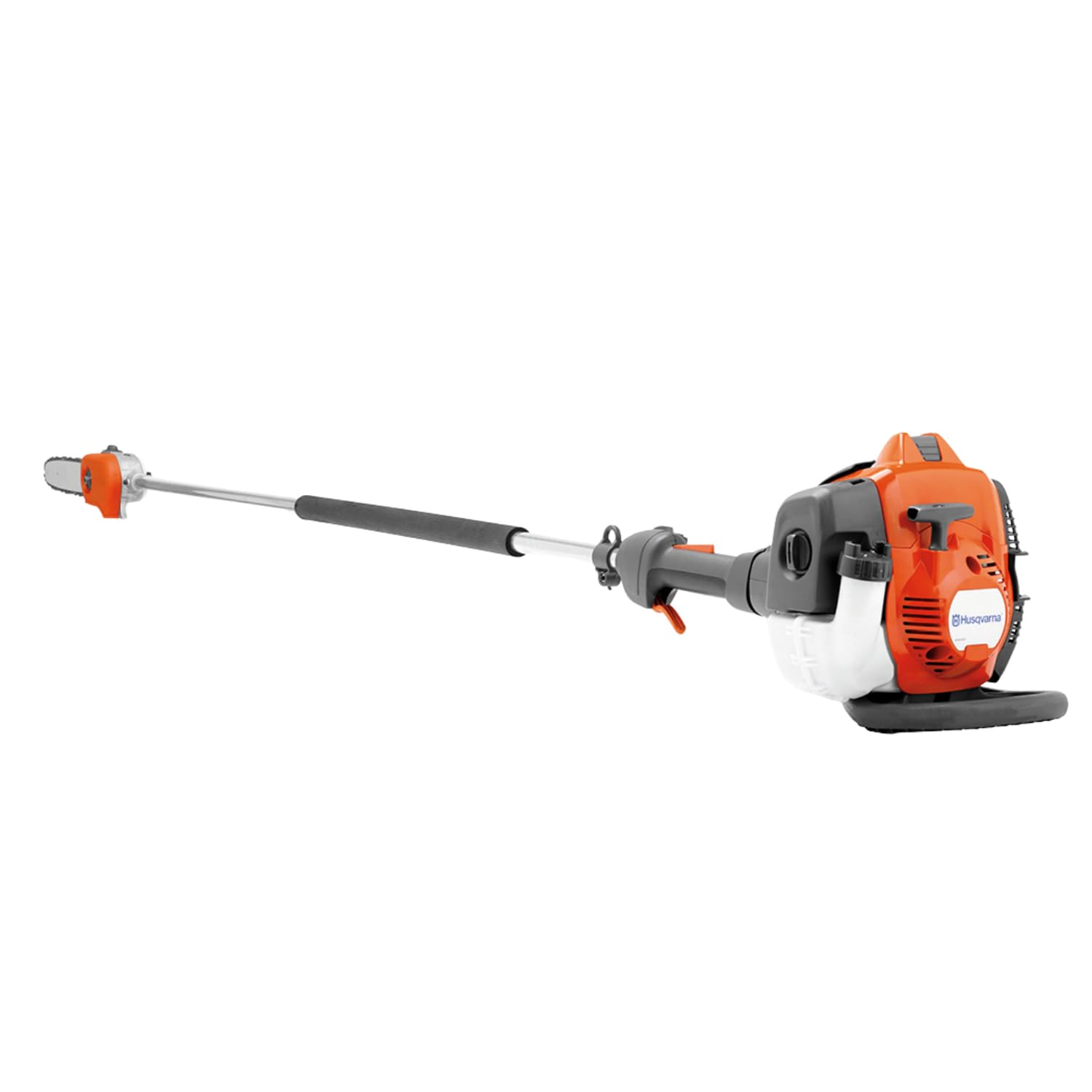 | Husqvarna 525P4S pole saw | $569.99 as of 10/31 See on Amazon | ★ 3.7 (13 ratings) | 25.4 cc | 12 in | 16.7 lb | Buyers wanting a balanced commercial-grade fixed-shaft saw get 1.36 hp with matched ergonomics. |
How a gas pole saw differs from a chainsaw on a pole
A gas pole saw puts the engine at your end of the tool. A centrifugal clutch on the engine drives a flexible inner shaft that runs the length of the pole, and a gearbox at the far end turns a short bar and chain. The cutting head carries no motor, no battery and no fuel, so it stays light.
That layout changes how the saw feels in your hands. The weight of the engine, the heat and the exhaust all sit near your body and away from the cut, which keeps fumes out of your face and keeps the head easy to place. The saw balances between your hands instead of hanging nose-heavy at the end of a stick. Many battery pole saws carry the motor and the battery at the head, which is why they can feel front-heavy at full extension.
The part that carries the load over distance is the drive shaft, not the engine. Every bit of torque the chain needs travels up that shaft, through a coupling at the powerhead and a gearbox at the head. A long, jointed drive train is the weak point of the design, and it is where most of the maintenance attention belongs.
Why reach changes the cutting geometry
A long pole turns the saw into a lever. The bar meets the limb at an angle set by where you stand and how you hold the pole, not by standing over the wood the way you would with a chainsaw. You plan the cut from a distance: where the bar enters, which way the limb will swing once it separates, and where you will step when it goes.
The lever works both ways. A small movement at your hands becomes a large movement at the head, so a slight wrist roll at 12 ft swings the bar several inches. Control comes from a steady grip and from bracing the pole against your body, not from quick corrections.
Reach is measured as working height, which is pole length plus your own arm reach, not pole length alone. A longer pole buys height at the cost of control, because every extra foot adds flex and leverage against your shoulders. Set your escape path before the chain touches wood, not while the limb is moving.
Choosing between a dedicated pole saw and a pole pruner attachment
Gas pole saws come in two formats. A fixed-shaft unit is built as one pole saw from the start: the shaft, gearbox and bar are matched to the engine, and the whole tool is tuned as a single machine. The other format is a powerhead that accepts a pruner or brushcutter attachment, with the attachments sold separately.
A dedicated unit tends to feel stiffer and better balanced, because nothing is added at a coupling and the engine is sized for the bar it drives. An attachment-capable powerhead spreads the cost of one engine across several tools, but it adds a joint in the drive train and the engine has to pull whatever bar the attachment carries. A small engine on a long attachment can feel strained in thick wood.
Think about how much bar the engine can drive and how far you need to reach. If pruning is the main job and you want the saw to feel like one piece, a dedicated pole saw is the simpler choice. If you also want an edger or a hedge trimmer from the same engine, the attachment route makes sense, as long as you accept the extra coupling.
Managing the drive shaft and pole joints
The inner drive shaft needs grease on the schedule the manual gives, and skipping it is the fastest way to wear out a long pole saw. Grease the shaft, check the coupling at the powerhead so the shaft stays seated, and keep telescoping or sectional joints tight so the head does not slip, rotate or whip under load.
Neglect shows up in recognizable ways. A head that lags behind the throttle means the shaft is slipping or the coupling is loose. New vibration points to a dry or bent shaft. A joint that creeps shorter mid-cut means the lock is not holding. These are the failures a long pole saw is most prone to, because the drive train is long and jointed and every joint is a place where torque can escape.
- Grease the shaft at the interval in the manual, not when it starts to squeal.
- Check the coupling at the powerhead before each session so the shaft stays seated.
- Tighten the joints on a telescoping or sectional pole and recheck them after the first cuts.
- Inspect the gearbox at the head for grease loss and play.
Cold starts, flooding and hot restarts on a pole unit
Starting a pole saw means working controls that sit far from the cutting head. Press the purge or primer bulb several times, set the choke out for a cold start, engage the throttle lockout, and pull until the engine fires. Then move the choke to run, let it warm up, and only then start cutting.
Two failure modes account for most no-starts. A flooded engine clears with the choke off and the throttle held open while you pull it through. A hot restart between limbs needs no choke and often no purge, just throttle and a pull. Learn both sequences before you are up a tree with a stalled saw.
A pole saw is fussier than a chainsaw here, because you cannot see or hear the head as clearly and a stall mid-limb means lowering the whole pole before you can restart. Keep the fuel fresh, the air filter clean and the spark plug dry, and the saw will start when you need it.
Our picks by budget
The Bavnnro HYGXBI048O is our budget pick because it puts a 48 cc engine behind a 2.7 ft extension pole for up to 16 ft of reach, which is a lot of cutting capacity for the outlay.
The Husqvarna 122LKP is our mid-range pick because it drops to 13.1 lb while keeping up to 12 ft of reach, adds an attachment-capable powerhead and backs it with a 2-year residential warranty.
The Echo PPT-2620 is our premium pick because 25.4 cc, a 12 in bar, telescoping reach to 12.1 ft, 2-stage air filtration and a 5-year consumer warranty are what frequent, heavy cutting on thick limbs actually needs.
Budget
Mid-range
High-end
Which gas pole saw for which buyer
Matching the saw to the job matters more than the spec sheet alone, because a 21 lb pole and a 13 lb pole suit very different afternoons.
The acreage owner with many trees
Telescoping reach to 12.1 ft, a 12 in bar and 2-stage filtration for dusty work. Built for frequent, heavy cutting on thick limbs.
The homeowner with several yard jobs
A saw at 13.1 lb, with up to 12 ft of reach and a powerhead that accepts other attachments. One gas engine covers pruning and yard chores.
The buyer who wants maximum reach
A 42.7 cc engine, a 12 in Oregon bar and chain, a 90-degree adjustable head and 15 ft of maximum reach, with a harness included for long sessions.
The buyer stretching to tall limbs on a budget
A reachable height of 16 ft, accepting 21 lb and no dealer network behind the brand.
The buyer who wants a balanced fixed-shaft saw
A 25.4 cc X-Torq engine, a 12 in bar, up to 13 ft of reach and an air purge system for easier starting, tuned as one machine rather than an attachment platform.
Our verdict on the best gas pole saws
The Echo PPT-2620 is the pick for most gas buyers: it pairs the reach, the 12 in bar and the 2-stage filtration that thick-limb work demands with the longest consumer warranty on the page. The Husqvarna 122LKP is the value pick for lighter, attachment-minded owners, and the Proyama PPS430 is the displacement-and-reach choice with a harness in the box. The Bavnnro HYGXBI048O is the budget stretch for tall trees, and the Husqvarna 525P4S is the balanced fixed-shaft alternative.
Gas is for runtime, torque and balance. If you have a handful of trees and no need for hours of cutting, a battery saw may serve you better.
Detailed model analysis
Displacement, bar length and reach decide how much limb a gas pole saw can take, and weight decides how long you can hold it up there.
Echo PPT-2620 pole saw
The PPT-2620 pairs a 25.4 cc 2-stroke X Series engine with a 12 in bar. Its telescoping shaft extends to 12.1 ft, so you can reach high limbs without moving the ladder.
At 17.4 lb it is a two-handed tool. The loop handle lets you swing the head around and over a limb instead of only straight down.
The 2-stage air filtration keeps dust out of the engine during long sessions in dry brush, and the automatic oiler keeps the chain fed as the bar works at odd angles.
The inner drive shaft is aluminum. The warranty runs 2 years commercial and 5 years consumer.
It suits owners with several mature trees who cut often. The 45-degree cutting angle and the reach make it a fit when limbs are both high and thick.
- Brand: Echo
- Engine displacement: 25.4 cc
- Bar length: 12 in
- Extended shaft length: 12.1 ft
- Weight: 17.4 lb
- Power source: Gas
Husqvarna 122LKP
The light gas pole saw in this guide. The Husqvarna 122LKP weighs 13.1 lb and offers up to 12 ft of reach, so you get real gas reach without a pole that wears your arms out after twenty minutes.
The cutting end uses a 10 in X-CUT chain and handles limbs up to 8 in thick. An optimized cutting angle is built in for cleaner bites.
Power comes from a 21.7 cc engine making 0.8 hp. With this saw you trade maximum displacement for a lighter pole, which is the main limit to weigh.
The powerhead accepts other attachments, including an edger and a hedge trimmer sold separately. One gas powerhead can then cover pruning and other yard chores.
The warranty is 2 years for residential use, which fits the home setting this saw is made for.
It suits the homeowner who wants one gas powerhead across pruning and yard chores, and who values a lighter pole over maximum displacement.
- Brand: Husqvarna
- Engine displacement: 21.7 cc
- Power: 0.8 hp
- Bar length: 10 in
- Reach: 12 ft
- Weight: 13.1 lb
PROYAMA PPS430 pole saw
A 42.7 cc 2-cycle engine making 2 hp drives the 12 in Oregon bar and chain.
The pole runs from 8.2 ft to 11.4 ft for a maximum reach of 15 ft. You should use the extended reach rather than climb.
The 90-degree adjustable head lets you set the bar to the limb instead of fighting the angle.
An ergonomic harness with broad back support, shoulder straps and a hip belt comes with it. That matters at this reach because the pole acts as a long lever. The saw also runs with reduced vibration.
It suits buyers who want maximum reach from a gas saw and will wear the harness on long trimming sessions.
- Brand: Proyama
- Engine displacement: 42.7 cc
- Bar length: 12 in
- Power: 2 hp
- Power source: Gas powered
- Maximum reach: 15 ft
Bavnnro HYGXBI048O
A 48 cc 2-cycle engine drives an 11.5 in bar, which is a lot of displacement for a pole saw. For tall trees on a tight budget, that combination is hard to match.
Reach is the other draw. A 2.7 ft extension pole brings the reachable height to 13 to 16 ft, which suits tall trees.
The box holds the motor, a two-section pole, the extension pole, a wrench, a shoulder belt and the working head. A proportioning pot of about 50.7 fl oz (1.5 L) is included for mixing fuel.
At 21 lb it is the heaviest saw on this page. Expect to carry more weight than with any other saw we list here.
The brand has no dealer network behind it, so parts and service are on you. Factor that in before you buy.
It suits the budget buyer with tall trees and occasional use, who accepts the weight and the lack of support in exchange for displacement and reach.
- Brand: Bavnnro
- Engine displacement: 48 cc
- Cutting bar length: 11.5 in
- Max reach: 16 ft
- Weight: 21 lb
- Power source: Gas powered
Husqvarna 525P4S pole saw
Fixed-shaft gas pole saw with a 25.4 cc X-Torq engine making 1.36 hp. Nothing is bolted on, so the shaft, gearbox and bar are matched to the engine.
You get a 12 in bar, a 96 in tool length and up to 13 ft of reach at 16.7 lb.
The air purge system clears air from the carburetor and fuel line for easier starting, which shortens the cold-start ritual.
The X-Torq engine delivers rapid acceleration and high torque with reduced emissions and fuel consumption. The balance is set up to cut fatigue on long jobs.
It suits buyers who want a balanced, commercial-grade saw rather than an attachment platform, and who cut high branches often. The warranty is 2 years limited.
- Brand: Husqvarna
- Power source: Gas powered
- Engine displacement: 25.4 cc
- Bar length: 12 in
- Maximum reach: 13 ft
- Weight: 16.7 lb
Frequently asked questions
Fuel mix, starting sequence and storage decide whether a gas pole saw fires on the first pull next spring.
How thick a limb can a gas pole saw cut?
Capacity follows bar length, and the safe rule is to keep the wood narrower than the bar so the tip never buries itself. A 10 in bar handles limbs up to about 8 in, which is the figure the Husqvarna 122LKP sheet gives. A 12 in bar takes slightly more, but anything much thicker belongs to a chainsaw.
What fuel mix does a gas pole saw take?
The 2-stroke engines here run on a 50:1 mix of fresh unleaded and 2-cycle oil. Mix it in a separate can, never in the tank, and use it within a few weeks. Fuel that sits in the tank gums the carburetor and is the usual reason a saw will not start after a season in the shed.
How high can a gas pole saw reach?
Working height is the pole plus your own arm reach, so a saw with 12 ft of reach puts the bar around 14 to 15 ft up when you hold it overhead. Across the saws here the reach runs from 12 to 16 ft, and the tallest limbs need the longest pole.
What's the difference between a fixed shaft and a telescoping shaft?
A fixed shaft is one length, lighter and stiffer, and cheaper to build. A telescoping shaft adjusts to the limb, which saves moving the ladder, but it adds weight and a joint that can flex or creep under load. Tighten the lock and recheck it after the first cuts.
Is a gas pole saw better than a battery pole saw?
A tank of mix runs for hours and a refill takes a minute, while a battery pack gives you 30 to 60 minutes before a swap or a recharge. If you have a handful of trees and cut for an hour at a time, battery may serve you better.