Best 10-Inch Chainsaw 2026: Light Pruning and Branch Cleanup
When you buy through the Amazon links on this page, we may earn a commission at no extra cost to you. Learn more
Last updated October 31, 2026
A 10-inch chainsaw is a light, two-handed saw for limbs and branches up to about 6 inches across, with 8 inches as the ceiling on a clean single pass. The Black+Decker LCS1020 leads this guide because it has an 8-inch cut capacity and ships with a low-kickback chain. The Worx WG322 weighs 6.2 lb and has auto-tensioning, and the Worx WG323 adds a pole attachment for overhead branches.
A 10-inch bar is not a firewood saw. If most of your wood is over 8 inches, or you plan to buck rounds for hours, step up to a 12-inch or larger saw.
Our 3 picks

Black+Decker LCS1020 chainsaw
See on Amazon
Worx WG322 20V 10 in. chainsaw
See on Amazon
Worx WG323
See on AmazonModel comparison
| Model | Price | Rating | Bar length | Weight | Power source | Best for | |
|---|---|---|---|---|---|---|---|
| | Black+Decker LCS1020 chainsaw | $149.00 as of 10/31 See on Amazon | ★ 4.4 (5,400+ ratings) | 10 in | 6.8 lb | Battery powered | Gardeners wanting the lightest saw for pruning, overgrowth and small branches, valuing low weight over cut capacity. |
| | Worx WG322 20V 10 in. chainsaw | $134.99 as of 10/31 See on Amazon | ★ 4.4 (3,900+ ratings) | 10 in | 6.2 lb | Battery powered | Gardeners stepping up from a mini saw get a 10 in bar and tool-free Auto-Tension adjustment in a 6.2 pound package. |
| | Worx WG323 | $169.99 as of 10/31 See on Amazon | ★ 4.4 (4,500+ ratings) | 10 in | 10 lb | Battery powered | Homeowners facing both ground pruning and overhead canopy work get a pole attachment in the box, so one kit covers both jobs. |
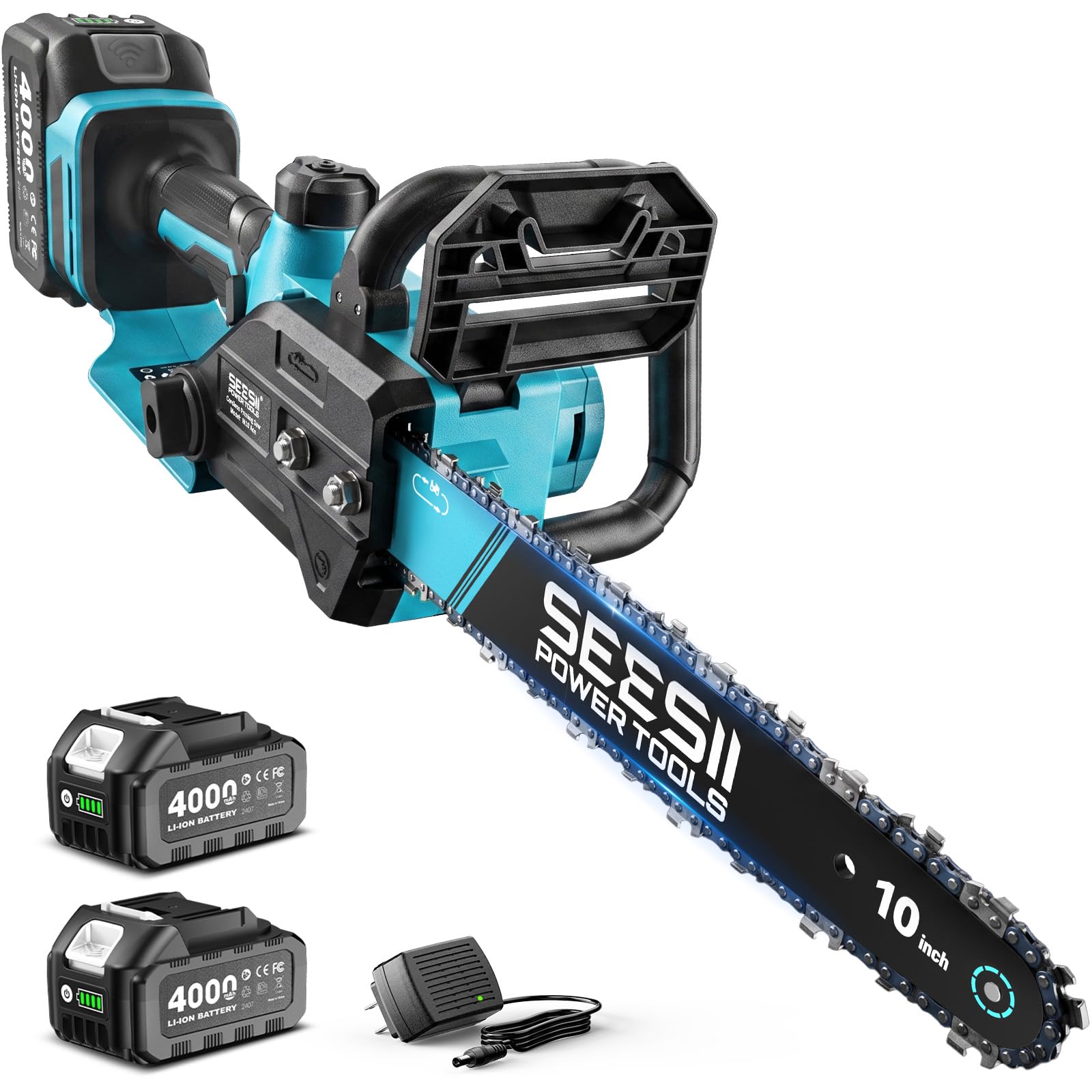 | Seesii M10 Ace | $99.99 as of 10/31 See on Amazon | ★ 4.3 (600+ ratings) | 10 in | 4.9 lb | not stated | Budget-conscious pruners wanting maximum runtime get two 4.0Ah batteries, a brushless motor and a full safety kit in one purchase. |
 | Craftsman CMCCS610D1 | $129.00 as of 10/31 See on Amazon | ★ 4.3 (550+ ratings) | 10 in | 7.9 lb | Battery powered | Shoppers already on the V20 platform get a 10-inch saw that shares their batteries and hangs on the VERSATRACK system. |
What a 10-inch bar can actually cut
The advertised bar length is the usable length of the bar, not the maximum log diameter. Real single-pass cut capacity runs roughly 2 inches less than the bar, so a 10-inch bar gives about 8 inches of clean cut at the very most.
Comfortable working size is smaller again. About 6 inches across is where a 10-inch saw cuts steadily with a sharp chain and a light feed. At 7 to 8 inches the cut is slow, the saw is working at its limit, and a dull chain or a lean will stall it.
Why the bar has to clear the whole branch
The bar has to pass through the whole diameter, the nose has to clear the far side, and the saw body and your hands need room. A branch wider than the bar can be cut from both sides, but that is a technique for someone who has practiced it, not a way to make a 10-inch saw into a bigger one.
The working rule for matching bar to wood
Match the bar to the wood, with the bar a little longer than the diameter being cut, so the tip is not buried and not swinging free into the next branch. In practice that means limbs, sucker growth, storm-broken branches, saplings and small rounds for kindling. It does not mean trunk sections, oak rounds or a winter's firewood.
Where a 10-inch chainsaw beats a larger one
A felled or fallen tree is mostly branches, and a short bar reaches into the crotches and tight angles where a 16- or 18-inch bar fouls on the next limb. That is the job the 10-inch class was built for.
Limbing and tight angles
With a short bar you can work close to the trunk and between limbs without the nose of the saw catching on wood you are not cutting. The saw goes where the branch is, not where the bar allows.
Working at chest height and above
A short bar with a light powerhead is easier to hold steady at chest height and above than a long bar whose nose is out of sight. The shorter, lighter nose is easier to keep in view and away from the kickback zone, and the saw is less tiring to hold up. Overhead cutting is still a high-risk operation, and the saw should stay below shoulder height wherever the work allows.
Small, frequent jobs
Pruning a few branches, clearing a path, cutting up a fallen limb: a short saw starts, handles and puts away faster than a big one, so it gets used instead of left in the shed. A short bar also tracks a straighter line in small wood and is easier to keep out of the ground and out of the fence.
Where a larger saw wins
Anything over about 8 inches, any regular bucking, and any work where the saw will run for an hour at a time belongs to a bigger saw. A 10-inch saw is a pruning and cleanup tool, not a felling or firewood tool.
Top-handle versus rear-handle 10-inch saws
Handle layout changes how a short saw balances in your hands, and on a 10-inch bar the difference matters more than on a long one.
Rear handle for ground work
On a rear-handle saw the rear handle sits behind the powerhead, your right hand is well back from the chain, and the saw balances forward. This is the layout for ground work: limbing a fallen tree, cutting brush, working at waist height.
Top handle for climbing and bucket work
On a top-handle saw the rear handle sits over the top of the powerhead, so the saw hangs from one hand and balances under the wrist, which leaves the other hand free for the rope or the branch.
Why the layout matters on a short bar
With a 10-inch bar your hands are already close to the chain, and a top-handle saw brings the right hand closer still. The top-handle layout is less forgiving of a lapse in grip and is a tool for trained users. A rear handle gives a longer lever for resisting kickback and for steering the bar; a top handle gives reach and one-handed carry but less resistance.
Ground pruning, storm cleanup and garden work call for a rear handle. Climbing, aerial work or a bucket call for a top handle, and only with the training that goes with it.
Battery voltage and runtime on short bars
A 10-inch bar with a narrow-kerf chain removes far less wood per cut than a 16- or 18-inch bar, so the motor draws less current and a given battery pack lasts longer. That is why small saws post high cut counts per charge even on modest packs.
What to expect in this class
Expect 18V, 20V and 24V platforms, packs of about 2.0Ah to 4.0Ah, and a runtime measured in tens of cuts through 4 to 6 inch wood rather than in hours. A 2.0Ah pack on a 10-inch saw typically gives a few dozen cuts in small hardwood, and a 4.0Ah pack roughly doubles that.
Voltage is a rough proxy, not a guarantee
A 24V saw with a faster chain will out-cut an 18V saw with a slower one, and chain speed and chain condition matter as much as voltage. A sharp chain on a modest saw beats a dull chain on a bigger one.
Charge time is part of runtime
Small saws often ship with slow chargers, so a pack can take several hours to refill. Two packs, or a fast charger, is what makes a cordless 10-inch saw practical for a half-day of pruning. Cold weather cuts runtime, so a warm pack used warm gives the rated performance.
Corded saws in this class
Corded 10-inch saws exist mainly as pole-saw combos. They run at mains power with no runtime limit, but they need a heavy-gauge extension cord kept short.
Chain pitch and gauge options for 10-inch bars
Two chain families dominate 10-inch bars: 3/8-inch low-profile pitch and 1/4-inch pitch. Both have to match the bar they run on, down to the drive-link count.
3/8-inch low-profile
This is the common choice on homeowner 10-inch saws. It takes a narrow kerf, cuts fast for its size, and is widely available. It is matched to a bar of the same pitch and gauge, and the drive-link count has to match the bar exactly.
1/4-inch pitch
This is a finer chain with a narrower kerf, smoother and less grabby in small wood, and favored on very small bars and on carving and fine pruning work. It cuts more slowly in bigger wood and is less common at retail.
Pitch, gauge and drive links
Gauge is the width of the groove in the bar and the thickness of the drive links; pitch is the distance between rivets. Both have to match the bar, and the drive-link count has to match the bar's length and nose sprocket.
Matching a replacement chain
Read the numbers stamped on the bar (pitch, gauge, drive links) and buy to those, not to the saw's model name. A chain of the wrong pitch or link count will not seat, and one of the wrong gauge will run loose or bind. Do not fit a longer bar to a 10-inch saw: the motor, the gearing and the oiler are matched to the short, narrow-kerf chain, and a longer bar overloads them.
Our picks by budget
The Seesii M10 Ace is our budget pick because it is the least expensive and comes with a brushless motor, a high chain speed, two 4.0Ah batteries, a fast charger, a case and a spare chain. It asks in return for tool-adjusted tensioning and a chain spec you read off the bar yourself.
The Worx WG322 is our mid-range pick because it trades chain speed for a light body and auto-tensioning that removes the tensioning chore, backed by a 3-year warranty and a place on a large battery platform.
The Worx WG323 is our premium pick because the pole attachment turns the same 10-inch saw into a pole saw for overhead work, with auto-tensioning and auto-lubrication. It is worth the outlay only if you actually have branches to reach.
Budget
Mid-range
High-end
Which 10-inch chainsaw fits your work
Matching the saw to the work matters more in this class than in any other, because a 10-inch bar has a hard ceiling and a pole attachment or a second battery changes what a pruning session looks like.
Wants a stated cut capacity
It has an 8-inch cut capacity and ships with a low-kickback chain, tool-free tensioning and an automatic oiler, with battery and charger in the box. You know what it will cut before you buy it.
Wants a light saw
At 6.2 lb, with auto-tensioning, a 3-year warranty and a place on the PowerShare platform. Good for someone who prunes often and wants a saw that is quick to pick up and put down.
Has overhead branches too
The pole attachment covers canopy work that a bare 10-inch saw cannot reach safely, so you are not tempted to use a ladder. It is the same saw and battery platform as the WG322.
Wants the most in the box
Two 4.0Ah batteries, a fast charger, a case and a safety kit, with a brushless motor and a high chain speed. Suits a reader who will check the chain spec on the bar and is fine with tool-adjusted tensioning.
Already on the V20 platform
It shares batteries with the V20 outdoor range and clips onto the VERSATRACK system for storage. The 3-year warranty and automatic oiling keep ownership simple.
Our verdict on the best 10-inch chainsaws
The Black+Decker LCS1020 is the overall pick for the reader who wants a stated cut capacity and a low-kickback chain, the Worx WG322 for the reader who wants a light saw with the least maintenance, and the Worx WG323 for the reader who needs the pole attachment. The ceiling of the class stays the same whichever you choose: about 6 inches comfortably, 8 inches at most. When most of your cuts land over 8 inches, or the saw will run for an hour at a time, move up to a 12-inch or larger saw.
Detailed model analysis
A 10-inch saw earns its place on limbs, storm debris and small rounds, and the details that separate one from another are cut capacity, weight and how much tensioning and oiling you have to do by hand.
Black+Decker LCS1020 chainsaw
The Black+Decker LCS1020 suits light pruning and branch cleanup. It pairs a 10 in bar with an 8 in cut capacity, the ceiling for a clean single pass.
It runs on a 20V MAX lithium ion battery, and battery and charger both come in the box. You can start cutting as soon as the battery is charged.
A low kickback chain matters on a saw you hold in both hands. An automatic oiler feeds the chain, and tool-free tensioning lets you adjust it without hunting for a wrench.
It weighs 6.8 lb. The Worx WG322 20V 10 in. chainsaw is lighter.
Its limits are plain. The 8 in cut capacity rules out big logs and thick trunks, and its 2 year limited warranty is shorter than the 3 years on both Worx models.
It suits gardeners who want a simple, ready-to-run saw for small branches and overgrowth, and who care more about easy handling than about cutting thick wood.
- Brand: Black+Decker
- Bar length: 10 in
- Voltage: 20 V max
- Power source: Battery powered
- Weight: 6.8 lb
- Dimensions: 16.7 in long, 8.81 in wide and 9.63 in high
Worx WG322 20V 10 in. chainsaw
The Worx WG322 is a step up from a mini saw that stays easy to carry. It weighs 6.2 lb and gives you a full 10 in. bar.
The big convenience is auto-tension chain adjustment. The saw sets the chain tightness for you, so you stop less often to adjust it during a long cleanup.
It runs on a 20 V battery from the PowerShare platform, shared with the Worx WG323. Saw, battery and charger come in the box, so you can start trimming right away.
Its chain runs at 12.5 ft/s, the same as the Worx WG323, while the Seesii M10 Ace lists 32.8 ft/s. It is lighter than the Black+Decker LCS1020 and the Craftsman CMCCS610D1.
It is a hand-held saw only, with no pole in the box. The 10 in. bar also suits limbs and branches, not firewood rounds.
It suits gardeners who want to move up from a mini saw, with auto-tension and a 3 year warranty that beats the 2 years on the Black+Decker.
- Brand: Worx
- Voltage: 20 V
- Bar length: 10 in
- Chain speed: 12.5 ft/s
- Weight: 6.2 lb
- Power source: Battery powered
Worx WG323
The Worx WG323 is the one to choose when branches are over your head. It is a 2-in-1 pole saw with up to 12 ft of reach that also works as a chainsaw.
The pole comes off without tools, leaving a 10 in chainsaw for fallen branches on the ground. The on/off switch sits on the pole handle, so you start and stop without lowering the saw.
Auto-tension chain adjustment and an auto-lubrication system look after the chain, which runs at 12.5 ft/s.
The kit includes a 20V 2.0Ah battery and a charger. Both work with every tool on the Worx Power Share platform. A 3 year warranty comes with it.
The cost of the pole is weight: the full kit weighs 10 lb, while the chainsaw alone weighs 6.2 lb. As with any 10 in saw, it is for limbs and branches, not firewood rounds.
It suits homeowners who face both ground cleanup and overhead trimming and want one kit for both jobs.
- Brand: Worx
- Voltage: 20 V
- Bar length: 10 in
- Chain speed: 12.5 ft/s
- Weight: 10 lb
- Power source: Battery powered
Seesii M10 Ace
The Seesii M10 Ace suits pruners who want plenty of run time and a light saw. It weighs 4.9 lb and comes with two 4.0Ah batteries.
Each battery gives up to 200 cuts per full charge under suitable cutting conditions. Charging one takes about 2 to 3 hours with the included charger, so you can charge one while you use the other.
A brushless motor drives the 10 in bar at a chain speed of 32.8 ft/s. The automatic oiler has a reservoir of about 1.7 fl oz (50 ml).
The safety kit includes a chain brake, a safety lock button and a front hand guard, plus gloves and goggles. A carry case, a user manual and a wrench are also in the box.
Chain tensioning needs a tool, while the Black+Decker LCS1020 offers tool-free tensioning. It works with a suitable pole saw extension, but the pole is not in the box.
- Brand: Seesii
- Bar length: 10 in
- Power: 1000 W
- Battery: 2 x 4.0 Ah
- Chain speed: 32.8 ft/s
- Weight: 4.9 lb
Craftsman CMCCS610D1
The CRAFTSMAN CMCCS610D1 makes the most sense if you already own CRAFTSMAN V20 tools. This 10 in saw runs on the same V20 battery platform, so you may already have a spare battery.
The kit includes a V20 CMCB202 2.0Ah lithium ion battery and a V20 charger. Auto-oiling keeps the chain lubricated between cuts, and a bar cover and a wrench are in the box.
An integrated VERSATRACK hook lets you hang the saw in your garage, off the floor and ready to grab. The VERSATRACK system itself is sold separately.
It weighs 7.9 lb, while the WORX WG322 20V 10 in. chainsaw weighs 6.2 lb and the BLACK+DECKER LCS1020 chainsaw weighs 6.8 lb.
Its single 2.0 Ah battery is smaller than each Seesii M10 Ace battery, and the Seesii kit includes two of them.
As with any 10 in saw, it is made for limbs and branches, not for firewood rounds. It suits shoppers already on the V20 platform.
- Brand: Craftsman
- Bar length: 10 in
- Power source: Battery powered
- Battery capacity: 2.0 Ah
- Battery type: Lithium-ion
- Weight: 7.9 lb
Frequently asked questions
The questions that come up most before buying a 10-inch saw are about the real cut size, the battery and the chain that fits the bar.
How big a branch can a 10-inch chainsaw cut?
Plan on about 6 inches across for steady cutting, and treat 8 inches as the absolute ceiling on a clean single pass. The bar length is not the maximum log size, so size the saw to the wood rather than to the number on the bar.
Is a 10-inch chainsaw big enough for firewood?
Not for regular firewood. It handles small rounds and kindling, but anything over about 8 inches, or a steady run of bucking, needs a longer bar.
Can you use a 10-inch chainsaw one-handed?
No. One-handed use is reserved for top-handle saws in trained hands, and a rear handle is built for two hands on the saw at all times.
How long does the battery last on a 10-inch chainsaw?
Plan on a 2.0Ah pack as the practical minimum for a pruning session, and step up to 4.0Ah only if you will be cutting for a half-day. Cold weather and a dull chain cut the count, so a spare pack or a fast charger matters more than a bigger pack.
Can you put a longer bar on a 10-inch chainsaw?
No. A 10-inch saw is built around its bar length, and fitting a longer one strains the saw beyond what it was designed for.
What chain does a 10-inch chainsaw take?
Either 3/8-inch low-profile or 1/4-inch pitch, in the gauge and drive-link count stamped on the bar. The drive-link count has to be exact so the chain seats on the nose sprocket.
What is the difference between a 10-inch chainsaw and a 10-inch pole saw?
The bar is the same length; the pole saw puts it on a shaft so you can reach overhead branches from the ground. A 10-inch chainsaw is for ground work, a pole saw is for canopy work, and one of the saws on this page converts between the two with a pole attachment.