Best 20-Inch Chainsaw 2026: Enough Bar for Felling, Storm Cleanup and Firewood
When you buy through the Amazon links on this page, we may earn a commission at no extra cost to you. Learn more
Last updated October 31, 2026
The best 20-inch chainsaw for most buyers is the Husqvarna 450 Rancher: 50.2 cc and 3.2 hp on a 20-inch bar at 11.3 lb, which matters most with a long bar because the mass sits further from your hands. For battery buyers, the EGO Power+ CS2000 matches a 55 cc gas saw without fuel mixing.
A 20-inch bar cuts about 18 inches of trunk in a single pass, since roughly two inches sit inside the powerhead, so it suits 16 to 18 inch wood and not a 24-inch trunk. It is also the top of the homeowner class, not a safety margin: more bar means more tip in the kickback zone and more weight to control.
Our 3 picks

Husqvarna 450 Rancher
See on Amazon
EGO Power+ CS2000
See on Amazon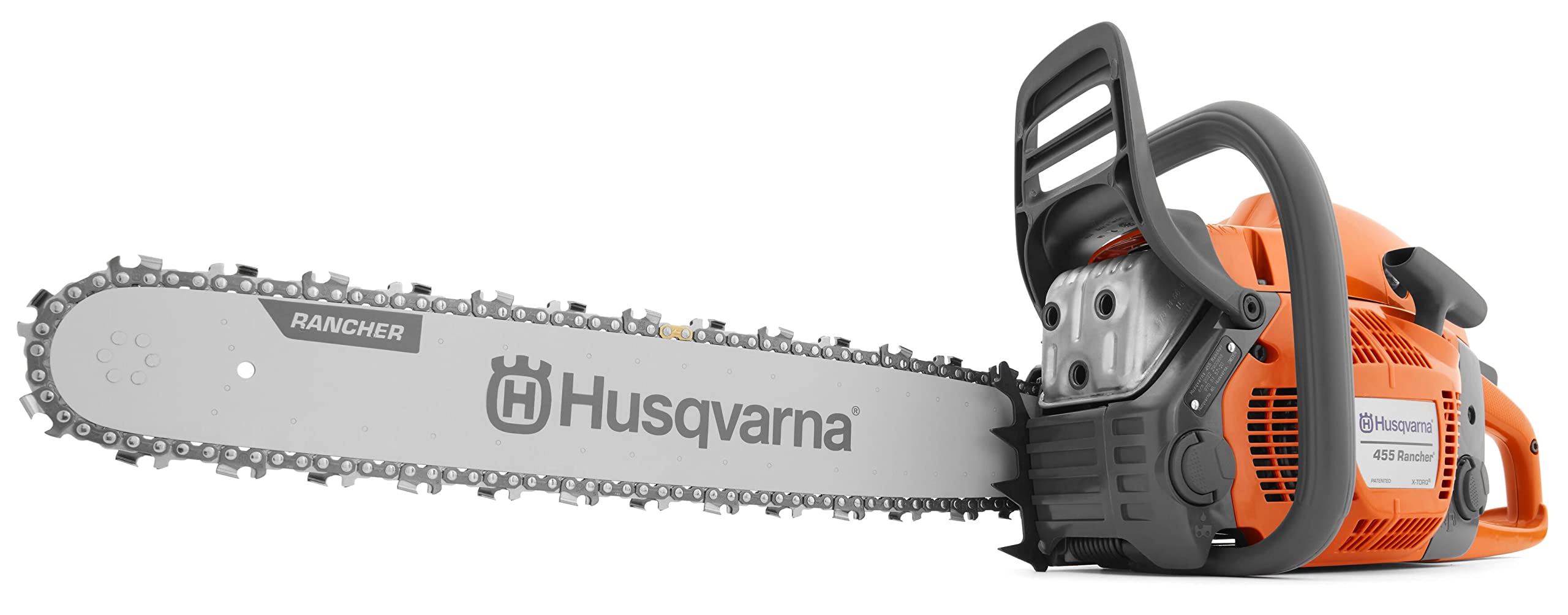
Husqvarna 455 Rancher chainsaw
See on AmazonModel comparison
| Model | Price | Rating | Bar length | Weight | Power source | Best for | |
|---|---|---|---|---|---|---|---|
| | Husqvarna 450 Rancher | $499.99 as of 10/31 See on Amazon | ★ 4.5 (550+ ratings) | 20 in | 11.3 lb | Gas powered | Firewood cutters and larger-property owners needing runtime and displacement get a 50.2 cc engine, 20-inch bar and easy starting. |
| | EGO Power+ CS2000 | $329.00 as of 10/31 See on Amazon | ★ 4.6 (150+ ratings) | 20 in | 12.7 lb | Battery powered | EGO platform owners and large-bar battery buyers get a 20-inch bar, 55 cc gas equivalent and 25 m/s chain speed. |
| | Husqvarna 455 Rancher chainsaw | $589.00 as of 10/31 See on Amazon | ★ 4.4 (400+ ratings) | 20 in | 13.2 lb | Gas powered | Firewood cutters with a woodlot wanting sustained power in a gas platform get a 3.5 hp X-Torq engine and Smart Start. |
 | PINKWAY 63ACG chainsaw | $96.99 as of 10/31 See on Amazon | ★ 4.1 (700+ ratings) | 20 in | 7.8 kg | not stated | Budget buyers wanting maximum displacement and bar length for the money accept a heavier 7.8 kg package and slower tensioning. |
 | SUPMIXTOOLS S6251 | $119.29 as of 10/31 See on Amazon | ★ 4.1 (650+ ratings) | 20 in | 14 lb | Gas powered | Buyers wanting the most horsepower on a 20-inch bar and willing to follow a start routine get 4.2 hp. |
What a 20-inch bar actually cuts through
A 20-inch bar is the called length, measured over the whole bar. About two inches of it sit inside the powerhead, so the usable cutting length is roughly 18 inches. That makes 18 inches the realistic maximum trunk diameter for a single-pass cut, with the bar buried to the tip on one side.
Cutting from both sides of the trunk to meet in the middle roughly doubles the practical diameter, into the low-to-mid 30s of inches. Treat that as an experienced-operator method, not a shopping target: on the second cut the tip works blind inside the wood, and if the two cuts do not line up the bar gets pinched.
The working rule of thumb is bar length equals log diameter plus about two inches. A 20-inch bar is the right tool for 16 to 18 inch wood and the wrong tool for a 24-inch trunk. Bucking a log on the ground is easier than felling a standing tree of the same diameter, because the ground supports the log and you can finish the cut from one side with a little roll.
Why 20 inches is the practical ceiling for most mid-size saws
For a gas saw, 50 to 60 cc is the sweet spot for a 20-inch bar, with about 50 cc as the floor for a consumer model. Each additional two inches of bar wants roughly 5 to 10 cc more displacement. For battery, the equivalent is a saw advertised at 50 cc gas equivalence or better, which is now common on 20-inch cordless models.
An underpowered saw on a long bar tells you so. The engine bogs in the cut, the chain stalls when the bar is buried, the powerhead runs hot, and the clutch slips or glazes. The cut also wanders, because the operator leans on the saw to keep it moving instead of letting the chain do the work.
Displacement alone does not tell the whole story: professional-grade 45 to 50 cc saws pull a 20-inch bar because of torque and lighter construction. But a homeowner saw at 40 cc on a 20-inch bar is a mismatch. Past 20 inches the powerheads get heavy and expensive, and the saws are built for professional logging rather than property work, which is why the homeowner class tops out here.
What Chain Specs Your 20-Inch Bar Needs Before You Buy a Replacement
"20-inch chain" is not a specification. A 20-inch bar takes a chain defined by its pitch, its gauge and its drive-link count. The common combinations on 20-inch bars are .325-inch pitch with .050-inch gauge and 78 to 80 drive links on 50 cc-class saws, 3/8-inch pitch with .050-inch gauge and 72 drive links on 55 cc-and-up saws, 3/8-inch low-profile on some lighter models, and .325-inch with .058 or .063 gauge on certain pro saws.
Pitch is the distance between drive links, which sets how the chain rides the sprocket. Gauge is the thickness of the drive-link tang, which sets how it fits the bar groove. A chain of the right length but the wrong gauge will not seat properly, and two chains of the same pitch and drive-link count but different gauge look identical on the shelf.
The authority is the stamp etched on the bar tail. That stamp, not the bar length, is what you match when buying a replacement. A loose-fitting chain can derail, and a too-tight one binds and overheats the bar, so the wrong chain costs you both cut speed and safety.
Where the extra bar length pays off in your trees and logs, and where it just adds weight
The extra reach pays when you fell medium trees in the 14 to 18 inch range, buck firewood where the log is too big to roll comfortably, or clear storm damage where the limb is down and you want to reach across it without repositioning your feet.
A shorter bar is faster and safer for limbing and pruning, for cutting small branches overhead or at awkward angles, for tight quarters, and for any task where you hold the saw up rather than down. The physics is simple: a longer bar means more chain to keep sharp, more weight out front and more tip in play, so it is slower in small wood and more tiring over a long session.
A 20-inch saw suits a property of an acre or more with regular firewood and felling work. A 16- or 18-inch saw suits most suburban yards and occasional limbing. Many 50 cc powerheads ship with an 18-inch bar and accept a 20-inch bar within the manufacturer's approved range, so buying the shorter kit and adding a longer bar later is a legitimate route, provided the manual lists that length as approved.
Balance and kickback risk with a longer bar
The extra length shifts the saw's center of gravity forward, away from the rear handle, so your wrists and forearms carry more of the weight and the saw feels heavier than its bare weight suggests. The kickback zone is the upper quadrant of the bar nose, and a longer bar puts more nose further from your hands, so the same rotational force has more leverage.
Consumer saws are required to ship with a low-kickback chain, which reduces but does not eliminate kickback. The inertia chain brake, chain catcher and right-hand guard are the backstops. Technique is what keeps a 20-inch bar controllable:
- Keep the saw at full throttle through the cut rather than feathering it.
- Avoid boring or plunge-cutting unless you have been trained.
- Keep the nose clear of the wood when you finish a cut.
- Stand to the side of the cut line rather than behind it.
- Never cut above shoulder height with a rear-handle saw.
Fatigue is the quiet risk. Most chainsaw injuries happen late in a session, when the arms are tired and the saw is being muscled rather than guided. The right 20-inch saw is the one you can run for hours, not the one you can lift once.
Transporting and storing a 20-inch saw
A 20-inch bar plus powerhead needs a scabbard or case sized for the full length. A case built for an 18-inch saw will not close over a 20-inch bar, and an ill-fitting scabbard lets the chain teeth catch on the vehicle or your leg. In a truck bed the saw lies across the bed; in a sedan trunk it goes in diagonally, so measure before assuming it fits.
On an ATV or UTV, mount a scabbard to the rack and point the bar away from the rider. For storage, hang the saw by the rear handle or set it on a shelf with the bar supported along its length rather than resting on its tip, which over time can bow a long bar. A 20-inch bar bends more easily than a short one because of the leverage, so never lean it against a wall by the nose or use it as a handle.
For a gas saw going into long storage, drain the tank and run the carburetor dry, and keep bar oil in its own container.
Our picks by budget
The PINKWAY 63ACG is our budget pick because it puts 63 cc and a 20-inch bar in your hands for the least money, and the 2-year manufacturer warranty covers the engine.
The EGO Power+ CS2000 is our mid-range pick because it matches a 55 cc gas saw without fuel mixing or pull-starting, and adds speed-select modes, a digital display and an auto chain brake sensor.
The Husqvarna 455 Rancher is our premium pick because 55 cc and 3.5 hp hold up to sustained cutting in 16 to 18 inch wood, with Smart Start, LowVib damping, Air Injection and an automatic oiler.
Budget
Mid-range
High-end
Which 20-inch chainsaw for which buyer
Firewood work, storm cleanup and a wooded lot each put different demands on a 20-inch saw, and the right pick follows the job rather than the spec sheet.
The firewood cutter with a woodlot
55 cc and 3.5 hp pull a 20-inch bar through repeated bucking without bogging, and the automatic oiler and Air Injection suit long sessions.
The storm-cleanup homeowner avoiding fuel
55 cc-equivalent power, speed-select modes for lighter work, and an auto chain brake sensor that adds a layer of safety for less experienced operators.
The buyer chasing displacement per dollar
63 cc on a 20-inch bar is at the lowest price tier, with the caveat that tensioning takes more steps and the package is heavier.
The buyer who wants the most horsepower
4.2 hp on a 20-inch bar, with an inertia chain brake and an adjustable automatic oiler.
The buyer unsure 20 inches is right
At 50.2 cc and 11.3 lb it is light enough to carry and steer for hours.
Our verdict on the best 20-inch chainsaws
The Husqvarna 450 Rancher is the best balance of weight, displacement and ergonomics for a 20-inch bar: 50.2 cc and 3.2 hp at 11.3 lb, light enough to steer through a long session. Battery buyers should take the EGO Power+ CS2000, which matches a 55 cc gas saw without fuel handling. For maximum displacement per dollar, the PINKWAY 63ACG puts 63 cc on a 20-inch bar; for more power in a gas platform, the Husqvarna 455 Rancher at 55 cc and 3.5 hp is the step up. Keep one caveat in mind: 20 inches is the top of the homeowner class, and the right saw is the one you can control for hours, not the biggest one on the page.
Detailed model analysis
A 20-inch bar only performs as well as the powerhead behind it, so weight and displacement decide how the saw feels once the bar is buried.
Husqvarna 450 Rancher
We would start here if you want a 20-inch bar you can still swing at the end of a long day. It weighs 11.3 lb, the lightest of the five, which eases strain on your arms.
Power comes from a 50.2 cc X-Torq 2-cycle engine rated at 3.2 hp. That is the smallest displacement of the gas saws here, the trade you make for the low weight.
Smart Start and an air purge help it fire up without a long fight with the pull cord. LowVib vibration reduction and an ergonomic rear handle keep your hands comfortable. Air Injection means you clean the filter less often.
Use fuel mixed 50:1 with Husqvarna 2-stroke lubricant. The oil tank holds 0.55 US pint. Fuel is not included. The warranty is 2 years, or 5 years if you buy 96 fl oz of premixed fuel with the saw.
Its main limit is power. If you cut bigger wood often, the Husqvarna 455 Rancher chainsaw gives you a bigger engine and more power.
It suits homeowners and firewood cutters who want a light 20-inch gas saw for pruning, yard cleanups and firewood.
- Brand: Husqvarna
- Engine displacement: 50.2 cc
- Power: 3.2 hp
- Bar length: 20 in
- Power source: Gas powered
- Weight: 11.3 lb
EGO Power+ CS2000
The EGO POWER+ 20-inch cordless chainsaw suits EGO battery owners who want a large bar for felling and storm cleanup without mixing fuel or pulling a starter cord.
Its brushless motor runs on any EGO POWER+ 56V ARC Lithium battery and drives the chain at up to 25 m/s. EGO compares its power to a 55 cc gas saw.
With the recommended 6.0Ah battery, you get up to 230 cuts on a 4x4 per charge. That is a maximum claim, so treat it as the best case.
An omnidirectional auto chain brake sensor stops the chain from many tool positions, and a kickback brake works alongside it. That matters on a long bar, where kickback risk grows.
A digital display shows battery charge and lets you pick a speed mode. A front LED work light lights your cut at dusk. The saw weighs 12.7 lb.
The main limit is that battery and charger are not included. You must buy an EGO POWER+ 56V ARC Lithium battery and a charger separately before the saw runs.
- Brand: Ego Power+
- Bar length: 20 in
- Power source: Battery powered
- Weight: 12.7 lb
- Dimensions: 39.76 in long, 11.22 in wide and 12.6 in high
- Included: Bare tool, battery and charger not included
Husqvarna 455 Rancher chainsaw
This 2-stroke gas saw has a 20-inch bar and an X-Torq engine with more displacement and power. That power suits the firewood cutting and storm cleanup Husqvarna points it at.
An automatic oiler feeds bar oil while you cut. The side-mounted chain tensioning puts slack adjustments within easy reach, and LowVib reduces vibration. The ergonomic front handle gives you a better grip.
Smart Start makes starting easier. Air Injection removes dust and debris before the air filter, which cuts down on filter cleanings during storm debris removal.
Fuel mix is 50:1 with Husqvarna 2-stroke lubricant, and the oil tank holds 0.7 US pint. Fuel and oil are not included. The warranty is 2 years, extended to 5 years with 96 fl oz of premixed fuel.
Weight is the cost of the extra power. At 13.2 lb on a 20-inch bar, the mass sits far from your hands. It suits firewood cutters with a woodlot who want sustained power.
- Brand: Husqvarna
- Bar length: 20 in
- Power: 3.5 hp
- Engine displacement: 55 cc
- Weight: 13.2 lb
- Power source: Gas powered
PINKWAY 63ACG chainsaw
The PINKWAY 63ACG chainsaw has the largest engine of the five: a 63 cc 2-cycle gas engine rated at 3.26 hp, paired with a 20-inch bar.
The SUPMIXTOOLS S6251 sits at 62 cc and the Husqvarna 455 Rancher chainsaw at 55 cc. Yet they list 4.2 hp and 3.5 hp, both above this saw's 3.26 hp.
The biggest limit is weight. It comes in at about 17.2 lb (7.8 kg), the heaviest of the five.
Its only listed feature is a chain tension adjustment pin. The Husqvarna 455 Rancher chainsaw adds Smart Start, LowVib vibration reduction and an automatic oiler.
Tensioning takes two steps. Loosen the two clutch cover bolts first, but not all the way, then turn the tension pin. Skip that and the chain tension will not hold.
The warranty runs 2 years. It suits buyers who want maximum displacement on a 20-inch bar and can handle a heavy saw with a manual tension routine.
- Brand: Pinkway
- Engine displacement: 63 cc
- Bar length: 20 in
- Horsepower: 3.26 hp
- Weight: 7.8 kg
- Dimensions: 20.47 in long, 10 in wide and 11.8 in high
SUPMIXTOOLS S6251
The SUPMIXTOOLS S6251 suits you if raw power on a 20-inch bar matters most. It lists 4.2 hp from a 62 cc 2-stroke engine, with chain speed listed at 8500 RPM/Min.
Control features include an anti-vibration handle, an adjustable automatic oiler, an inertia-activated chain brake, a low kickback safety feature and a throttle trigger lockout.
It weighs 14 lb, so it is heavier than the Husqvarna 455 Rancher chainsaw at 13.2 lb and the Husqvarna 450 Rancher at 11.3 lb.
Cold start: pull the choke knob out fully, switch on, and pull the starter handle up to 6 times until you hear a big motor sound. Then push the choke fully in and pull up to 20 more times.
Do not keep pulling with the choke closed after the first ignition sound, or you flood the engine. A warm engine skips the priming steps.
The chain is not installed at the start. You set it up yourself with the included installation toolkit. It suits buyers who want the most horsepower on a 20-inch bar.
- Brand: Supmixtools
- Bar length: 20 in
- Power: 4.2 hp
- Power source: Gas powered
- Weight: 14 lb
- Dimensions: 35.4 in long, 10 in wide and 10.8 in high
Frequently asked questions
Bar length, engine size and chain specification are the three things buyers get wrong first with a 20-inch saw.
How big of a tree can a 20-inch chainsaw cut?
About 18 inches across in one pass, because roughly two inches of the bar sit inside the powerhead. Working from both sides of the trunk, an experienced operator can roughly double that figure, but the cuts must line up or the bar gets pinched.
Should I get an 18-inch or a 20-inch chainsaw?
18 inches for most suburban yards and occasional limbing. Go to 20 inches when the trunks you cut most often measure 14 to 18 inches across and you cut them regularly.
Is a 20-inch chainsaw too big for a beginner?
A beginner can run one, but only with a low-kickback chain, a working inertia brake and a firm two-handed grip, and only on wood that fits the bar. If your cutting is mostly limbing and small branches, a 16- or 18-inch bar is the easier place to build technique before moving up.
Can I put a 20-inch bar on a 40 cc or 45 cc saw?
Not recommended. The saw will bog in the cut, the clutch will wear, and the powerhead will run hot. Check the owner's manual for the approved bar lengths before swapping.
Are battery-powered 20-inch chainsaws powerful enough to fell trees?
Yes. Current 20-inch cordless saws are advertised at 50 to 70 cc gas equivalence, enough to fell and buck medium trees, though runtime per battery charge is the real limit on a full day of cutting.