Best Gas-Powered Chainsaw 2026: Engine Size for Felling and Bucking
When you buy through the Amazon links on this page, we may earn a commission at no extra cost to you. Learn more
Last updated October 31, 2026
The best gas-powered chainsaw for most landowners is the Husqvarna 460 Rancher chainsaw: 60.3 cc and 3.6 hp pulling a 24-inch bar, enough to fell larger trees and buck big-diameter logs where the saw stays under load for minutes at a time. If you cut medium trunks and firewood year after year and want less weight to carry, the Husqvarna 450 Rancher brings 50.2 cc, 3.2 hp and a 20-inch bar.
Engine size is the decision on a gas saw, and bar length follows it. Displacement sets what the powerhead can pull through wood; the bar is a label you can swap, the engine is not. Size the engine for the diameter you cut most, then take the bar the manufacturer pairs with it.
The best gas-powered chainsaws for 2026

Husqvarna 460 Rancher chainsaw
See on Amazon
Husqvarna 450 Rancher
See on Amazon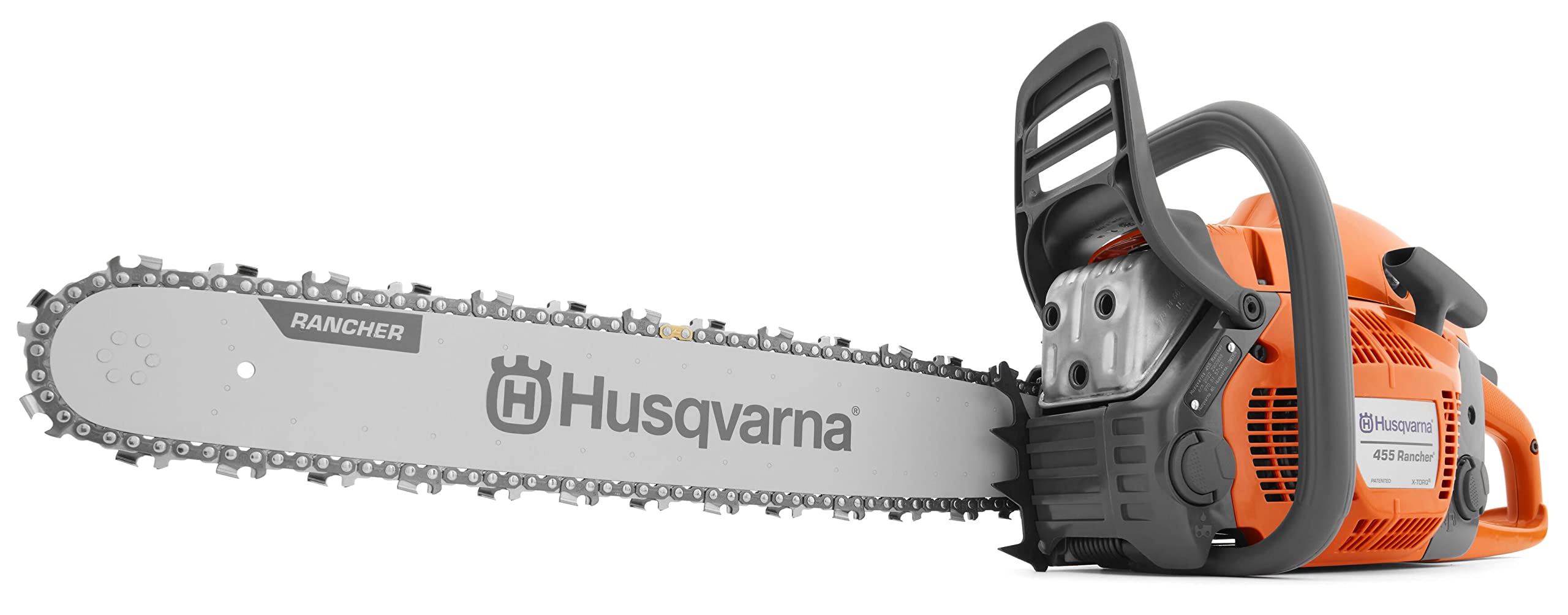
Husqvarna 455 Rancher chainsaw
See on AmazonModel comparison
| Model | Price | Rating | Engine displacement | Power | Weight | Best for | |
|---|---|---|---|---|---|---|---|
| | Husqvarna 460 Rancher chainsaw | $649.00 as of 10/31 See on Amazon | ★ 4.5 (550+ ratings) | 60.3 cc | 3.6 hp | 13.2 lb | Farm and landowners cutting firewood who want a factory-rated 24-inch bar with Smart Start and LowVib comfort. |
| | Husqvarna 450 Rancher | $499.99 as of 10/31 See on Amazon | ★ 4.5 (550+ ratings) | 50.2 cc | 3.2 hp | 11.3 lb | Firewood cutters and larger-property owners needing runtime and displacement get a 50.2 cc engine, 20-inch bar and easy starting. |
| | Husqvarna 455 Rancher chainsaw | $589.00 as of 10/31 See on Amazon | ★ 4.4 (400+ ratings) | 55 cc | 3.5 hp | 13.2 lb | Firewood cutters with a woodlot wanting sustained power in a gas platform get a 3.5 hp X-Torq engine and Smart Start. |
 | Husqvarna 120 Mark III chainsaw | $219.99 as of 10/31 See on Amazon | ★ 4.4 (250+ ratings) | 38 cc | 1.88 hp | 10.7 lb | Buyers wanting gas but working small get a 10.7-pound saw with a 38 cc engine and 14-inch bar for pruning and limbing. |
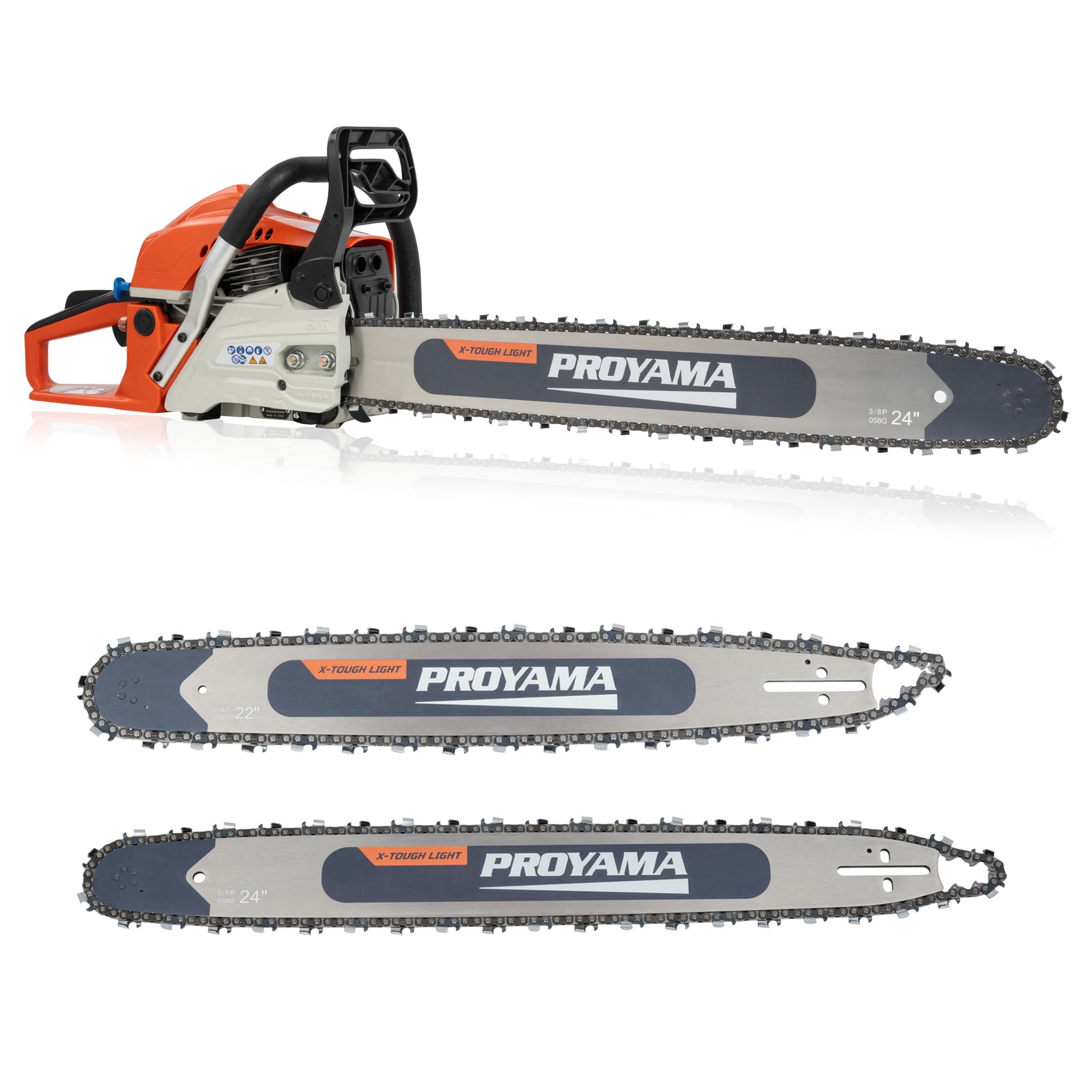 | Proyama PCS68X 68cc chainsaw | $229.00 as of 10/31 See on Amazon | ★ 4.0 (1,100+ ratings) | 68 cc | 4.5 hp | 17 lb | Buyers tackling large logs and heavy-duty woodwork who want two bars plus magnesium alloy construction and 4.5 hp. |
How engine displacement maps to felling and bucking work
Displacement is the honest measure of what a gas saw can do. Bar length is a label you can swap; the engine's cubic centimeters cannot be changed. That is why two saws with the same bar can behave nothing alike in the same log.
The small end, roughly 35 to 40 cc
These saws handle limbing, bucking small logs, pruning, storm cleanup and firewood from wood that is already down. They are light and start easily, and they cut well as long as the bar stays short. Ask one to pull a long bar through green hardwood and it bogs and stalls.
The middle, roughly 45 to 55 cc
This is the do-everything band for a landowner. There is enough torque to fell and buck medium trunks and to run an 18- or 20-inch bar without straining. If you cut firewood every year, this is where most buyers should land.
The top of the consumer range, roughly 60 cc and up
This is what actually pulls a long bar through a big trunk: felling larger trees, bucking big-diameter logs, sustained cutting where the saw stays under load for minutes. These saws are heavier, thirstier and buzzier, and genuinely tiring for limbing work.
Where consumer ends and professional begins
Under the ANSI/CPSC standard, gas saws below 3.8 cu in (62.3 cc) are classed as consumer or non-professional; above that is professional territory. That line is a useful way to define a homeowner gas saw rigorously instead of by feel.
Matching displacement to the diameter you cut most
Size for the wood you cut routinely, not the biggest trunk you will ever meet. A saw that is right for 90% of your cutting and slightly slow on the occasional big log beats one that is oversized and miserable for the other 90%.
Bar-length math
A saw cuts through wood roughly 2 inches smaller in diameter than its bar length in a single pass; bigger wood needs a second cut from the other side. A 20-inch bar handles about an 18-inch trunk in one pass, a 24-inch bar about 22 inches. The bar should be slightly longer than the wood you cut, but not so long that the tip drags the ground when you buck low.
Felling and bucking are different demands
Felling wants torque at the hinge and a bar long enough to reach through the back cut, so displacement in the 50 cc band and up serves it. Bucking wants sustained chain speed and a bar long enough to finish the cut without burying the tip, which is where a 60 cc saw earns its weight on big logs.
Keeping a Gas Saw Balanced When You Fell and Buck
Engine, bar and weight are a matched set. A saw is balanced when the powerhead can pull its bar at full chain speed through the wood it is meant for, and every combination that breaks that rule costs you in the cut.
Big engine, short bar
The saw is nose-heavy and overpowered for its bar. It cuts fast, but the balance is wrong, you fight the weight forward, and there is no benefit over a smaller, lighter saw doing the same work. It is a saw built for a job it isn't doing.
Small engine, long bar
The engine cannot hold chain speed under load, the chain stalls in the cut, you lean on the saw, the engine runs hot and lean, and the bar and chain wear faster.
Why you can't just bolt on a longer bar
The powerhead's displacement sets the ceiling. Fitting a longer bar than the saw was designed for also leaves the carburetor set for the wrong load, so the mixture has to be adjusted when bar length changes or the saw runs wrong.
Weight is the third leg
A 60 cc saw with a 24-inch bar is a two-handed, deliberate tool; a 38 cc saw with a 14-inch bar is one you can carry all afternoon. The right combination is the one where the weight is justified by the work.
Pick the displacement for your work, then take the bar length the manufacturer pairs with it, not the longest bar that fits.
Two-stroke power bands and where a gas saw makes its torque
A gas chainsaw's two-stroke engine makes its power in a narrow, high-rpm band. Below that band it has little torque; at the top it sings. That is the opposite of how a battery saw feels, where torque arrives from a standstill.
What that means at the cut
You don't lug a gas saw slowly through wood. You bring the engine up to speed and let the chain do the work at high rpm. Leaning on a slow-turning chain is how you stall the saw, overheat it and burn the bar.
Keeping the engine in its sweet spot
- Keep the chain sharp so the saw isn't fighting itself.
- Let the saw's weight feed it rather than pushing.
- Back off slightly when the rpm drops and let it recover instead of forcing it.
- Keep the depth gauges at spec so the chain bites the right amount.
Why the technique differs from a battery saw
With a battery saw you can feather into a cut and the torque holds. With a gas saw you commit to the cut at speed. Limbing becomes a series of short, high-rpm bites, not a slow steady push.
Idle and warm-up
A cold two-stroke needs a brief warm-up before it will hold a clean idle and pull cleanly. A saw that won't idle, or dies when you tip it into a cut, has a mixture or filter problem, not a technique problem.
Carburetor adjustment for altitude and temperature
A gas chainsaw's carburetor is set at the factory for a nominal altitude and temperature. Take it to 5,000 feet or into 20°F air and the air-fuel mixture is wrong: the saw runs rich at altitude because the air is thinner, and lean in cold, dense air.
The two screws
The H (high-speed) screw sets the mixture at full throttle; the L (low-speed) screw sets it at idle and just off idle. Turning in leans the mixture, turning out richens it.
Signs of a rich mixture
The saw four-strokes or burbles at full throttle, smokes, fouls the plug, loses power, and is hard to start when hot.
Signs of a lean mixture
The saw screams at high rpm with no load, hesitates or bogs when you tip it into a cut, and runs hot. The dangerous one: a lean saw can seize from overheating. A lean saw is a saw being damaged.
The practical routine
Set the L screw for a clean, reliable idle and crisp pickup. Set the H screw so the saw just cleans up at full throttle under load; a slight four-stroke when unloaded is normal and safe. Adjust in small increments and check the result in wood, not in air.
When to re-tune
Re-tune after a change of altitude, a change of season (cold air is denser), and after changing bar length. Some modern saws use fixed or limited-adjustment carburetors and must be set by a dealer, so check the manual before turning screws.
Never tune a saw with the chain near anything you don't want cut, and never reach for the screws with the engine running and the bar unsecured.
Cylinder and air filter care that keeps a gas saw cutting
A gas saw's power loss is usually airflow, not wear.
The air filter
Sawdust is the enemy. A clogged filter richens the mixture, costs power and can foul the plug. Clean it after every use in dusty conditions, and more often when cutting dry wood. Many saws use a centrifugal pre-cleaner that spins out larger debris before it reaches the filter; that reduces how often you clean, it doesn't eliminate the job.
The cooling fins on the cylinder
Sawdust and oil mist pack into the fins and the cylinder can't shed heat. Overheating costs power and shortens engine life. Blow or brush the fins clean regularly, especially after cutting resinous wood.
The spark arrestor
The mesh screen in the muffler clogs with carbon and restricts exhaust flow, which costs power. Clean or replace it per the manual. It is also a legal requirement on public land in many places.
The routine
- Clean the filter and check the fins after every tank or two.
- Check the spark arrestor periodically.
- Keep the chain sharp so the engine isn't working against a dull chain.
- Use fresh, correctly mixed fuel so you aren't fighting a fuel problem on top of an airflow problem.
A battery saw has no air filter, no carburetor and no exhaust to clog. This maintenance routine is the price of the gas saw's sustained power.
Our picks by budget
The Husqvarna 120 Mark III chainsaw is our budget pick because 38 cc and a 14-inch bar cover the limb-and-small-log work most homeowners actually do, at 10.7 lb with easy starting.
The Husqvarna 450 Rancher is our mid-range pick because 50.2 cc pulling a 20-inch bar is the displacement that fells and bucks medium trunks without the heft of a bigger saw.
The Husqvarna 460 Rancher chainsaw is our premium pick because 60.3 cc and a 24-inch bar are what pull a long bar through big wood under sustained load.
Budget
Mid-range
High-end
Which gas chainsaw for which buyer
The diameter of the wood you cut most often points to one displacement band, and the saw that sits in it.
Homeowner with storm cleanup
Limbs, small logs and debris after a storm are 14-inch-bar work. The light saw starts easily and doesn't wear you out carrying it around the yard.
Landowner cutting firewood yearly
Felling medium trees and bucking logs every season calls for the 50 cc band and a 20-inch bar. This is the saw that covers that work without the weight of a bigger one.
Firewood cutter who wants more pull
If you want a 20-inch bar with more power behind it for firewood and cleanup, this saw adds horsepower without adding bar length.
Buyer with big trunks
Large trees and big-diameter logs need the displacement and the 24-inch bar to pull through in one pass. Accept the weight and the fuel burn.
Buyer who wants the biggest engine
The largest displacement on the page, with both a 22-inch and a 24-inch bar in the box, for heavy cutting on big wood.
Our verdict on the best gas-powered chainsaw
The best gas-powered chainsaw for most buyers is the Husqvarna 460 Rancher chainsaw: 60.3 cc and 3.6 hp pulling a 24-inch bar fell larger trees and buck big-diameter logs where the saw stays under load for minutes at a time. If you cut medium trunks and firewood year after year and want less weight to carry, the Husqvarna 450 Rancher brings 50.2 cc and a 20-inch bar; for light work and occasional use, the Husqvarna 120 Mark III chainsaw is the honest small saw. Match displacement to the diameter you cut most, then take the bar the manufacturer pairs with it. And remember that the engine is only as good as its fuel, its filter and its carburetor setting: the maintenance is part of the purchase decision, not an afterthought.
Detailed model analysis
A gas saw's displacement decides what it can pull through wood, and the bar length that comes with it is the manufacturer's answer to that engine.
Husqvarna 460 Rancher chainsaw
The Husqvarna 460 Rancher chainsaw suits felling and bucking. Its 60.3 cc, 3.6 hp 2-cycle X-Torq engine pulls a 24-inch bar, giving you reach on big trunks and muscle through thick logs.
It has the most displacement among Husqvarna Rancher saws, ahead of the Husqvarna 455 Rancher chainsaw at 55 cc and the Husqvarna 450 Rancher at 50.2 cc. Only the Proyama PCS68X 68cc chainsaw, at 68 cc, is bigger.
LowVib vibration reduction takes some buzz out of the handles. Smart Start eases starting, a side-mounted tensioner makes chain slack easy to adjust, and Air Injection throws larger debris out before the air filter.
It runs on a 50:1 mix of fuel and Husqvarna 2-stroke lubricant, and a 2.6 oz bottle of mix comes in the box.
The main limit is carry weight. At 13.2 lb, it is heavier than the Husqvarna 450 Rancher. The warranty is 2 years, or 5 years if you buy 96 fl oz of pre-mixed fuel separately.
It suits landowners who fell larger trees and buck big firewood rounds, and who accept a heavier saw for the longer bar.
- Brand: Husqvarna
- Engine displacement: 60.3 cc
- Power: 3.6 hp
- Bar length: 24 in
- Weight: 13.2 lb
- Power source: Gas powered
Husqvarna 450 Rancher
The Husqvarna 450 Rancher suits owners of larger yards and small woodlots who cut medium trunks and firewood. Its 50.2 cc, 3.2 hp 2-cycle X-Torq engine pulls a 20-inch bar for pruning and yard cleanups.
It weighs 11.3 lb, lighter than the Husqvarna 460 Rancher chainsaw and the Husqvarna 455 Rancher chainsaw at 13.2 lb each. Your arms notice that difference over a long afternoon of bucking.
Smart Start and an air purge handle starting. LowVib vibration reduction cuts handle buzz, and the rear handle gives you a grip for steady cuts.
Air Injection pushes dust and debris out before it reaches the air filter, so you clean it less often. It runs on a 50:1 mix of fuel and Husqvarna 2-stroke lubricant, with a 0.55 US pint oil tank.
The limit is size: it gives up displacement and bar length to the Husqvarna 460 Rancher chainsaw, which has 60.3 cc and a longer bar. Fuel is not included, so you buy it separately.
The warranty is 2 years, or 5 years if you buy 96 fl oz of pre-mixed fuel with it.
- Brand: Husqvarna
- Engine displacement: 50.2 cc
- Power: 3.2 hp
- Bar length: 20 in
- Power source: Gas powered
- Weight: 11.3 lb
Husqvarna 455 Rancher chainsaw
The Husqvarna 455 Rancher puts a mid-size engine on a 20-inch bar, a good fit for firewood and storm cleanup.
Its 55 cc, 3.5 hp X-Torq 2-stroke engine helps when the chain sits deep in a log, the usual situation when bucking firewood.
An automatic oiler feeds the chain, and Smart Start eases starting. A side-mounted tensioner makes slack easy to adjust. LowVib vibration reduction cuts handle buzz, and Air Injection keeps larger dust and debris away from the air filter.
It runs on a 50:1 mix of fuel and Husqvarna 2-stroke lubricant, with a 0.7 US pint oil tank. Fuel is not included.
The warranty is 2 years, or 5 years if you buy 96 fl oz of pre-mixed fuel with it.
It suits firewood cutters with a woodlot who also want a 20-inch bar for storm cleanup and branch trimming.
- Brand: Husqvarna
- Bar length: 20 in
- Power: 3.5 hp
- Engine displacement: 55 cc
- Weight: 13.2 lb
- Power source: Gas powered
Husqvarna 120 Mark III chainsaw
The Husqvarna 120 Mark III is a small gas saw for wood cutting and tree pruning. It weighs 10.7 lb, the lowest of the five, with a 38 cc, 1.88 hp 2-cycle X-TORQ engine and a 14-inch bar.
The X-TORQ engine is built for increased fuel efficiency and low emissions. An automatic oiler feeds the chain, LowVib reduction keeps the saw comfortable, and Air Injection expels larger dust and debris before the air filter.
Gas power means no cord and no battery to charge, so it works wherever you can carry fuel. That suits limbing and pruning, where you lift the saw often and cut small wood.
Size is the limit: 38 cc and 1.88 hp are the smallest engine and lowest power of the five. Larger trees call for the Husqvarna 460 Rancher chainsaw at 60.3 cc or the Proyama PCS68X 68cc chainsaw at 68 cc.
It suits buyers who want a gas saw for small work such as pruning and limbing and value a 10.7 lb body over engine size. Only the chainsaw is included in the box.
- Brand: Husqvarna
- Power source: Gas powered
- Engine displacement: 38 cc
- Bar length: 14 in
- Power: 1.88 hp
- Weight: 10.7 lb
Proyama PCS68X 68cc chainsaw
The Proyama PCS68X is built for the heaviest felling and bucking work, and it leads on engine size. Its 68 cc, 4.5 hp 2-cycle engine tops the Husqvarna 460 Rancher chainsaw at 60.3 cc.
Two bar-and-chain sets come in the box, a 22-inch and a 24-inch. The shorter bar suits trimming, while the 24-inch handles large logs and thick branches on the same powerhead.
The chain brake and case are magnesium alloy, a hard material that resists deformation and wear during heavy cutting. Air injection filters 97% of incoming sawdust, grit and dirt, and the easy start engine eases starting.
Weight is the main limit. At 17 lb it is 3.8 lb more than the Husqvarna 460 Rancher chainsaw at 13.2 lb. It is also a gas saw, so you handle fuel rather than batteries.
It suits buyers who tackle large logs and heavy-duty woodwork, want two bar lengths and 4.5 hp, and can handle 17 lb.
- Brand: Proyama
- Engine displacement: 68 cc
- Power: 4.5 hp
- Power source: Gas powered
- Weight: 17 lb
- Dimensions: 41 in long, 9.4 in wide and 11.4 in high
Frequently asked questions
Fuel mix, carburetor settings and storage decide whether a gas saw starts in spring and holds its power through a season.
Is a 60 cc saw too much for limbing and small cleanup work?
Yes, for that kind of work it is more saw than you need. A 60 cc powerhead is heavier, thirstier and buzzier than a smaller saw, and it tires you out when you spend the session on limbs and downed tops rather than on trunks. The 38 cc Husqvarna 120 Mark III with its 14-inch bar is built for limbing and small logs, and the 50.2 cc Husqvarna 450 Rancher covers medium trunks and firewood with less weight to carry. Save the 60 cc class for felling larger trees and bucking big-diameter logs.
Why does my gas saw bog down in the cut?
Check in this order: a dull chain, a clogged air filter, a carburetor set too lean, then a bar longer than the engine can pull. Each one drops chain speed under load, and the first two are the most common.
Why does my saw run differently at altitude or in cold weather?
The mixture is set for a nominal altitude and temperature. At elevation the air is thinner and the saw runs rich; in cold dense air it runs lean. The H and L screws correct it, or a dealer does on a limited-adjustment carburetor.
What fuel mix does a gas chainsaw take?
50:1, which is 2.6 fl oz of two-stroke oil per gallon of gas. Mix fresh, use it within a month or two, and don't leave old mix sitting in the tank.
What octane gas should I use?
Regular 87 octane. Higher octane doesn't help a small two-stroke and can make starting harder. Avoid E15 and E85.
How long does a tank last?
Roughly 30 to 45 minutes of continuous cutting, less on a bigger engine under load. Plan refuels before you start a long bucking session.
How do I store a gas saw for winter?
Run it dry or fill it with stabilized or pre-mixed fuel. Old mix left in the tank and carburetor is the most common way a gas saw fails to start in spring.