Best 18-Inch Chainsaw 2026: Enough Bar for Bigger Trunks
When you buy through the Amazon links on this page, we may earn a commission at no extra cost to you. Learn more
Last updated October 31, 2026
The best 18-inch chainsaw for most yards is the Black+Decker CS1518: a real 18-inch Oregon low-kickback bar and chain on a corded saw that never runs out of power mid-cut. It weighs 12.5 lb, tensions without tools and oils the chain automatically.
If a cord will not reach your work, the Husqvarna Power Axe 350i puts the same bar length on a 7.7 lb battery saw with a boost mode, and the EGO Power+ CS1815 brings a 6.0Ah battery and charger in the box. An 18-inch bar cuts about 16 inches of trunk in one pass.
Our 3 picks

Black+Decker CS1518 chainsaw
See on Amazon
Husqvarna Power Axe 350i
See on Amazon
DeWalt DCCS672B chainsaw
See on AmazonModel comparison
| Model | Price | Rating | Bar length | Power source | Weight | Best for | |
|---|---|---|---|---|---|---|---|
| | Black+Decker CS1518 chainsaw | $94.05 as of 10/31 See on Amazon | ★ 4.4 (1,900+ ratings) | 18 in | Corded electric | 12.5 lb | Owners facing bigger limbs, firewood rounds and storm cleanup get an 18-inch Oregon low-kickback bar and chain with a chain brake. |
| | Husqvarna Power Axe 350i | $479.99 as of 10/31 See on Amazon | ★ 4.3 (400+ ratings) | 18 in | Battery powered | 7.7 lb | Homeowners and DIYers doing backyard pruning and firewood get an 18-inch bar on the lightest 7.7-pound body here. |
| | DeWalt DCCS672B chainsaw | $289.99 as of 10/31 See on Amazon | ★ 4.2 (450+ ratings) | 18 in | not stated | not stated | Shoppers already on DeWalt's battery platform get an 18-inch cordless saw sold as a bare tool, with no battery or charger in the box. |
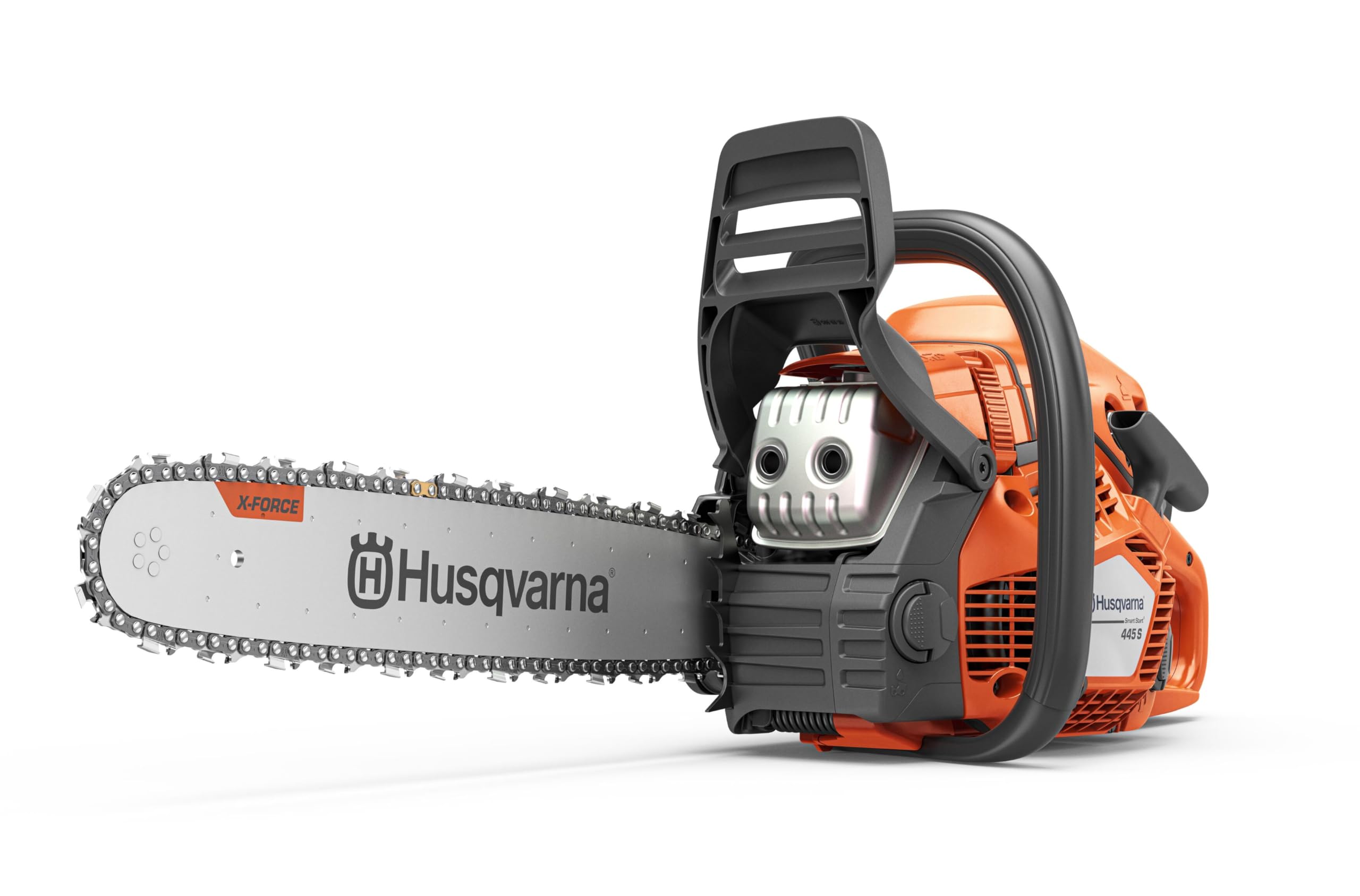 | Husqvarna 445S | $449.99 as of 10/31 See on Amazon | ★ 4.5 (40+ ratings) | 18 in | Gas powered | 14.3 lb | Firewood cutters and tree trimmers wanting gas power get an 18-inch bar on a 50 cc X-Torq engine. |
 | EGO Power+ CS1815 chainsaw | $419.00 as of 10/31 See on Amazon | ★ 5.0 (40+ ratings) | 18 in | Battery powered | not stated | Firewood cutters wanting a complete kit with the longest advertised runtime get an 18-inch bar, 6.0Ah battery and 330 cuts. |
What an 18-inch bar actually cuts through
An 18-inch bar fells or bucks a trunk of roughly 16 inches in diameter in a single pass. The bar needs about two inches of clearance past the far side of the log, so the tip does not bury itself in the wood and jam the chain. That two-inch margin is the working rule for every bar length, and it is why the saw is always rated below its bar.
Advertised length against usable cutting length
The 18 inches are measured from the tip of the bar to where the bar meets the saw body. Part of that length sits inside the powerhead and the bar's tail, so the free cut you actually get is shorter than the number on the box. On a rear-handle saw, plan on a little less than the full bar length reaching through the wood, and check the bar against the log before you commit to a felling cut.
Cutting wood bigger than 16 inches
A two-sided cut takes an 18-inch bar well past 16 inches, up to roughly double that figure. You bore into the log, cut one side, roll the log and cut the other, meeting the first cut. It works, but it is an advanced technique: it takes longer, it puts the tip of the bar into the wood on purpose, and it exposes you to kickback in a way a straight bucking cut does not. A beginner should not start here.
Bar length against trunk diameter
| Bar length | Single-pass trunk diameter | Two-sided cut, roughly |
|---|---|---|
| 14 in | 12 in | 24 in |
| 16 in | 14 in | 28 in |
| 18 in | 16 in | 32 in |
| 20 in | 18 in | 36 in |
The table shows where 18 inches sits: two inches more reach than a 16-inch bar, two inches less than a 20-inch one, and enough for the firewood and storm debris most yards produce.
When an 18-inch bar is the right size and when it is not
An 18-inch bar suits regular firewood bucking, felling small-to-medium trees, and cutting logs and storm debris up to about 16 inches across. It is the bar for the homeowner who wants one saw to do firewood and occasional felling rather than pure pruning.
The engine classes where 18 inches fits
On gas saws, the mid-size class of roughly 40 to 50 cc is the sweet spot for an 18-inch bar. Smaller-displacement engines bog down and slip the clutch when asked to pull that much bar through hardwood, and larger engines are built for longer bars. Battery and corded saws are sized to their bar by the maker rather than by a cc figure, so on those the bar length itself tells you the class: an 18-inch bar marks a saw built for real cutting, not for pruning.
When to step down to 16 inches
Choose 16 inches when the work is mostly limbing, pruning and small logs, when you are new to chainsaws and control matters more than reach, or when the saw is a smaller-displacement gas model or a compact battery one. A shorter bar is lighter at the nose, easier to keep level and less exposed to kickback, and for a beginner those advantages outweigh the lost two inches.
When to step up to 20 inches
Go to 20 inches when your regular diet is larger trunks, when you fell bigger trees or process serious firewood volume, and when the saw is a larger-displacement gas model that can pull the extra bar. The trade is explicit: a longer bar gives more reach and more single-pass capacity, but it adds weight, vibration and effort, and it puts more bar tip in play, which raises your kickback exposure.
How bar length changes the saw's balance and reach
Two extra inches of bar move the saw's center of gravity forward, away from the handles. The saw feels nose-heavy, and your wrists and forearms work harder to hold the bar level through a cut. On a light saw the shift is noticeable; on a heavy one it adds up over a morning.
Reach at the log and in the tree
The extra length keeps the powerhead further from the wood. When you buck a log on the ground, you stoop less, and when you limb a branch, your body stays further from it. That distance is the practical payoff of the longer bar, and it is why an 18-inch saw feels easier on a pile of logs than a 16-inch one.
Limbing with a longer bar
In the canopy, a longer bar is more bar to swing and more tip to keep clear of branches you are not cutting. A shorter bar is handier in tight branch structure, where the saw spends more time moving between cuts than cutting. If most of your work is up in the limbs, the extra reach of 18 inches buys you less than it costs.
Fatigue over a long session
Forward weight and the extra vibration of a longer bar accumulate over a session. Fatigue is a safety issue, not just a comfort one: tired arms hold the saw less steadily and react more slowly to kickback. A gas saw with an 18-inch bar is often lighter overall than a battery saw with the same bar, because the battery pack carries the weight, so check the total weight before you assume the cordless saw is the easier one to carry.
Matching chain and sprocket to an 18-inch bar
Pitch is the distance between drive links; gauge, the thickness of the drive link that rides in the bar groove; and drive-link count, how many links the loop has, which the bar length sets. Get one wrong and the chain will not seat, will not tension, or will wear the bar out fast.
Common combinations on 18-inch bars
On the mid-size gas class, an 18-inch bar usually runs .325-inch pitch with .050 to .058 gauge. On smaller-displacement saws, the common setup is 3/8-inch low-profile with .043 to .050 gauge. Drive-link count varies by bar and by saw even at the same length, so read it off the bar or the manual rather than assuming it from the 18 inches.
The sprocket has to match the pitch
A .325 chain will not run on a 3/8 sprocket. The drive sprocket on the saw and the nose sprocket in the bar are a matched set with the chain, and the pitch has to agree across all three. If you change the bar, check the sprocket before you fit the new chain.
Confirming the right combination for a saw
Read the numbers stamped on the bar, then cross-check them against the saw's manual. Match pitch, gauge and link count together, never one at a time. A bar one size up can sometimes be fitted if the saw's stated bar range allows it, but the chain must match the new bar exactly, and the engine has to be able to pull the extra length.
Keeping an 18-inch bar cutting straight
Longer bars are more prone to uneven rail wear and crooked cuts. More bar length means more flex and more leverage, so a rail that is slightly off or a chain sharpened to different angles on each side pulls the cut off line over a longer span. On a short bar the same fault barely shows.
Filing habits that keep the cut true
Sharpen both sides to the same angle and the same depth-gauge setting. Check the depth gauges at the same interval as the cutters, and keep the file at the correct angle to the bar as you work. A chain that is sharp on one side and dull on the other is the most common cause of a saw pulling to one side, and an 18-inch bar shows it more than a short one.
Dressing the bar
Check the bar groove for wear and burrs, true up the rails if they are uneven, and keep the oil holes clear and the groove clean. Make sure the chain is not over-tightened and pinching the bar, which wears the rails and robs the saw of power. A bar that is dressed and oiled properly tracks straight and lasts longer.
Our picks by budget
The Black+Decker CS1518 is our budget pick because it delivers the full 18-inch Oregon bar and chain on a corded saw, so runtime is unlimited and there is no fuel or battery to buy.
The EGO Power+ CS1815 is our mid-range pick because it adds cordless freedom, a brushless motor rated at 50cc gas power, and a 6.0Ah battery and charger in the kit.
The Husqvarna Power Axe 350i is our premium pick because it weighs 7.7 lb, with a boost mode, X-Cut chain and a chain-brake indicator light.
Budget
Mid-range
High-end
Which 18-inch chainsaw for which buyer
Matching the saw to how you actually cut matters more than the bar length alone, since a corded, battery or gas saw each suits a different kind of yard.
The homeowner with a power point
A corded saw means no refuelling and no recharging, and the 18-inch Oregon bar and chain handle firewood, storm cleanup and property maintenance as long as an extension lead reaches.
The cordless-first yard owner
The 18-inch bar, brushless motor, 6.0Ah battery and charger in the box, metal bucking spikes and work light make it the pick for seasonal cleanup and firewood without a cord.
The low-fatigue DIYer
At 7.7 lb it is lighter than the Black+Decker CS1518 chainsaw and the Husqvarna 445S, and the boost mode, X-Cut chain and chain-brake indicator suit regular yard maintenance where tired arms are the real limit.
The firewood cutter who wants gas
A 50 cc engine pulls the 18-inch bar through hardwood without bogging, and Smart Start and LowVib cut the effort of starting and running a gas saw all day.
The reader already on the battery platform
The bare-tool format puts an 18-inch cordless saw in your hands without paying for another battery and charger, provided you already own compatible packs.
Our verdict on the best 18-inch chainsaws
The Black+Decker CS1518 is the overall pick for the widest range of 18-inch buyers: a real 18-inch Oregon bar and chain, unlimited corded runtime and the lowest outlay of the group. For cordless freedom, the EGO Power+ CS1815 brings a 6.0Ah battery and charger and gas-class power in one kit. For a light premium saw, the Husqvarna Power Axe 350i at 7.7 lb with boost mode and X-Cut chain is easy to carry.
One caveat applies to all three: an 18-inch bar cuts about 16 inches in a single pass, and the two-sided cut is how you go bigger. If your work is mostly limbing and pruning, a 16-inch saw is the better tool; for firewood and medium felling, 18 inches is the right bar.
Detailed model analysis
A 50 cc gas engine pulls an 18-inch bar through hardwood without bogging, while a corded saw trades range for unlimited runtime and a battery saw trades runtime for freedom from the cord.
Black+Decker CS1518 chainsaw
The Black+Decker CS1518 chainsaw gives you an 18-inch Oregon low-kickback bar and chain on a corded electric body. That length suits bigger limbs, firewood rounds and storm cleanup.
Its 15 Amp motor plugs into an outlet, so there is no battery to charge and no fuel to mix. A scabbard comes with it to cover the bar.
Tool-free chain tensioning lets you tighten a slack chain without a wrench. An automatic oiling system feeds the bar and chain continuously, and a chain brake adds a safety stop.
It weighs 12.5 lb, which is 4.8 lb more than the Husqvarna Power Axe 350i at 7.7 lb, so your arms carry more on long sessions.
The main limit is that it needs a power outlet, so anything beyond your cord's reach is out. It is not a battery saw like the Husqvarna Power Axe 350i or the EGO Power+ CS1815.
It suits owners with an outlet near the work who want an 18-inch bar without batteries or fuel to manage.
- Brand: Black+Decker
- Bar length: 18 in
- Power source: Corded electric
- Weight: 12.5 lb
- Dimensions: 20.69 in long, 13.19 in wide and 10.81 in high
Husqvarna Power Axe 350i
The Husqvarna Power Axe 350i puts an 18-inch bar on a cordless body that weighs 7.7 lb. That is 4.8 lb less than the Black+Decker CS1518 chainsaw at 12.5 lb, and you carry no cord.
It runs on a 40V lithium-ion battery, and the kit includes the battery and a charger. You can start cutting as soon as the battery is charged.
The brushless motor is rated at 1.9 hp. Boost mode gives 25 percent more power when you need it.
Tool-less chain tensioning lets you take up slack without a wrench, and the chain brake has an indicator light that glows when the brake is engaged.
The main limit is the battery system. It runs only on a Husqvarna 40V battery, so you are tied to that brand. When the included battery runs down, cutting stops until you recharge or add another.
It suits homeowners and DIYers who want a light cordless 18-inch saw for backyard pruning and firewood.
- Brand: Husqvarna
- Bar length: 18 in
- Power: 1.9 hp
- Power source: Battery powered
- Motor type: Brushless
- Weight: 7.7 lb
DeWalt DCCS672B chainsaw
The DeWalt DCCS672B is a 60V MAX cordless chainsaw with an 18-inch bar, sold as a bare tool. The box holds the saw only. No battery and no charger come with it.
The Husqvarna Power Axe 350i and the EGO Power+ CS1815 chainsaw both include a battery and start from the box. With the DeWalt, you bring the power source before you can make a single cut.
The 60V MAX rating is the number to build your battery plan around. The Husqvarna Power Axe 350i runs on a 40V battery, so the DeWalt works on a higher voltage.
Buying a bare tool pays off if you already own a compatible battery and charger. You skip a second set you do not need and keep one battery system in the garage.
The main limit is the missing battery and charger. Without a 60V MAX battery and a charger, the saw cannot run.
It suits shoppers already on DeWalt's battery platform who want an 18-inch cordless saw to add to their kit.
- Brand: DeWalt
- Bar length: 18 in
- Power: 2.85 hp
- Voltage: 60 V max
- Battery: Not included (tool only)
Husqvarna 445S
The Husqvarna 445S is the only gas saw we picked, with a 50 cc X-Torq 2-stroke engine rated at 3 hp and an 18-inch bar. It handles firewood cutting and tree trimming without a cord or a battery.
Smart Start makes starting easier, and a combined choke and stop control lowers the risk of flooding the engine. LowVib anti-vibration technology cuts vibration to lessen fatigue.
Air Injection removes larger dust and debris before it reaches the air filter. A transparent fuel indicator shows when to refill, and an automatic oiler lubricates the chain.
It weighs 14.3 lb, more than the Black+Decker CS1518 chainsaw at 12.5 lb and the Husqvarna Power Axe 350i at 7.7 lb.
Fuel mixes with Husqvarna 2-stroke lubricant at a 50:1 ratio, and only the saw is in the box. Battery and corded saws skip that chore. It suits firewood cutters and tree trimmers comfortable mixing fuel.
The standard warranty is 2 years, or 5 years only if you buy 96 fl oz of premixed fuel and oil with the saw. The EGO Power+ CS1815 chainsaw carries a 5-year tool warranty.
- Brand: Husqvarna
- Power source: Gas powered
- Engine displacement: 50 cc
- Power: 3 hp
- Bar length: 18 in
- Weight: 14.3 lb
EGO Power+ CS1815 chainsaw
The EGO Power+ CS1815 comes ready to cut with an 18-inch bar, a 6.0Ah ARC Lithium battery and a 320W charger in the box.
The 18-inch bar and chain suit large branches, stumps and tall trees, plus seasonal yard cleanup. The battery makes up to 330 cuts on a 4x4, a useful figure for planning a firewood session.
A brushless motor drives the saw. An LED display shows speed modes and battery charge status, and an adjustable LED work light on the front lights up the cut.
Tool-free chain tensioning works with the twist of a dial, so you tighten the chain without taking anything apart. Large metal bucking spikes add stability and leverage for controlled cuts.
It suits firewood cutters who want a complete cordless kit. The tool carries a 5-year warranty, and the battery and charger carry 3 years.
It is longer than the Husqvarna Power Axe 350i and the Husqvarna 445S, so it takes up more space. The 330-cut figure is for a 4x4, so bigger trunks fall outside it.
- Brand: Ego Power+
- Bar length: 18 in
- Power source: Battery powered
- Battery capacity: 6.0 Ah
- Charger power: 320 W
Frequently asked questions
Bar length, engine size and chain spec are the three things buyers ask about most before settling on an 18-inch saw.
What size tree can an 18-inch chainsaw cut?
Roughly 16 inches across in one pass. With a two-sided cut you can take on wood up to about 32 inches, but it is slower and demands good technique.
Is an 18-inch chainsaw too big for a beginner?
It sits at the top of the homeowner range. A beginner whose work is mostly limbing and pruning will control a 16-inch saw more easily, while someone cutting firewood and felling small-to-medium trees gets real use from the 18 inches.
What cc do I need for an 18-inch bar?
Roughly 40 to 50 cc on a gas saw. Below that, the engine struggles to pull the bar through hardwood and the clutch slips; above it, you are paying for displacement the bar cannot use.
How much bigger a log can I take on with a two-sided cut instead of a single pass?
A single pass through an 18-inch bar tops out at roughly 16 inches of trunk, but boring in and cutting from both sides takes the same saw to about 32 inches. That doubles your capacity, at the cost of a slower cut that puts the bar tip into the wood on purpose and raises your kickback exposure, so it is not a technique to learn on your first logs.
What chain fits an 18-inch bar?
It depends on the saw. The loop has to agree with the bar on pitch, gauge and drive-link count, and the count changes with the bar even at the same length. Read the stamping on the bar and cross-check it in the manual.
Why does my 18-inch chainsaw cut crooked?
Most often the chain is sharpened unevenly from one side to the other, or the bar rails have worn unevenly. Longer bars show both faults more than short ones, so check the cutters and dress the bar.