Best Battery Chain Saw 2026: Voltage, Bar Length and Runtime Compared
When you buy through the Amazon links on this page, we may earn a commission at no extra cost to you. Learn more
Last updated October 30, 2026
The EGO Power+ CS1613 is the best battery chain saw for most homeowners: a 56V pack with 4.0Ah of capacity drives a 16-inch bar through firewood and storm limbs, and the brushless motor is rated equivalent to a 40cc gas saw. It cuts up to 220 times through a 4x4 on the included battery.
If you already own a brand's yard tools, the pack you have often decides the saw. A 12-inch compact suits limbing, and a 10-inch saw handles pruning.
The best battery chain saws of 2026
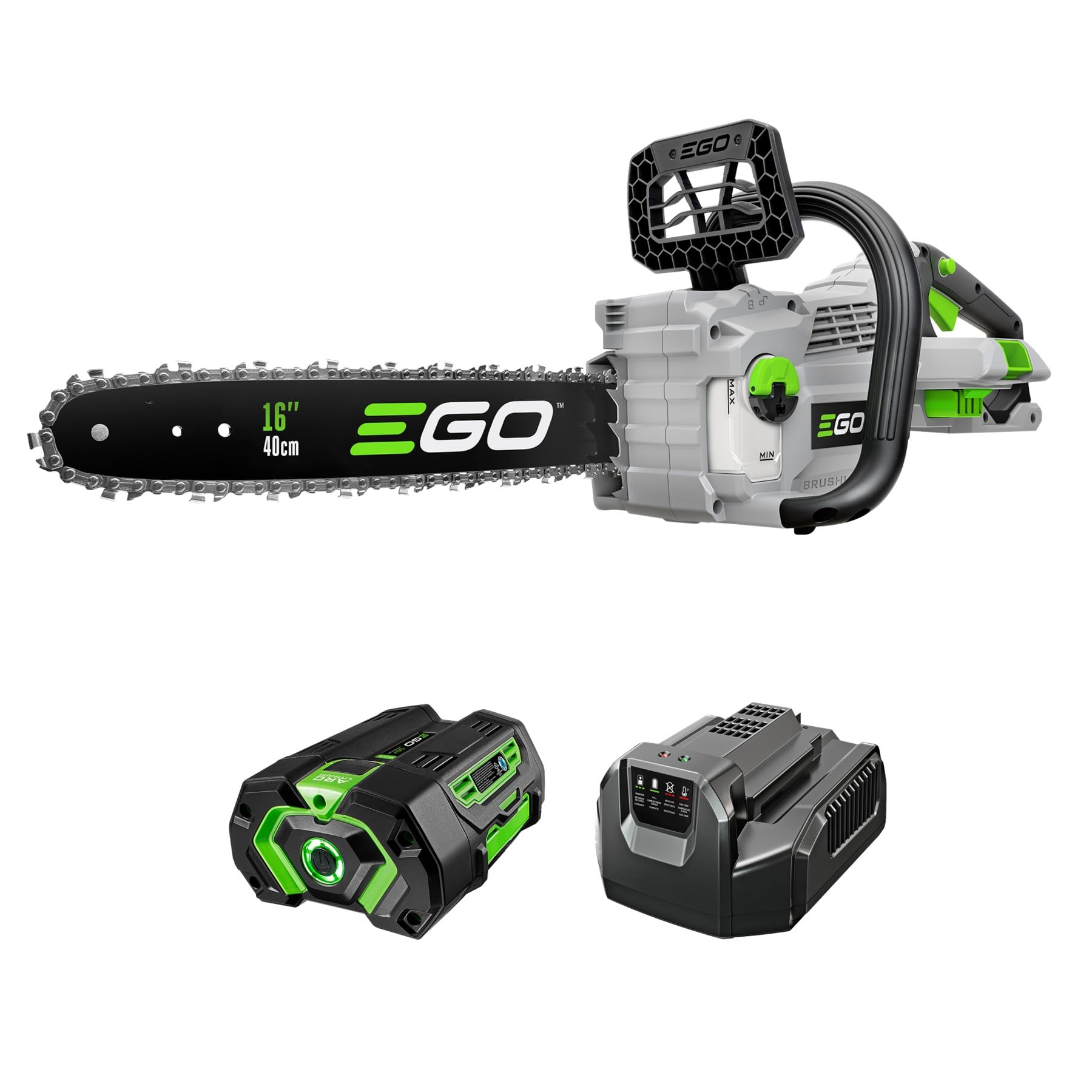
EGO Power+ CS1613 chainsaw
See on Amazon
Greenworks 20312 40V 16 in. chainsaw
See on Amazon
DeWalt DCCS620P1 20V chainsaw
See on AmazonModel comparison
| Model | Price | Rating | Bar length | Voltage | Battery capacity | Best for | |
|---|---|---|---|---|---|---|---|
| | EGO Power+ CS1613 chainsaw | $299.00 as of 10/31 See on Amazon | ★ 4.7 (1,000+ ratings) | 16 in | 56 V | 4.0 Ah | Homeowners wanting one saw for limbing, cleanup and occasional small trees get a 16-inch bar, 40 cc gas equivalent and included 4.0 Ah battery. |
| | Greenworks 20312 40V 16 in. chainsaw | $249.99 as of 10/31 See on Amazon | ★ 4.4 (6,100+ ratings) | 16 in | 40 V | 4.0 Ah | Budget-conscious battery buyers wanting a 16-inch bar get a brushless motor, Oregon bar and chain and a 4.0 Ah pack. |
| | DeWalt DCCS620P1 20V chainsaw | $379.00 as of 10/31 See on Amazon | ★ 4.5 (5,600+ ratings) | 12 in | 20 V | 5 Ah | DeWalt 20V tool owners wanting a light compact saw for limbing branches and storm debris, sharing packs with their drills. |
 | Craftsman CMCCS620M1 chainsaw | $199.99 as of 10/31 See on Amazon | ★ 4.6 (1,100+ ratings) | 12 in | not stated | 4.0 Ah | Craftsman V20 tool owners wanting a compact 12-inch saw for pruning, limbing and light cleanup around the yard. |
 | Black+Decker LCS1020 chainsaw | $149.00 as of 10/31 See on Amazon | ★ 4.4 (5,400+ ratings) | 10 in | 20 V max | not stated | Gardeners wanting the lightest saw for pruning, overgrowth and small branches, valuing low weight over cut capacity. |
How voltage and amp-hours together set a battery chain saw's real power
Voltage alone is not power. Volts describe the electrical pressure of the pack, and the motor's design, efficiency and control electronics decide how much of that pressure becomes chain speed and torque. A well-engineered 40V saw can out-cut a poorly engineered 80V one, which is why the voltage number on the box tells you less than the marketing suggests.
Watt-hours are the fair comparison
Multiply volts by amp-hours and you get watt-hours, the stored energy in the pack. A 40V 4.0Ah pack holds 160 Wh. An 80V 2.0Ah pack also holds 160 Wh. Same energy, different behavior, and that difference is what you feel in the cut.
The higher-voltage pack delivers its energy at lower current, so it holds speed better under a sudden load: a knot, a pinch, a thick trunk. It stalls less. The lower-voltage pack with more amp-hours tends to run longer at a steadier, lower chain speed and sags sooner when you push it hard. Neither is better on its own. One suits long light cutting, the other suits short heavy cutting.
Amp-hours are runtime, not power
A bigger amp-hour pack on the same saw cuts at the same speed, just for longer, and it weighs more. If you want more power, you need a different saw. If you want more time between charges, you need a bigger pack.
Chain speed is the practical proxy
Chain speed, measured in meters or feet per second, is the best single number for how fast a saw cuts. Electric motors trade chain speed for torque, which is why a battery saw rarely bogs down but can feel slower than a gas saw of similar size. A saw with a high chain speed and a sharp chain clears a cut quickly; a saw with a low chain speed leans on torque and takes longer.
How to read a spec sheet
Read in this order: watt-hours first, then chain speed, then bar length, then weight. Watt-hours tell you how much work the pack can do. Chain speed tells you how fast the saw cuts. Bar length tells you what wood it handles. Weight tells you how long you can hold it.
What bar length a battery saw can actually pull
A saw's motor is matched to its bar. A 16-inch bar on a small motor means the saw is working at its limit in hardwood. The same motor with a 12-inch bar cuts the same wood faster and stalls less, because the chain has less wood to clear and the motor has less resistance to fight.
The bands by motor class
- Compact 18 to 20V saws with 10 to 12-inch bars suit limbs, small logs and light cleanup.
- Mid 40V-class saws with 14 to 16-inch bars handle firewood and storm cleanup.
- High-voltage 56 to 80V saws with 16 to 20-inch bars take sustained bucking and small felling.
The two-inch rule
Choose a bar about two inches longer than the thickest wood you routinely cut. A bar cuts a log narrower than its length in one pass, so a 16-inch bar handles roughly 12 to 14-inch trunks and a 20-inch bar handles roughly 18-inch logs. If you cut firewood to 16 inches, a 16-inch bar is the natural fit.
What happens when you over-bar a saw
The chain slows in the cut, the motor pulls more current, the pack drains faster and the overload or thermal protection cuts in. The saw stops mid-cut and the user blames the battery. The fix is a shorter bar or a bigger saw, not a new pack.
Reach, weight and chain fit
Bar length is also a reach and weight decision. Longer bars are heavier at the tip and harder to control at shoulder height, and a heavy saw tires your arms faster than a light one. Chain pitch and gauge must match the bar and sprocket, and replacement chain availability is part of long-term ownership: check that the size you need is easy to find before you commit.
Estimating runtime from amp-hours and cut load
Watt-hours divided by average draw gives you minutes of actual cutting. A pack of about 160 Wh running a saw that draws roughly 800 to 1,000 W in the cut gives on the order of 10 to 12 minutes of continuous cutting. Because chainsaw work is start-stop, that stretches across a much longer session of limbing and bucking.
Minutes into cuts
A cut through a 10-inch log takes a handful of seconds of trigger time. A cut through an 18-inch hardwood log takes several times longer and draws far more energy per cut. Expect a pack to make many cuts when you are limbing small branches and far fewer when you are bucking trunks. Advertised cuts-per-charge figures are usually measured in softwood 4x4, so treat them as a best case and halve them for hardwood.
What cuts runtime hardest
- Diameter. Energy rises steeply with cross-section, so a log twice as thick costs far more than twice the energy.
- Wood species and moisture. Green hardwood is the worst case, and dry softwood the easiest.
- Chain sharpness. A dull chain can cost a large share of runtime because the motor works against friction instead of cutting.
Charge time is part of runtime
A fast charger that refills a pack in well under an hour changes how you plan a working day. A multi-hour charger means owning two packs. For anyone cutting for more than an hour, cycle two packs: one on the saw, one on the charger.
The thermal limiter
Sustained heavy cuts can make the saw stop to protect the electronics. The fix is sequencing work rather than forcing it: cut, then split, then stack, and let the saw cool while you do something else.
Battery platform lock-in and cross-compatibility
The pack is a large share of what you pay, and a spare pack is a significant additional purchase. Once you own two or three packs of one brand, that brand effectively chooses your next saw, blower, trimmer and mower.
Inventory what you own first
If you already run a brand's 18V, 40V or 56V yard tools, buying that brand's bare saw is usually the better decision than buying the best saw on a new platform. The money you save on packs pays for a lot of saw.
Platform breadth is a real criterion
Some ecosystems cover only a handful of outdoor tools. Others cover hundreds of tools across the home and yard. A narrow platform is fine if you only want a saw. A broad one pays off over years as you add tools.
What adapters can and cannot do
Third-party battery-to-tool adapters exist, but they bypass the communication between pack and tool: no temperature sensing, no cell balancing handshake, no warranty cover. The safe position is to stay within one brand's system. Replacement packs are available from the brand and, for some platforms, as generics, so check availability before you commit.
Battery care, charging and cold-weather performance
Store packs at roughly 40 to 60% charge for long periods, never fully charged or fully drained. Keep them cool, around 50 to 68°F, dry, out of direct sun, away from the charger and away from the tool.
Charging habits
Charge at room temperature. Do not charge a pack straight off a hard job while it is hot, and do not charge below freezing: let it warm up first. Remove the pack from the saw for storage.
Cold weather
A pack that gives a full session at 70°F can give noticeably less at freezing and substantially less well below it. Cold also makes the saw feel weaker before the pack is empty. Keep spare packs indoors until you need them, carry them in an inside pocket, and expect to shorten sessions.
Heat and lifespan
Leaving a pack in a hot shed or a car trunk shortens its life faster than any amount of use. Lithium-ion packs are consumables: expect several hundred charge cycles and a working life measured in years, then budget for replacement. Treat the pack as part of the cost of ownership, not an accessory.
Chain and bar care
Check chain tension before each use, because chains stretch when new and when hot. Keep the oil reservoir filled with bar-and-chain oil, never a substitute. Sharpen roughly every hour of cutting. A sharp, properly tensioned chain protects runtime as much as a fresh pack does.
When a battery chain saw is the wrong tool
A battery saw is the wrong choice when the wood is consistently large. Sustained bucking of trunks well beyond the bar's comfortable diameter drains packs and trips thermal protection, and a gas saw with a long bar is the honest answer.
It is also the wrong choice for a full day of continuous cutting: firewood in volume, clearing a fallen tree of significant size, or repeated felling. Runtime and recharge cycles make cordless a stop-start tool.
Felling trees of real size is a job for training and technique more than for a bigger battery saw. Beyond small-diameter work, call a professional.
When the work is stationary and near power, a corded electric saw gives unlimited runtime for less money if you have an outlet and a heavy-gauge cord within reach. When the reach is above shoulder height, that is pole saw territory, not a chainsaw held aloft.
Our picks by budget
The Black+Decker LCS1020 is our budget pick because it puts a light, easy-to-carry saw with automatic oiling and tool-free tensioning in your hands for pruning and small branches, where capacity matters less than weight.
The Greenworks 20312 is our mid-range pick because a 40V brushless motor, a 4.0Ah pack and a 16-inch Oregon bar cover firewood and storm cleanup without the weight or the platform commitment of a bigger saw.
The DEWALT DCCS620P1 is our premium pick because it brings a 5.0Ah pack and a 1 hp motor to a compact 12-inch saw, which suits anyone already inside the DEWALT 20V system and wants a saw that shares packs with their other tools.
Budget
Mid-range
High-end
Which battery chain saw for which buyer
The all-round homeowner
You want one capable saw for firewood, storm cleanup and regular yard work, and you are ready to build on a large battery platform. The 16-inch bar and 56V pack give you high capacity.
The value-minded 16-inch buyer
You want a 16-inch bar at the lowest sensible outlay. The light 10.4-pound build is easy to handle for long sessions.
The DEWALT 20V owner
You already own DEWALT 20V packs, or you want a compact saw for limbing and light work. The 12-inch bar keeps the motor comfortably inside its limits.
The Craftsman V20 household
You run Craftsman V20 tools and want a compact saw with tool-free tensioning and auto-oiling. The integrated hook keeps it tidy in the garage.
The pruner with small branches
You want a light saw for pruning and small branches, and you value low weight over capacity. At 6.8 pounds it is easy to carry all afternoon.
Our verdict on the best battery chain saws
The EGO Power+ CS1613 is the overall pick: a 16-inch bar its brushless motor can genuinely pull, 4.0Ah of 56V capacity in the box, and a platform that will carry future tools. The Greenworks 20312 is the value pick for a light 16-inch saw, and the Black+Decker LCS1020 is the compact pick for pruning and small branches. Match the bar to the wood, match the pack to the session, and match the platform to the tools you already own.
Detailed model analysis
EGO Power+ CS1613 chainsaw
This EGO Power+ chainsaw is built around runtime: up to 220 cuts on a 4x4 with the included 56V, 4.0Ah ARC Lithium battery and charger.
Its brushless motor is rated equivalent to a 40cc gas chainsaw, so you get gas-class power without fuel mixing or fumes.
The 16 in bar and a chain speed of about 65.6 ft/s (20 m/s) suit firewood, storm limbs and small trees.
Tool-free tensioning uses independent dials that sit low, so you can cut flush to the ground. Automatic oiling lubricates the chain. Metal bucking spikes and a kickback brake with a visible position indicator add control.
The limits are weight, at 20.9 lb, and battery choice. It runs only on EGO Power+ 56V ARC Lithium batteries, and a second pack is a separate purchase.
It suits homeowners who want one saw for limbing, cleanup and occasional small trees, and who are happy to build around the EGO battery line.
- Brand: Ego Power+
- Bar length: 16 in
- Voltage: 56 V
- Battery capacity: 4.0 Ah
- Chain speed: 20 m/s
- Weight: 20.9 lb
Greenworks 20312 40V 16 in. chainsaw
The Greenworks 20312 pairs a 16 in bar with a 40 V brushless system. A 4.0 Ah lithium-ion battery and a charger come in the box. There is no pull cord and no fuel to mix.
The Oregon bar and chain suits firewood, storm cleanup, limbing, pruning and tree felling. A safety chain brake, metal bucking spikes and an automatic oiler round out the saw.
The brushless motor gives up to 80% longer life and up to 30% more torque, with lower noise and vibration. It weighs 10.4 lb, and a 3-year warranty backs it.
The battery works across the G-MAX 40V system's 14 different lawn tools. At 40 V, it sits below the 56V of the EGO Power+ CS1613 chainsaw and above the 20 V of the DeWalt DCCS620P1 20V chainsaw.
It has no tool-free chain tensioning, which the EGO Power+ CS1613 chainsaw offers. No cuts-per-charge figure comes with it either, so you cannot size a job by runtime.
It suits homeowners wanting a 16 in brushless saw with battery and charger included, who may add other G-MAX 40V tools later.
- Brand: Greenworks
- Bar length: 16 in
- Voltage: 40 V
- Battery capacity: 4.0 Ah
- Power source: Battery powered
- Weight: 10.4 lb
DeWalt DCCS620P1 20V chainsaw
The DeWalt DCCS620P1 is a compact saw with a 12 in bar on a 20 V platform.
Its 5 Ah rating is a step up from the batteries that come with the EGO Power+ CS1613, the Greenworks 20312 40V 16 in. and the Craftsman CMCCS620M1. More amp-hours means more stored energy, the start of longer runtime.
Its bar is longer than the Black+Decker LCS1020 and shorter than the EGO Power+ CS1613. That length suits limbing branches and storm debris. For felling larger trees or cutting big firewood, a longer bar gives you more reach.
At 20 V, it sits at the low end of voltage, level with the Black+Decker LCS1020 and below the Greenworks 20312 40V 16 in. at 40 V and the EGO Power+ CS1613 at 56V.
No cuts-per-charge figure accompanies it, so you have no runtime number to plan a job around. The Craftsman CMCCS620M1 also has a 12 in bar, so the choice comes down to which battery platform you own.
It suits owners of 20 V tools who want a compact saw for limbing branches and storm debris.
- Brand: DeWalt
- Voltage: 20 V
- Battery capacity: 5 Ah
- Bar length: 12 in
- Power source: Battery powered
Craftsman CMCCS620M1 chainsaw
The Craftsman CMCCS620M1 is a 12 in compact saw built on the V20 battery platform. It is sold as a kit with a 4.0 Ah lithium-ion battery, a V20 charger and a bar cover.
Upkeep stays simple, with automatic oiling and tool-free chain tensioning. It weighs 9.9 lb, which is 3.1 lb more than the Black+Decker LCS1020 chainsaw, in return for a longer 12 in bar.
An integrated VERSATRACK hook lets you hang the saw on a VERSATRACK system, which is sold separately. The V20 platform also works with Craftsman V20 outdoor equipment and power tools, so one battery can serve tools you already own.
The main limit is the 12 in bar, which is shorter than the bar on the EGO Power+ CS1613 chainsaw.
It suits Craftsman V20 owners who want a compact saw for pruning, limbing and light cleanup around the yard.
- Brand: Craftsman
- Bar length: 12 in
- Power source: Battery powered
- Battery capacity: 4.0 Ah
- Weight: 9.9 lb
- Dimensions: 26.94 in long, 9.03 in wide and 10.88 in high
Black+Decker LCS1020 chainsaw
The Black+Decker LCS1020 is the small end of this guide, with a 10 in bar on a 20V MAX lithium-ion battery system. A battery and charger are included.
It weighs 6.8 lb, against 9.9 lb for the Craftsman CMCCS620M1 chainsaw and 10.4 lb for the Greenworks 20312 40V 16 in. chainsaw. That means less strain on your arms over a long pruning session.
Automatic oiling, a low kickback chain and tool-free chain tensioning are all part of the saw. A 2-year limited warranty covers it, one year shorter than the 3 years on the Greenworks 20312 40V 16 in. chainsaw.
The cut capacity is 8 in, enough for pruning, overgrowth and small branches. The 10 in bar is 2 in under the Craftsman CMCCS620M1 chainsaw and 6 in under the EGO Power+ CS1613 chainsaw.
Felling and big firewood are outside its range. It suits gardeners who want a light saw for pruning and value low weight over cut capacity.
- Brand: Black+Decker
- Bar length: 10 in
- Voltage: 20 V max
- Power source: Battery powered
- Weight: 6.8 lb
- Dimensions: 16.7 in long, 8.81 in wide and 9.63 in high
Frequently asked questions
Is a battery chain saw powerful enough to replace a gas saw?
For homeowner limbing, firewood and storm cleanup, yes. For sustained cutting of large-diameter trunks, no: runtime and thermal protection make a gas saw the honest choice.
How many cuts will you get on one charge?
Plan on a minimum of roughly 10 to 12 minutes of trigger time from a 160 Wh pack, which spreads across a much longer session because cutting is start-stop. A 10-inch log costs a few seconds per cut, while an 18-inch hardwood log costs several times more energy, so the practical limit is set by diameter and species rather than by the label on the pack.
Is a higher voltage always more powerful?
No. Watt-hours and motor design decide real power. A 40V 4.0Ah pack and an 80V 2.0Ah pack both hold 160 Wh, so the energy ceiling is identical; the 80V pack simply delivers it at lower current, which means less sag and fewer stalls when the chain meets a knot or a pinch.
Do battery chain saws need bar and chain oil?
Yes, always. Automatic oilers are standard on these saws, but you still fill the reservoir with bar-and-chain oil and never a substitute.
How long does a battery take to charge, and should you buy a second pack?
Charge time varies widely by charger. A second pack is worth buying whenever your charger is the slow type, because a spare keeps the saw running while the first pack sits on the charger.
Can you use a battery chain saw in cold weather?
Yes, with reduced runtime. Expect a pack that lasts a full session at 70°F to fall short at freezing and to drop further well below it, so bring a spare kept at room temperature and swap packs rather than pushing one to empty.
What watt-hours does a battery chain saw pack hold, and why does that number matter more than volts?
Watt-hours measure stored energy, and that is the number that sets how much work a pack can do. Multiply volts by amp-hours to get it: 40V times 4.0Ah gives 160 Wh, and 80V times 2.0Ah also gives 160 Wh, so two packs with very different labels can carry identical energy. Read watt-hours first on a spec sheet, ahead of chain speed, bar length and weight, because a bigger voltage label alone tells you nothing about capacity.