Best Pole Saw 2026: Reach, Power and Weight for Overhead Pruning
When you buy through the Amazon links on this page, we may earn a commission at no extra cost to you. Learn more
Last updated October 31, 2026
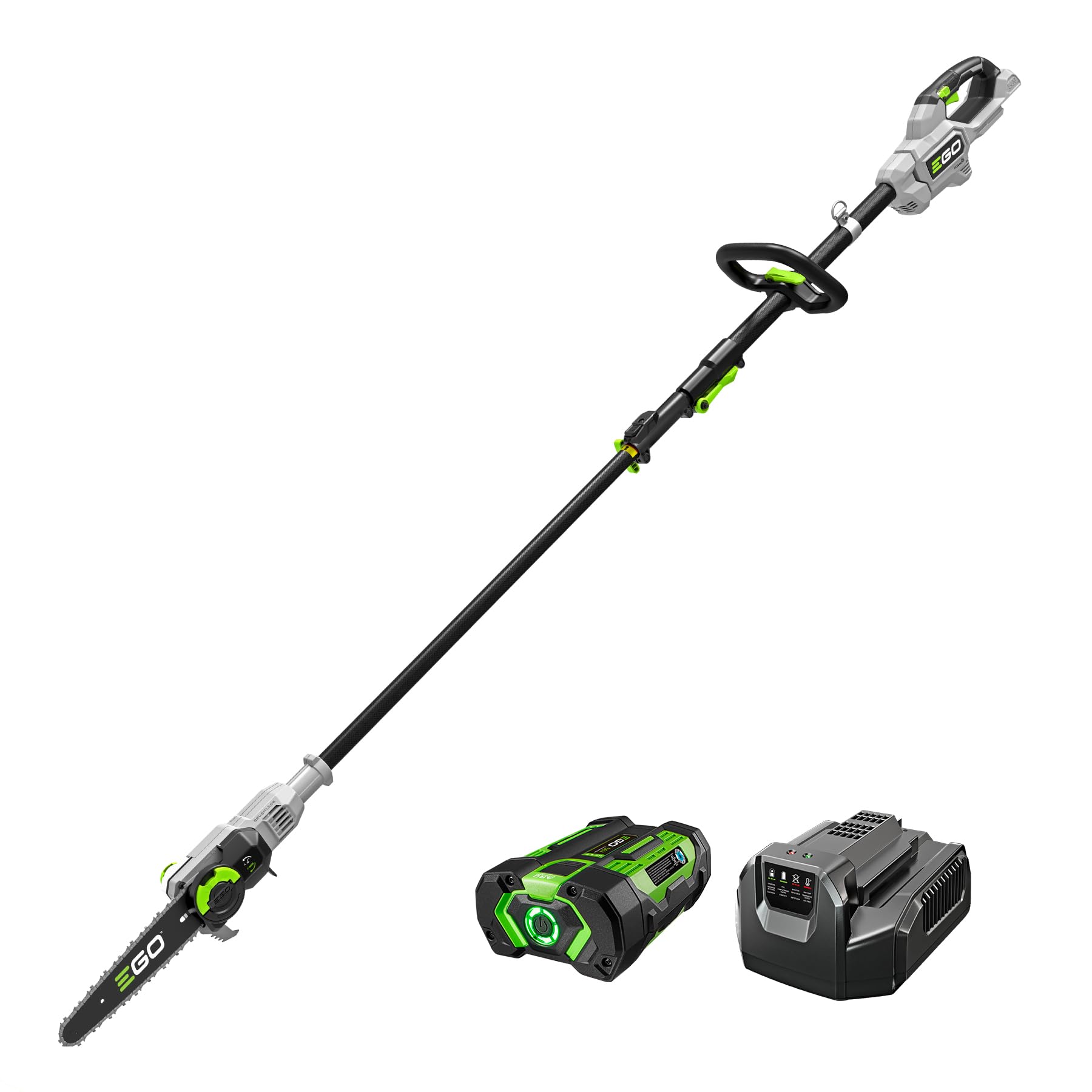
A pole saw lets you cut branches above head height while both feet stay on the ground, and the best one for most yards is the EGO Power+ PS1001: a light carbon-fiber telescoping shaft, a 10-inch bar and up to 13 ft of reach, 17 ft with the optional extension pole, so the head stays steady where a heavier saw would wobble.
If your trees stand within cord's length of an outlet, the Sun Joe SWJ803E gets a 10-inch bar overhead for the least money, with no battery to charge. For big limbs and sustained cutting, the gas Echo PPT-2620 brings a 12-inch bar and a 25.4 cc engine, at 17.4 lb to hold up.
The best pole saws of 2026
EGO Power+ PS1001
See on Amazon
Craftsman V20 CMCCSP20M1 pole saw
See on Amazon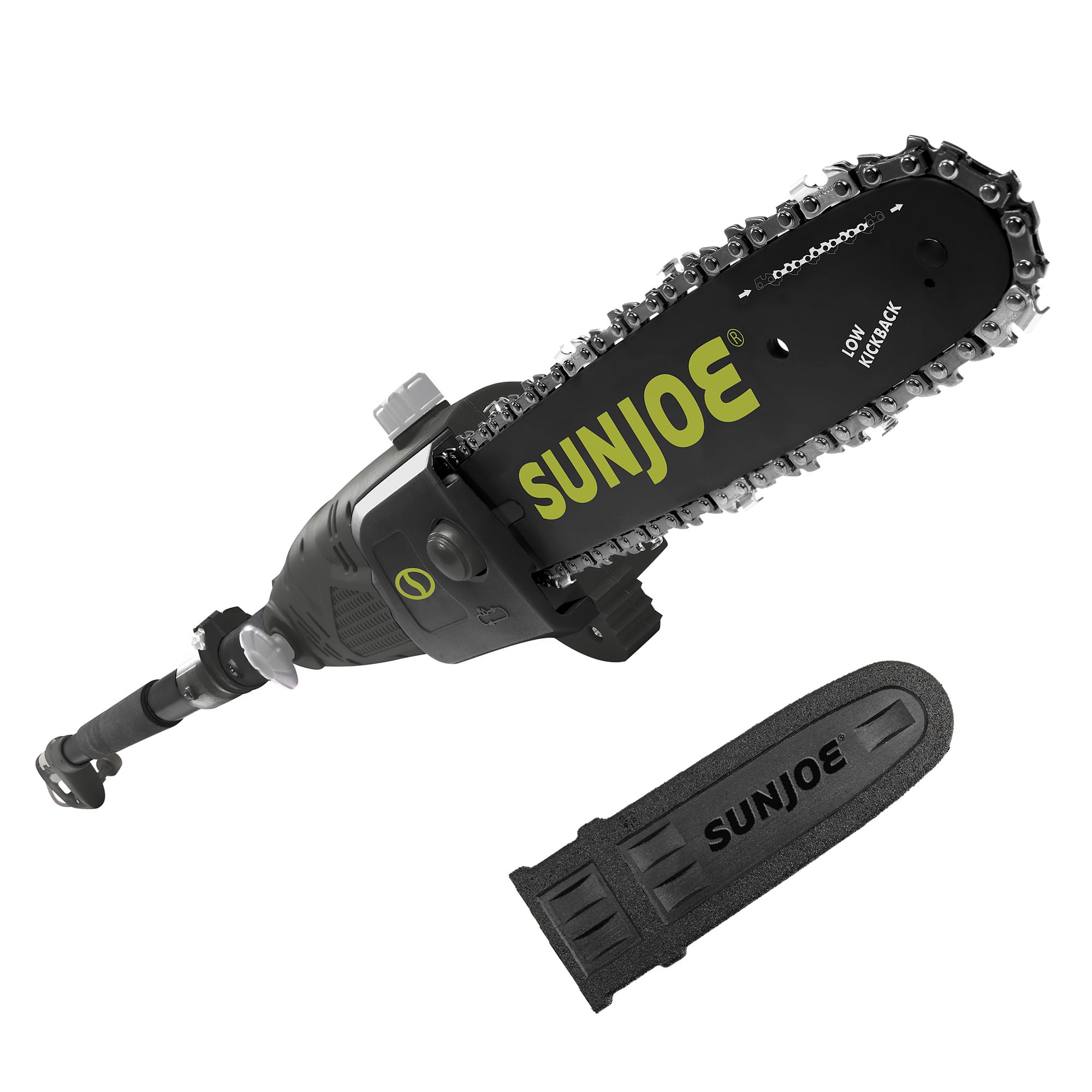
Sun Joe SWJ803E pole saw
See on AmazonModel comparison
| Model | Price | Rating | Bar length | Weight | Power source | Best for | |
|---|---|---|---|---|---|---|---|
| | EGO Power+ PS1001 | $339.00 as of 10/31 See on Amazon | ★ 4.6 (350+ ratings) | 10 in | 9.4 lb | Battery powered | Owners of bigger properties who work past the last outlet get reach, light weight and battery convenience at the top of the range. |
| | Craftsman V20 CMCCSP20M1 pole saw | $179.00 as of 10/31 See on Amazon | ★ 4.4 (3,000+ ratings) | 8 in | 6 lb | Battery powered | Gardeners already on the Craftsman V20 platform wanting a light 6 pound cordless saw for regular light pruning with up to 14 foot reach. |
| | Sun Joe SWJ803E pole saw | $114.99 as of 10/31 See on Amazon | ★ 4.5 (9,600+ ratings) | 10 in | 4.55 kg | Corded electric | Buyers with an outdoor outlet and real limbs to cut get cutting capacity and an adjustable head without a battery to charge or replace. |
 | Greenworks PS40B210 40V pole saw | $136.99 as of 10/31 See on Amazon | ★ 4.5 (1,900+ ratings) | 8 in | 7.8 lb | Battery powered | Buyers who want a battery, a charger and a spare chain included get a complete 40V kit they can share with other tools. |
 | Echo PPT-2620 pole saw | $676.49 as of 10/31 See on Amazon | ★ 4.5 (90+ ratings) | 12 in | 17.4 lb | Gas | Owners of several mature trees who cut often get 2-stage air filtration for dusty, heavy seasonal work. |
How a pole saw differs from a chainsaw
The long shaft is the whole story, and it changes the physics of the cut rather than the power. On a chainsaw the cutting head sits at arm's length and your body is close to the work. On a pole saw the head sits one to two meters away at the end of a lever, and two consequences follow.
Leverage works against you
The weight of the head, multiplied by the distance to your hands, becomes a torque your shoulders and back must resist for the whole cut. A saw that feels light in the shop can be exhausting after twenty overhead cuts. This is why weight and balance decide more than motor power on a pole saw, and why a saw with a modest motor and a stiff, light shaft often outperforms a more powerful one on a flexing pole.
Control is reduced, so the cut is less precise
You cannot see the branch collar clearly from the ground, you cannot feel the bar pinch as directly, and shaft flex absorbs some of the force you apply. A pole saw therefore makes a rougher cut than a handsaw or a chainsaw held close, and the operator has to compensate with technique.
Where the weight sits depends on the power source
On a gas pole saw the engine is at the operator's end and drives the cutting head through a shaft, so the tool feels balanced but heavy overall. On a battery or corded pole saw the motor sits at the cutting head, so the tool is lighter overall but top-heavy, which is exactly what makes it wobble at full extension. Neither is better in the abstract; know which compromise you are buying.
Reach, leverage and control, not raw power, decide whether a given pole saw will do a given branch well.
Choosing the right reach for your trees
The advertised reach figure is not the number to buy on. What matters is the height of the highest branch you actually intend to cut, measured from the ground where you will stand.
Measure the cut, not the tree
A 40-foot tree with a clear trunk to 12 feet needs a saw that reaches 12 feet, not 40. Walk out, look up, and pick the highest limb on your list.
Working height is not pole length
The usable height is the pole length plus your own reach, roughly the distance from the ground to your hands plus the length of your arms, typically two to three feet. A saw sold as reaching a given height is usually quoting pole plus operator; the pole itself is shorter.
You rarely cut at full extension
At maximum extension the shaft is at its least stiff and the head at its least controllable, so the practical working height sits below the maximum. Plan for the branches you cut most often to fall comfortably inside the saw's maximum reach, not at the limit.
The safe cutting angle costs height
Cutting at a steep angle overhead is unsafe. Working at a shallower angle to the side means the head reaches less high than the pole length suggests, so allow for it when you size the saw.
Match the reach to the job, not to the biggest tree on the property. A saw bought for one tall tree and used mostly on shrubs will be heavier and more awkward than needed every other day of the year. An extension pole accessory, where the saw's sheet lists one as compatible, adds reach without a second tool, but it adds weight at the worst place, the far end, and is an occasional measure rather than the everyday setting.
Telescoping versus fixed-length shafts
Every sliding joint is a place where the shaft can flex and where the clamp can slip under load, and that trade-off decides which shaft type suits you.
Telescoping shafts
They adjust continuously, collapse for storage and transport, and let one tool cover low shrubs and high limbs. The cost is stiffness: a flexing shaft wastes cutting force and makes the head wander, and telescoping saws are generally heavier at a given reach than a rigid pole of the same length.
Fixed-length shafts
Single-piece poles or a small number of rigid sections are stiffer and lighter for their length, transmit force to the cut more directly and hold the head steadier. The cost is that they do not adjust: one length for every job, and long ones are awkward to store and carry.
Which suits whom
Occasional pruning across a range of heights, and anyone who has to store the tool in a shed or car, is better served by telescoping. Regular work at a consistent height, and anyone cutting thicker limbs where control matters, is better served by a rigid shaft, accepting the storage penalty.
Shaft material is part of this. A carbon-fiber or similarly stiff, light shaft is the reason some saws stay controllable at long extension; a heavier or more flexible shaft is the reason others do not, whatever their motor. Where a saw's sheet states its shaft material, that is a genuine buying signal.
Keeping the head steady at full extension
At full extension you are fighting a top-heavy tool at the end of a lever, and a handful of habits keep it under control.
Stance first
Feet apart, weight centered, body turned so the cut is in front of and slightly to the side of the shoulder, never directly overhead. Reposition the feet rather than stretching the arms; overreaching is how control is lost.
Two hands, and grip where the balance is
The rear hand stays on the trigger, the front hand well up the shaft to act as a fulcrum. Moving the front hand changes the leverage, so find the point where the head feels lightest and keep it there.
Brace the shaft
Where the geometry allows, rest the shaft against the inside of the forearm or the shoulder to take the load off the wrists. A shoulder strap, listed with some saws, transfers weight to the torso and is the single biggest comfort upgrade on a long or heavy saw.
Let the saw's weight make the cut
On a downward cut the head's own weight feeds the chain. You guide and steady; you do not push. Pushing loads the shaft, flexes it, and makes the bar wander or bind.
Keep the chain sharp and tensioned
A dull or loose chain needs force, and force at full extension is exactly what destroys control. Sharp chain, correct tension, light hand.
Fatigue is the real safety limit. Put the saw down between limbs, and stop when the arms start to shake, because a shaky operator at full extension is the accident waiting to happen.
When a pole saw is the wrong tool
- Thick trunks and large-diameter limbs. A pole saw's bar is short and its control is limited; it is a pruning tool, not a felling or sectioning tool. Limbs beyond the saw's stated cutting capacity, and anything that needs a felling cut, are chainsaw work.
- Work near power lines. Assume every line is live. A pole saw is long, conductive in parts, and held by an operator on the ground; a branch in or near a line is a job for the utility or a qualified arborist.
- Anything that needs a climb, is hung up, or is under tension. Storm-damaged and tension-loaded limbs can spring or split unpredictably, and a limb already hung in another tree is the classic hazard. These are arborist calls.
- Anything over structures, vehicles, fences or a road, where a mis-dropped limb does damage beyond the tree.
- Where the cut has to be precise, such as formative pruning of a young or valuable tree or work where the branch collar must be respected exactly. A handsaw or a saw used close-up makes a better cut than a pole saw can from the ground.
The pole saw's job is safe, controlled pruning of reachable branches from the ground. When the job stops being that, the right answer is a different tool or a professional.
Our picks by budget
The Sun Joe SWJ803E is our budget pick because mains power removes the battery and the engine from the tool entirely: you get a 10-inch bar overhead for the least money, as long as the cord reaches the tree.
The Craftsman V20 CMCCSP20M1 is our mid-range pick because it buys cordless freedom on a battery platform, with the battery, charger and extension pole in the box and a 6 lb build light enough to hold overhead for a session.
The Echo PPT-2620 is our premium pick because gas power and pro-grade build buy cutting capacity the battery saws lack: a 12-inch bar, a 25.4 cc engine and an aluminum inner drive shaft for sustained, heavier work.
Budget
Mid-range
High-end
Which pole saw for which buyer
The battery platform you already own, the distance from your nearest outlet and the thickness of your thickest regular limb narrow the choice faster than any spec sheet.
The all-round homeowner
You want one good saw, no fuss and no cord. The EGO Power+ PS1001 brings a light carbon-fiber shaft, a 10-inch bar, up to 13 ft of reach and a shoulder strap in the box, which is the best balance of reach, weight and control for regular overhead pruning.
The budget buyer near an outlet
Your trees stand within cord's length of the house and you cut occasionally. The Sun Joe SWJ803E is the lowest-cost way into motorized pole pruning, with a 10-inch bar and a multi-angle head.
The 20V platform owner
You already own Craftsman V20 batteries and want light and simple. The Craftsman V20 CMCCSP20M1 weighs 6 lb, includes an extension pole and states up to 325 cuts per charge.
The 40V platform owner
You are invested in the Greenworks 40V platform and want cordless pruning without a second charging system. The Greenworks PS40B210 adds an extension pole and a spare chain in the box.
The heavy-duty user
You have big limbs, regular or heavy cutting, and no patience for batteries. The Echo PPT-2620 brings a 25.4 cc engine, a 12-inch bar and pro-grade filtration and drive shaft, with the weight and upkeep to match.
Our verdict on the best pole saws
The EGO Power+ PS1001 is the best overall because it solves the problem that decides every overhead cut: a stiff, light carbon-fiber shaft holds a 10-inch bar steady at up to 13 ft, and 9.4 lb is light enough to keep the head under control through a session. The Sun Joe SWJ803E is the value and simplest pick, corded and light, for anyone whose trees stand within reach of an outlet. The Echo PPT-2620 is the heavy-work pick, with a 12-inch bar and a 25.4 cc engine, at 17.4 lb and with fuel upkeep to match.
The right pole saw is the lightest one that reaches your highest regular cut and cuts your thickest regular limb. Everything above that is weight you carry overhead for no reason.
Detailed model analysis
On a pole saw the weight at the end of the lever and the stiffness of the shaft decide how the tool behaves overhead, long before motor power comes into it.
EGO Power+ PS1001
The EGO Power+ PS1001 pairs a telescopic carbon fiber shaft with a cordless 56V battery, so you can trim limbs above head height with both feet on the ground and no cord to drag across the yard.
It reaches up to 13 ft with the shaft fully extended. Add the optional EP1000 extension pole, sold separately, and reach grows to 17 ft.
The 10 in bar and 1/4 in chain run at chain speeds up to about 65.6 ft/s (20 m/s). A brushless motor keeps vibration low and extends motor life.
An LED cut line indicator lights the cut under dark, shaded canopies. Tool-free chain tensioning, a quick-adjust handle and a shoulder strap with hook add speed, control and comfort.
The 56V 2.5Ah battery makes up to 100 cuts per charge. It weighs 9.4 lb, more than the Craftsman V20 CMCCSP20M1 pole saw at 6 lb and the Greenworks PS40B210 40V pole saw at 7.8 lb.
The main limit: 17 ft needs the extra pole. It suits owners of bigger properties who work past the last outlet and want reach and battery convenience.
- Brand: Ego Power+
- Bar length: 10 in
- Battery voltage: 56 V
- Battery capacity: 2.5 Ah
- Weight: 9.4 lb
- Power source: Battery powered
Craftsman V20 CMCCSP20M1 pole saw
The Craftsman V20 CMCCSP20M1 weighs just 6 lb, which matters when you hold a saw overhead. Reach is up to 14 ft with the extension pole attached.
A soft grip on the pole extension helps you steer, and the angled head and blade aim the cut at the branch. A branch hook helps you pull down cut limbs.
The 20 V battery is a 4.0 Ah lithium-ion pack, rated for up to 325 cuts per charge. It fits other Craftsman V20 outdoor equipment and power tools.
The motor is brushless, the bar measures 8 in, and the blade is high speed steel with 30 teeth. The box holds a charger, an oil bottle and a wrench. A 3 year limited warranty applies.
Its limit is the 8 in bar, shorter than the bars on the Ego Power+ PS1001, Sun Joe SWJ803E pole saw and Echo PPT-2620 pole saw.
It suits gardeners already on the V20 platform who want a light saw for regular light pruning up to 14 ft.
- Brand: Craftsman
- Voltage: 20 V
- Battery capacity: 4.0 Ah
- Bar length: 8 in
- Weight: 6 lb
- Power source: Battery powered
Sun Joe SWJ803E pole saw
The Sun Joe SWJ803E runs on corded electric power, so you never wait on a battery charge. The cord is the main limit: it needs a power outlet, so you must work within reach of one.
An 8 amp motor, listed at 1 hp, drives a 10 in Oregon chain and guide bar. The recommended maximum branch thickness is 8.5 in.
The pole extends up to 8 ft for a maximum overhead reach of up to 14 ft. You cut from the ground, so you can trim overhanging branches, shrubs and hard-to-reach limbs without a ladder.
The multi-angle cutting head lets you reposition the blade in tight or awkward spaces. An automatic chain oiling system reduces friction and helps the chain last longer.
It weighs about 10.0 lb (4.55 kg), more than the EGO Power+ PS1001 at 9.4 lb and the Craftsman V20 CMCCSP20M1 at 6 lb, yet well under the 17.4 lb of the Echo PPT-2620.
A 2 year manufacturer warranty covers it, and the kit includes a cutting bar sheath, a hex key wrench and blade screwdriver. It suits buyers with an outdoor outlet who want an adjustable head without a battery.
- Brand: Sun Joe
- Bar length: 10 in
- Power source: Corded electric
- Motor current: 8 A
- Weight: 4.55 kg
- Overall length: 63.25 in
Greenworks PS40B210 40V pole saw
The Greenworks PS40B210 is a complete cordless kit. Saw, battery, charger, extension pole, scabbard and operator's manual come in the box, so you can work overhead as supplied.
It runs on a 40V, 2.0 Ah battery from the Greenworks 40V platform, which also powers other tools on that platform. There is no cord to manage and no fuel to buy.
The bar is 8 in long and the motor is listed at 1 hp. At 7.8 lb, it is lighter than the EGO Power+ PS1001 but heavier than the Craftsman V20 CMCCSP20M1. The Echo PPT-2620 weighs 17.4 lb.
The main limit is the 2.0 Ah battery, the smallest capacity of the three cordless models. Greenworks also recommends a helmet, protective chaps and protective gloves, which are not included.
It is aimed at pruning, trimming branches, hard to reach areas and storm cleanup. It suits buyers wanting a ready-to-run 40V kit who can share the battery with other Greenworks 40V tools.
- Brand: Greenworks
- Voltage: 40 V
- Battery capacity: 2.0 Ah
- Bar length: 8 in
- Weight: 7.8 lb
- Power source: Battery powered
Echo PPT-2620 pole saw
The Echo PPT-2620 is the only gas model of the five, with a 2-stroke engine in the X Series. No cord or battery limits how long you can keep cutting.
The 12 in blade is high carbon steel with 10 teeth and cuts at a 45 degree angle. That bar is longer than on the EGO Power+ PS1001, Sun Joe SWJ803E, Craftsman V20 CMCCSP20M1 and Greenworks PS40B210.
The telescoping shaft extends up to 12.1 ft, and the loop handle gives you a firm grip. An aluminum inner drive shaft carries power down the pole, and an automatic oiler lubricates the chain as you cut.
A 2-stage air filtration system suits dusty, heavy work. The warranty runs 5 years for consumer use and 2 years for commercial use.
It weighs 17.4 lb, the heaviest of the five. That weight is the main limit, since you hold it overhead for the whole cut.
It suits owners of several mature trees who cut often and want a long bar for heavy seasonal work.
- Brand: Echo
- Engine displacement: 25.4 cc
- Bar length: 12 in
- Extended shaft length: 12.1 ft
- Weight: 17.4 lb
- Power source: Gas
Frequently asked questions
Reach, bar size and battery life are the three figures that decide whether a pole saw will do your branches, and each has a simple rule behind it.
Why does a pole saw with a modest motor sometimes beat a more powerful one?
A stiff, light shaft keeps the cutting head from wandering, so the force you apply reaches the branch instead of being soaked up by flex. A stronger motor on a shaft that bends under load wastes that extra power and leaves you fighting the head at full extension. That is why a modest motor paired with a rigid, light pole often finishes the cut more cleanly than a bigger motor on a whippy one.
Is a 10-inch bar better than an 8-inch?
It cuts thicker limbs and reaches further per cut, but it adds weight and length at the head. Choose the bar for your thickest regular limb, not your thickest ever.
Are battery pole saws powerful enough?
For pruning the branch sizes their bars are rated for, yes. The limit is the bar and your control of the head, not the motor. For thick limbs and sustained heavy cutting, gas is the better fit.
Can I use a pole saw from a ladder?
No. The pole saw exists to replace the ladder. Cut from the ground, with both feet planted.