Best 24-Inch Chainsaw 2026: Pro-Level Power for Large Hardwood Trees
When you buy through the Amazon links on this page, we may earn a commission at no extra cost to you. Learn more
Last updated October 31, 2026
The Husqvarna 460 Rancher chainsaw is the best 24-inch chainsaw for most hardwood cutters: it is factory-rated for a 24-inch bar and pairs that rating with Smart Start, LowVib, an adjustable oiler, Air Injection and a side-mounted tensioning system. That combination is what a 24-inch saw owner actually needs over years of use, not just reach.
The Proyama PCS68X 68cc chainsaw is the budget entry, with 68cc and a kit that includes both a 22-inch and a 24-inch bar. The Neo-Tec NS872 brings the most headroom in dense wood, at 72cc and 4.9 hp.
Our 3 picks

Husqvarna 460 Rancher chainsaw
See on Amazon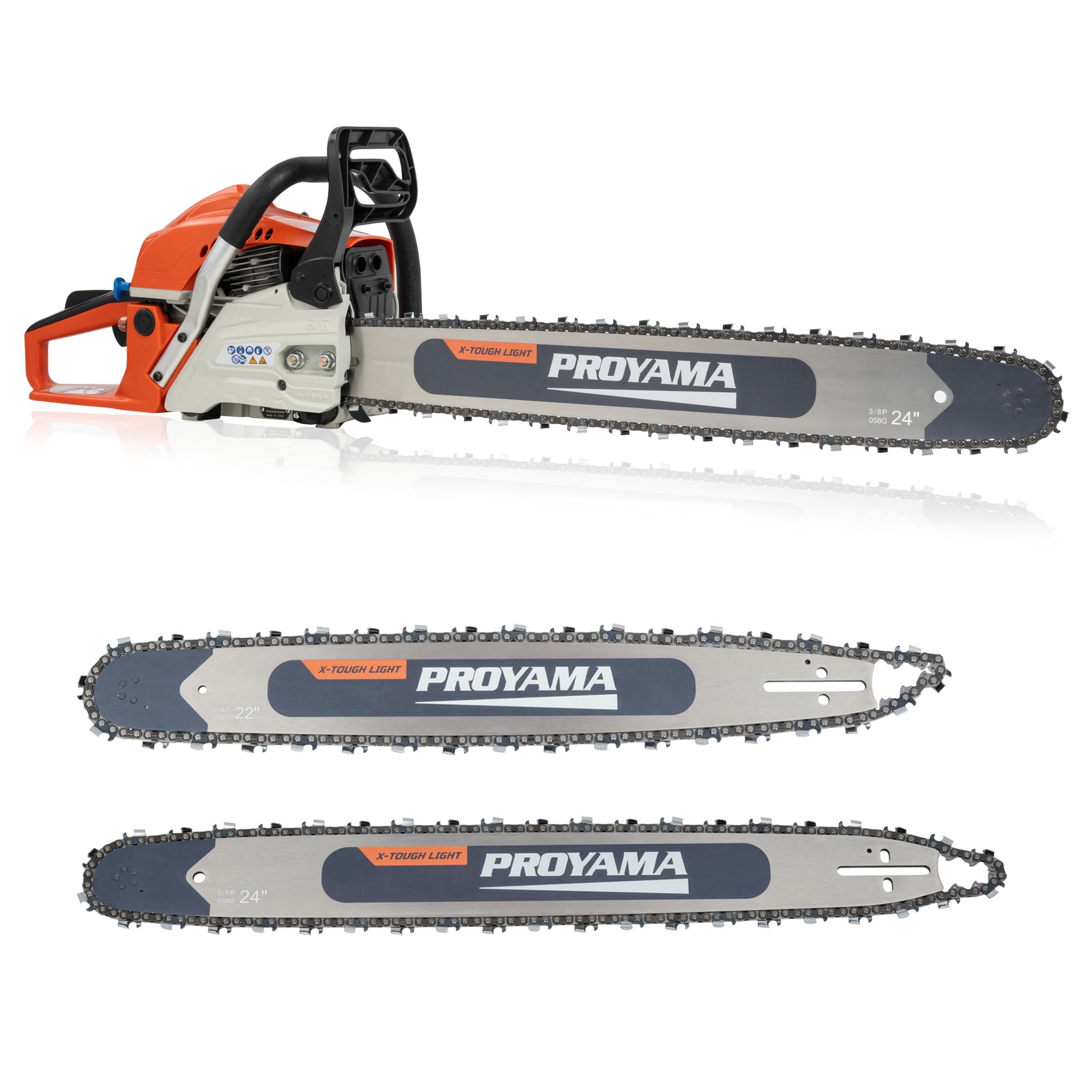
Proyama PCS68X 68cc chainsaw
See on Amazon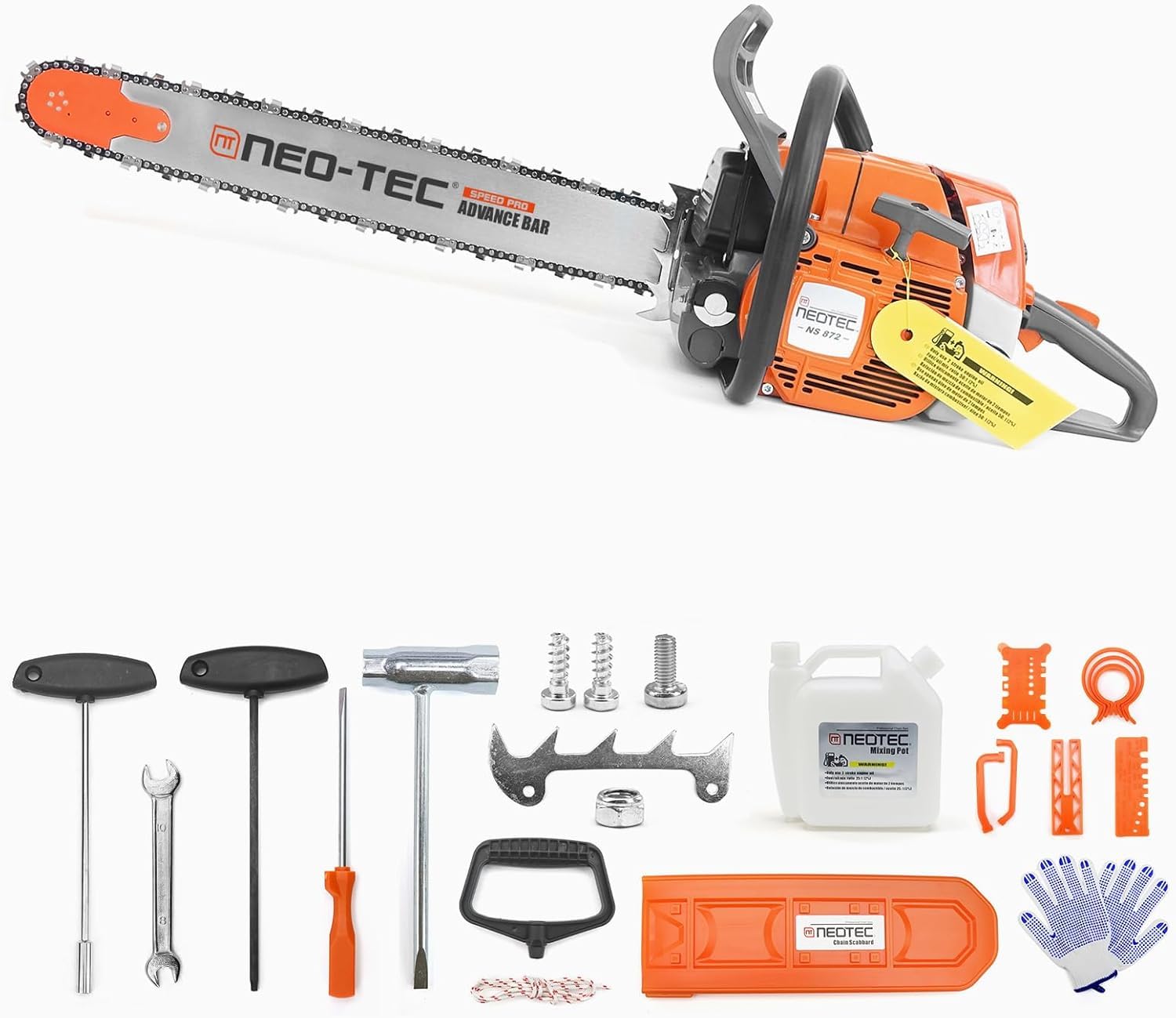
NEO-TEC NS872
See on AmazonModel comparison
| Model | Price | Rating | Engine displacement | Power | Weight | Best for | |
|---|---|---|---|---|---|---|---|
| | Husqvarna 460 Rancher chainsaw | $649.00 as of 10/31 See on Amazon | ★ 4.5 (550+ ratings) | 60.3 cc | 3.6 hp | 13.2 lb | Farm and landowners cutting firewood who want a factory-rated 24-inch bar with Smart Start and LowVib comfort. |
| | Proyama PCS68X 68cc chainsaw | $229.00 as of 10/31 See on Amazon | ★ 4.0 (1,100+ ratings) | 68 cc | 4.5 hp | 17 lb | Buyers tackling large logs and heavy-duty woodwork who want two bars plus magnesium alloy construction and 4.5 hp. |
| | NEO-TEC NS872 | $299.99 as of 10/31 See on Amazon | ★ 5.0 (17 ratings) | 72 cc | 4.9 hp | 20 lb | Owners felling dense oak or hickory who want the most displacement here and parts compatibility with G372 and MS 038 saws. |
What a 24-inch bar actually cuts through
A bar sold as 24 inches gives roughly 22 inches of usable cutting length. The called length is measured to the tip of the bar, but the sprocket nose and the raker zone take up the last stretch, so the chain never reaches the full number. That gap is why tree-size answers on the web disagree so wildly, and it is the number to keep in your head when you size up a trunk.
Measure the trunk at the cut, not the tree's height or its species name. A 24-inch bar passes through a trunk of 20 to 22 inches in one clean cut, with the tip exiting the far side. Push to about 24 inches and you are at the single-pass limit: the tip is buried, chip clearance drops and the saw is working at its ceiling.
Beyond that, a trunk of roughly 38 to 48 inches can still be felled by an experienced operator who cuts from both sides and uses a bore cut. That is a technique question, not a bar-length question, and it is covered further down.
Where a 24-inch saw stalls in hardwood
Dense oak, hickory and hard maple at the top of the comfortable range are where a 24-inch saw starts to labor, especially with a chain that is less than sharp or rakers set too aggressive. Softwood of the same diameter cuts far more easily, so a pine trunk that feels easy tells you nothing about how the saw will behave in oak.
When 24 inches is the right bar length and when it is too much
A 24-inch bar is the correct choice when you routinely cut trunks in the 18 to 24-inch range: mature hardwoods for firewood, storm-damaged limbs, and felling medium-to-large yard and woodlot trees. If most of your cutting stays below 18 inches, a 24-inch bar is buying reach you will not use.
When a shorter bar cuts faster
On trunks under about 16 to 18 inches, a 20-inch bar on the same powerhead is lighter, better balanced and keeps chain speed higher through the cut. A long bar on small wood is slower and more tiring, not more capable. The practical answer for most owners of a 24-inch saw is to keep a shorter bar for limbing and swap bars rather than fight a long bar through small branches.
When 24 inches is not enough
Trunks consistently over roughly 28 to 30 inches, or a plan to mill lumber, call for a longer bar and a bigger powerhead. Know that before you buy, because a 24-inch saw will not grow into that work.
Where it sits between homeowner and pro
A 24-inch bar is at the top of the homeowner and prosumer class and the bottom of the professional class. It suits someone who cuts large wood regularly but not commercially, and it is the wrong bar for occasional light pruning.
How engine size must scale with a 24-inch bar
A 24-inch bar needs roughly 60cc to pull it through hardwood without bogging. Below that, the saw will turn the chain in softwood but labors and heats in dense wood. For regular hardwood work, 70cc and up is where a 24-inch bar stops feeling like a stretch and starts feeling like the saw's natural size.
Why an underpowered saw with a long bar is a false economy
The chain loses speed under load, the cut takes longer, the engine runs hotter and works harder, and you end up pushing the saw into the wood. That is both slower and less safe. Bar length does not add cutting power. It adds reach that the engine then has to drive.
Which way compatibility runs
A powerhead rated for a 24-inch bar can run a shorter bar safely. A powerhead rated only for a 20-inch bar cannot be upgraded to 24 inches just by fitting a longer bar. The rating is set by the manufacturer and printed on the bar and in the manual, so check both before you swap anything.
In practice, a saw at the 60cc floor will do the job but has little margin, while a powerhead with more displacement keeps chain speed up in dense wood and leaves room for a dull chain or a heavy cut.
Chain pitch, gauge and cutter type for 24-inch hardwood work
The common pairing for a 24-inch bar is 3/8-inch pitch, .050 or .058 gauge and 84 drive links. Match pitch, gauge and drive-link count to the bar and the sprocket rather than guessing, because a chain that is close but not right will wear the bar and jump the sprocket.
Full-chisel versus semi-chisel
Full-chisel is faster in clean wood but dulls quickly on dirty bark, storm wood and soil contact. Semi-chisel holds an edge longer in gritty conditions and is the more forgiving choice for firewood and yard work. Treat it as a choice, not a ranking: clean logs reward full-chisel, and a tree that came down in a storm rewards semi-chisel.
Skip-tooth chain at 24 inches
Skip chain becomes relevant at and above 24 inches on long bars and powerful saws, because it clears chips better and loads the engine less. It cuts rougher, though, and it is not the default for a 24-inch bar on a 60cc saw. It helps when the bar is long and the powerhead is modest, and it is unnecessary on a saw with power to spare.
Why sharpness matters more at 24 inches
The longer the bar, the more cutters are in the wood at once and the more the engine feels a dull chain. A 24-inch bar with a dull chain is the single most common reason a capable saw feels underpowered.
Oil delivery
A 24-inch bar needs more oil than a short bar. An adjustable oil pump set too lean shortens bar and chain life, so check oil delivery against the bar length and turn it up if the bar looks dry.
Balance and fatigue when swinging a 24-inch bar all day
A longer bar shifts the saw's center of gravity forward and away from the handles, so the saw feels heavier than its powerhead weight suggests. The bar and chain add roughly 1.5 to 2 lb on top of the dry powerhead figure, and fuel adds more as the tank fills.
What that means for limbing
The tip is far from you and the saw is nose-heavy, which is why a shorter bar for limbing is the practical companion to a 24-inch saw.
What that means for bucking and felling
The extra reach is an advantage at the trunk. You stand further from the cut and can see the bar tip exit the far side, which improves felling accuracy.
Fatigue over a long session
Vibration control and handle ergonomics matter more at this bar length because the saw is heavier and the cuts are longer. Anti-vibration systems and a comfortable front handle are not luxuries on a 24-inch saw. A 24-inch saw is a two-handed tool for a fit operator, and anyone who finds a 16-inch saw tiring should think carefully before stepping up and should look at the lightest powerhead in the class.
Felling and bucking large hardwoods with a 24-inch bar
A trunk wider than the bar comes down with a sequence rather than a single cut. Cut the notch on the fall side, then make a bore or plunge cut to establish the hinge, then release the back cut. That is the technique that lets a 24-inch bar fell a trunk it cannot cross in one pass, and it belongs to an experienced operator. A trunk beyond the bar's single-pass reach is where many owners should stop and call a professional.
Bucking a trunk larger than the bar
Cut from one side, roll or wedge the log, then cut from the other. Keep the bar tip clear of the far-side cut to avoid pinch and kickback.
Kickback risk scales with bar length
The longer the bar, the greater the leverage if the upper quadrant of the tip contacts wood. The chain brake and a firm two-handed grip are the mitigations, and you never bore with the tip's upper quadrant.
Fall-zone discipline
Clear an escape route, plan the direction, use wedges on a leaning or heavy-headed tree, and never work alone on a large hardwood.
When to hire instead of buying
Call a certified arborist for any tree close to a structure, road or power line where the fall zone cannot be cleared, any tree with visible decay or root damage, and any trunk well beyond the saw's single-pass reach. For a one-off large tree, renting a bigger saw or hiring the work is the sensible call.
Our picks by budget
The Proyama PCS68X is our budget pick because it is the entry point into a genuine 24-inch-capable saw: 68cc clears the 60cc floor, the chain brake and case are magnesium alloy, and the two-bar kit hands you a limbing bar and a felling bar in one purchase.
The Neo-Tec NS872 is our mid-range pick because 4.9 hp gives the most power on this page, with a factory 24-inch bar and chain and parts compatibility that helps with consumables and repairs.
The Husqvarna 460 Rancher is our premium pick because it is a complete, supported system rather than a powerhead and a bar: a factory 24-inch rating, Smart Start, LowVib, Air Injection, an adjustable oiler and a dealer network behind it.
Budget
Mid-range
High-end
Which 24-inch chainsaw for which buyer
What separates these three saws is not the bar length but how much power, weight and dealer support you are willing to trade for each other.
Firewood cutter and landowner
The 460 Rancher is factory-rated for a 24-inch bar, and Smart Start and LowVib make repeated starts and long sessions less punishing. The adjustable oiler and Air Injection cut down on maintenance fuss, and dealer support matters when something needs fixing. It is the default recommendation for most buyers.
Maximum power per dollar
The NS872 gives you 72cc and 4.9 hp, the most headroom in hardwood of the three, and its parts compatibility helps keep it running. Accept the 20 lb weight and the thinner dealer network.
Stepping up on a tighter outlay
The PCS68X ships with a 22-inch and a 24-inch bar, so limbing and felling are covered without a second purchase, and the magnesium-alloy construction is built for heavy cutting. Accept the heavier feel and the less-established brand.
Our verdict on the best 24-inch chainsaw
The Husqvarna 460 Rancher wins for most hardwood cutters. It comes with a factory 24-inch rating, a full anti-vibration and easy-start package, and a dealer network behind it, which is what a 24-inch saw owner actually needs over years of use.
The Neo-Tec NS872 is the best value for power, with 72cc and 4.9 hp for buyers who do their own maintenance and want maximum headroom in dense wood. The Proyama PCS68X is the best budget entry, and it hands you a 22-inch and a 24-inch bar in the same box.
The bar is the easy part. The powerhead, the chain and the support behind the saw are what make a 24-inch saw worth owning.
Detailed model analysis
A saw only belongs in a 24-inch ranking if its powerhead is rated for the bar and its displacement clears the 60cc line that hardwood demands.
Husqvarna 460 Rancher chainsaw
The Husqvarna 460 Rancher suits you if you hold a 24-inch saw for long stretches of firewood work. It is factory-rated for that length.
At 13.2 lb, it is lighter than the Proyama PCS68X at 17 lb and the Neo-Tec NS872 at 20 lb. That saves your arms on big hardwood.
Its 2-cycle X-Torq engine is 60.3 cc and 3.6 HP. Smart Start makes starting easier, and LowVib cuts the vibration that reaches your hands. Air Injection throws larger debris out before it reaches the air filter.
The automatic adjustable oil pump handles bar lubrication, and the side-mounted tensioner lets you adjust chain slack. The kit includes a 24-inch bar and chain, a scrench and 2.6 oz of 50:1 fuel mix.
The main limit is power. It has the smallest engine and lowest horsepower of the three, so the Proyama PCS68X and Neo-Tec NS872 give you more engine for dense hardwood.
It suits farm and landowners who want a light, comfortable 24-inch saw with easy starting. The warranty is 2 years, extended to 5 years when you buy 96 fl oz of fuel with select handheld products.
- Brand: Husqvarna
- Engine displacement: 60.3 cc
- Power: 3.6 hp
- Bar length: 24 in
- Weight: 13.2 lb
- Power source: Gas powered
Proyama PCS68X 68cc chainsaw
The Proyama PCS68X 68cc chainsaw gives you two bar choices in one box: a 22-inch bar and chain and a 24-inch bar and chain.
Use the 22-inch bar for flexible, precise trimming and the 24-inch bar for large logs and thick branches. One saw covers both kinds of work.
The engine is a 2-cycle at 68 cc and 4.5 hp, between the Husqvarna 460 Rancher and the Neo-Tec NS872 in engine size. It also has an easy start engine.
The chain brake and case are magnesium alloy, a hard material that resists deformation and wear during heavy cutting. The air injection system filters 97% of incoming sawdust, grit and dirt.
It weighs 17 lb, which is 3.8 lb more than the Husqvarna 460 Rancher, so expect more weight to carry on long days. It is lighter than the Neo-Tec NS872 at 20 lb.
It suits buyers who split their work between trimming and large hardwood logs and want 4.5 hp with heavy-duty magnesium construction.
- Brand: Proyama
- Engine displacement: 68 cc
- Power: 4.5 hp
- Power source: Gas powered
- Weight: 17 lb
- Dimensions: 41 in long, 9.4 in wide and 11.4 in high
NEO-TEC NS872
The Neo-Tec NS872 has the biggest engine of the three: 72 cc and 4.9 hp. That is ahead of the Proyama PCS68X 68cc chainsaw at 68 cc and the Husqvarna 460 Rancher chainsaw at 60.3 cc.
It also lists 3.6 kW, which describes the same engine as 4.9 hp, so you can compare it with other saws in either unit.
It is a gas saw with a 2-cycle engine, so it runs on fuel rather than a battery or cord. The package is the NS872 chainsaw head with a 24-inch bar and chain.
Its parts are compatible with G372, MS 038, 380, 381 and Magnum parts, which helps if you already run one of those saws. Those parts are not included.
The main limit is weight. At 20 lb, it is the heaviest of the three, 6.8 lb more than the Husqvarna 460 Rancher chainsaw and 3 lb more than the Proyama PCS68X 68cc chainsaw.
Extra weight means more to hold on long cuts and more to carry between trees. It suits owners who want the most displacement and parts compatibility with G372 and MS 038 saws.
- Brand: Neo-Tec
- Engine displacement: 72 cc
- Power: 4.9 hp
- Bar length: 24 in
- Power source: Gas powered
- Weight: 20 lb
Frequently asked questions
Most doubts about a 24-inch saw come down to how much trunk it really handles and whether the powerhead is rated for the bar.
How big of a tree can a 24-inch chainsaw cut?
A trunk of about 20 to 22 inches goes through in one comfortable pass, and around 24 inches is the single-pass limit where the tip is buried. An experienced operator can go well beyond that by cutting from both sides with a bore cut, using the notch-and-hinge sequence rather than a single pass. Expect to lose about 2 inches between the number stamped on the bar and the wood the chain actually crosses.
What cc do I need for a 24-inch bar?
About 60cc is the minimum to pull a 24-inch bar through hardwood without bogging. Add another 10cc or so if most of your cutting is dense oak, hickory or hard maple, so the saw keeps its chain speed through long cuts. Milling or constant large-trunk work calls for more.
Is a 24-inch chainsaw too big for a homeowner?
It is too big only if you do not routinely cut 18 to 24-inch wood. For occasional light cutting a shorter bar is lighter, faster and safer. For regular large-trunk work a 24-inch saw is the right step up, as long as you are comfortable with the weight and the kickback leverage of a long bar.
Is there a 24-inch battery chainsaw?
Yes, battery saws rated for 24-inch bars now exist. Runtime under continuous trunk cutting is the constraint, though, and for sustained hardwood work a gas saw remains the practical choice at this bar length.
What chain goes on a 24-inch bar?
A 24-inch bar usually takes 84 drive links, and the pitch and gauge must match the sprocket or the chain will wear the bar and jump. The bar's etch and the saw's manual both list the exact pitch, gauge and link count, so read them before buying a replacement.
How much does a 24-inch chainsaw weigh?
Powerheads in this class run roughly 13 to 20 lb dry. Add about 1.5 to 2 lb for the bar and chain, and more as the fuel tank fills, so a saw listed at 13.2 lb is closer to 15 lb ready to cut.