Best Chainsaw 2026: Gas, Battery or Corded for Your Yard
When you buy through the Amazon links on this page, we may earn a commission at no extra cost to you. Learn more
Last updated October 30, 2026
The best chainsaw for most homeowners in 2026 is the EGO Power+ CS1613. Its 16-inch bar covers the limbing, storm cleanup and small felling most yards actually need, and the brushless motor is quoted as the equal of a 40 cc gas saw. Push-button start, no fumes and no pull cord make it the saw you will actually take out of the garage.
If your work is firewood and trunks past the mid-teens in diameter, a gas saw earns its keep instead. The Husqvarna 450 Rancher pairs a 50.2 cc engine with a 20-inch bar for that volume.
The best chainsaws of 2026, ranked
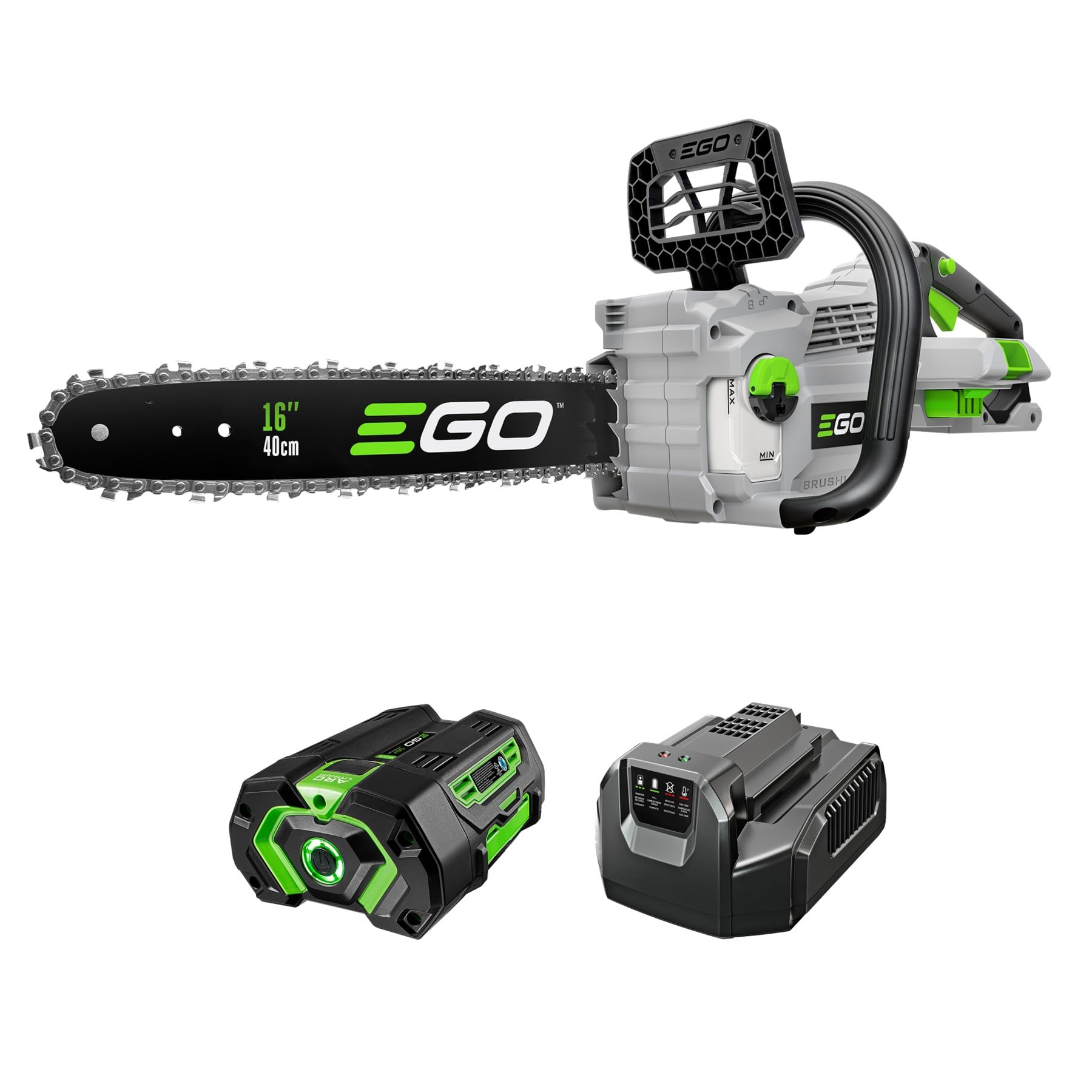
EGO Power+ CS1613 chainsaw
See on Amazon
Husqvarna 450 Rancher
See on Amazon
Greenworks 20312 40V 16 in. chainsaw
See on AmazonModel comparison
| Model | Price | Rating | Bar length | Weight | Power source | Best for | |
|---|---|---|---|---|---|---|---|
| | EGO Power+ CS1613 chainsaw | $299.00 as of 10/31 See on Amazon | ★ 4.7 (1,000+ ratings) | 16 in | 20.9 lb | not stated | Homeowners wanting one saw for limbing, cleanup and occasional small trees get a 16-inch bar, 40 cc gas equivalent and included 4.0 Ah battery. |
| | Husqvarna 450 Rancher | $499.99 as of 10/31 See on Amazon | ★ 4.5 (550+ ratings) | 20 in | 11.3 lb | Gas powered | Firewood cutters and larger-property owners needing runtime and displacement get a 50.2 cc engine, 20-inch bar and easy starting. |
| | Greenworks 20312 40V 16 in. chainsaw | $249.99 as of 10/31 See on Amazon | ★ 4.4 (6,100+ ratings) | 16 in | 10.4 lb | Battery powered | Budget-conscious battery buyers wanting a 16-inch bar get a brushless motor, Oregon bar and chain and a 4.0 Ah pack. |
 | Husqvarna 120 Mark III chainsaw | $219.99 as of 10/31 See on Amazon | ★ 4.4 (250+ ratings) | 14 in | 10.7 lb | Gas powered | Buyers wanting gas but working small get a 10.7-pound saw with a 38 cc engine and 14-inch bar for pruning and limbing. |
 | EGO Power+ CS2000 | $329.00 as of 10/31 See on Amazon | ★ 4.6 (150+ ratings) | 20 in | 12.7 lb | Battery powered | EGO platform owners and large-bar battery buyers get a 20-inch bar, 55 cc gas equivalent and 25 m/s chain speed. |
Pick the Saw That Matches Your Yard, Your Wood and Your Patience for Upkeep
The power source decides how the saw fits your property before any other spec matters. Each one suits a different job, and picking the wrong one is the mistake that makes a saw sit in the garage.
Gas, for volume and distance from an outlet
A gas saw runs as long as you keep refueling, and a refill takes minutes. That makes it the right tool for all-day firewood, large-diameter trunks, cold weather and a back lot with no power. You pay for it with fuel mix, a pull-start routine, exhaust and noise loud enough to annoy a neighborhood.
Battery, for the yard most people actually have
A battery saw starts with a button, makes no fumes and runs quiet enough for a suburb. The catch is runtime: the pack caps how much you cut before a break, and the big packs that buy runtime are heavy and costly. Performance also sags in cold, and the pack is the part that wears out. For occasional limbing and storm cleanup, none of that matters much, which is why most homeowners land on battery.
Corded, for work beside the house
A corded saw delivers real cutting power without a pack or an engine to carry, because the motor draws from the outlet. It is also tethered to an outlet through a 12 to 14 gauge extension cord, kept short and never daisy-chained. That rules it out for a back lot and suits a yard with an outdoor outlet and work near the house.
The crossover in plain terms
Occasional limbing and storm cleanup point to battery. Regular firewood and trunks past the mid-teens in diameter point to gas. Fixed work near power points to corded. One regulatory note for California buyers: new small off-road engine emissions rules are phasing out the sale of new gas saws in the smaller displacement band there, while saws already owned remain legal to use. That is pushing some of those buyers to battery now.
Sizing the Guide Bar to the Logs and Limbs You Actually Cut
Bar length sets the biggest log you can cut in one pass, and the working rule is simple: a saw cuts a log roughly two inches smaller than its bar in diameter, so match the bar to the wood you expect to cut. A 16-inch bar handles about a 14-inch log, an 18-inch bar about 16 inches, a 20-inch bar about 18 inches. The tip and the powerhead limit the pass, which is why the bar has to be longer than the wood.
Matching the bar to the job
- Around 14 inches for limbing and pruning, and for lighter, easier control.
- 16 inches as the homeowner all-rounder and the most common size, because firewood is cut to 16 inches.
- 18 to 20 inches for larger trunks and volume firewood, at the cost of weight and a bigger saw to handle.
A longer bar than the job needs is a downside, not an upgrade. It adds weight out front, more chain to drive and more kickback exposure, and it buys you nothing if your wood is small.
Power ratings, cc for gas, volts and amp-hours for battery, amps for corded
Each power source has its own honest measure, and reading the wrong number is how buyers end up disappointed.
Gas displacement
Displacement in cc is the real power figure. Homeowner saws sit in the 30s to 40s cc, and the farm-and-ranch class runs around 50 cc and up. Under roughly 62 cc is the consumer, non-professional band.
Battery voltage and amp-hours
Voltage is a rough proxy only. A high-voltage saw with a small pack can be weaker than a lower-voltage saw with a large one. Judge a battery saw by the pack it ships with in amp-hours, the chain speed it quotes and the cuts-per-charge figure, not the voltage badge alone.
Corded amps
Amps is the measure here, and a 15 A saw is a serious cutter.
Chain speed across all three
Chain speed in m/s or ft/s is the number that most directly tracks how fast the bar moves through wood, and it is worth comparing across any shortlist. A saw with a fast chain and a modest motor can outcut a slower one with more power on paper.
Weight and balance, the spec that decides whether you finish the job
Weight is usually quoted for the powerhead alone. Add the bar and chain, and on a battery saw add the pack, which can be a large share of the total. A saw that feels fine in the store can feel like a different tool after twenty minutes of cutting.
A heavier saw is harder to control in a kickback and tires your arms faster. Balance matters as much as the number: where the weight sits between the handles decides whether the saw feels planted or nose-heavy. Lighter saws suit limbing overhead and smaller or less strong users. A heavier saw only makes sense where the cutting volume justifies it.
Safety features that are non-negotiable on a homeowner saw
Chainsaw injuries send tens of thousands of people to US emergency rooms each year, and most involve the hands and legs. The safety kit on the saw and on your body is part of the purchase, not an add-on.
What the saw must have
- Chain brake, with a visible brake-position indicator so you can see at a glance that it is set.
- Trigger lockout, so the saw cannot start with your hand off the rear handle.
- Chain catcher, to catch a thrown or broken chain.
- Hand guard, between your front hand and the chain.
- Low-kickback chain, as fitted on consumer saws.
Kickback and the rules that matter
Kickback comes from tip contact, when the nose of the bar bites and throws the saw up and back. A brake and a low-kickback chain reduce the risk but do not remove it. Never cut above shoulder height or from a ladder, keep bystanders well clear when felling, and wear chaps, a helmet, eye and ear protection and boots.
Top-handle saws are not for ground work
A top-handle saw has one in-line handle and is built for in-tree and bucket work. It is harder to control in a kickback, and it is not the right saw for a homeowner working from the ground.
What the batteries and chargers will cost you over the years you own the saw
A battery saw is a commitment to a battery system. Packs and chargers are shared across that brand's tools, so the pack you already own can decide the saw you buy, and a second brand means a second set of packs and chargers.
Over several years, gas means fuel mix, bar oil and periodic servicing. Battery means bar oil plus eventual pack replacement, which is the big line item. The cheaper sticker is not always the cheaper option over time, so weigh the pack you will need against the fuel and servicing you would otherwise buy.
What You Will Need to Do to Keep Your Saw Cutting
Every saw needs chain tension checked, bar oil kept topped up, the chain sharpened when it stops self-feeding or starts throwing dust, and the bar flipped now and then for even wear. A tool-free tensioner is the convenience feature that matters most day to day.
Gas saws add the fuel routine: the correct mix ratio, and stabilizer or a drained tank for storage beyond a couple of months. Battery saws add pack care: store packs partially charged, cool and dry, and expect reduced output in cold. Sharpen when the saw stops pulling itself into the wood, and check tension and oil at every refuel.
Your First Cuts With a New Saw, From Cold Start to Clean Finish
A gas saw starts cold with the choke out and the chain brake set, then the choke goes in once it fires. A battery saw starts with a button and a trigger lockout, with no choke and no pull cord. Either way, set the brake, check the chain tension and confirm the bar oil before you cut.
For bucking a log on the ground, stand to the side of the cut line, not behind it, and let the saw's weight do the work. For felling, plan an escape route and keep bystanders clear. If a trunk is beyond your experience or leans toward a structure, call a professional rather than improvise.
Noise, vibration and the environment
Gas saws are loud enough to require hearing protection every time, and their vibration numbs hands over a long session. Battery and corded saws run quieter and smoother, which makes them easier to live with in a suburb and kinder to your hands. On emissions, a battery saw produces none at the point of use, while a gas saw does, which is the direction the regulations in some states are pushing.
Cutting techniques that keep you safe and your saw sharp
Buying the right saw is only half the job. The other half is knowing how to use it, because most chainsaw injuries come from technique errors, not from a weak motor. The CDC estimates about 36,000 chainsaw injuries land in US emergency rooms each year, and roughly 70 percent of them involve the hands and lower legs. The good news is that a handful of habits and two core cuts cover almost everything a homeowner does.
Set up before you pull the trigger
- Read the manual for your specific saw. Chain brake behavior, choke and primer sequences, and bar oil checks differ by model, so follow the manual for your saw.
- Check chain tension cold. With the saw off, the chain should lift only about its own height off the bar and snap back. A loose chain can derail; an over-tight one burns the bar and clutch.
- Fill the bar oil every time you fuel up. Never substitute used motor oil, which voids most warranties and throws off the oil pump.
- Dress for the job. Hard hat, eye and hearing protection, heavy gloves, boots that cover the ankle, and chaps that run from waist to the top of the foot. Practically every saw, electric included, exceeds the 85 dB hearing damage threshold.
- Clear your escape routes. Before any cut, pick two paths away from the trunk at roughly 45 degrees to the rear, and clear trip hazards along both.
Bucking, or cutting a log or felled tree into lengths
Bucking is the cut you will make most often, and it is where kickback and pinch happen. Work through these checks in order.
- Keep the wood off the ground. Roll the log so it rests on other logs or cribbing. Cutting into dirt dulls the chain in seconds and can throw grit.
- Stand uphill of the log and to one side of the cut line. Never straddle the log or stand directly behind the bar.
- Watch for compression and tension. A log supported at both ends compresses on top and pulls apart underneath, so your first cut goes from the top about a third of the way through, then you finish from below. A log supported at one end is the reverse: cut from below first, then finish from the top. Cutting the wrong side first pinches the bar.
- Keep the saw at waist level or below. The CDC names cutting above shoulder height as a leading cause of serious injury. If the log is too high, roll it down or leave it.
- Let the chain do the work. If you have to push, the chain is dull. A sharp chain self-feeds and throws chips, not dust.
- Shut off and set the saw down before you move logs or clear debris. Never walk with a running saw.
Felling, or bringing down a standing tree
Felling is the most dangerous cut you can make, and it is the one to skip if you are unsure. As a rule of thumb, do not fell anything over about 5 inches in diameter without proper training, and hire a pro for anything leaning toward a structure, dead or hollow, or within reach of power lines.
- Plan the fall line first. Check lean, crown weight, wind, and what the tree can snag on the way down. Clear bystanders to at least two tree lengths, and keep them there.
- Make the notch on the side you want it to fall. A top cut angled down at roughly 45 degrees meeting a flat bottom cut creates an open-faced notch about a quarter of the trunk deep. The hinge of wood left between the notch point and the back cut steers the tree.
- Cut the back cut level and slightly above the notch point, leaving a hinge roughly 10 percent of the trunk diameter. Never cut through the hinge.
- Use a wedge as soon as the back cut starts to close. It keeps the bar from pinching and gives you control over the direction of fall.
- Watch for spring poles and widowmakers. A bent sapling under tension can whip back at you, and a dead branch overhead can drop without warning. Clear both before you start.
- Move as soon as the tree commits. Retreat along one of your escape paths at an angle, not straight back, and keep your eyes on the falling trunk.
Limbing and the cuts to avoid
- Limb from the base of the trunk upward on a felled tree, keeping the trunk between you and the bar where possible. Cut limbs under tension from the outside in so they do not split and snap back.
- Never cut with the tip of the bar. The top quarter of the nose is the kickback zone, and contact there can throw the saw at you faster than you can react.
- Never cut one-handed, and never work from a ladder or above shoulder height. Bring the work down to you instead.
- Keep the chain brake engaged whenever you move between cuts, and release it only when the bar is positioned and you are ready to cut.
Keep the chain sharp and the saw ready
- Touch up the chain every time you refill fuel or swap a battery. Two or three strokes per cutter with the correct file size keeps the saw cutting straight and reduces kickback risk.
- Watch for the dull-chain signs: fine dust instead of chips, a cut that wanders, smoke, and having to push. Stop and sharpen.
- Flip the bar at each sharpening to even out wear, and clean the bar groove and oil holes.
- Store the saw properly. For gas saws, drain the tank or add stabilizer before long storage. For battery saws, store packs partially charged in a cool, dry spot, and never leave a pack on the charger indefinitely.
If you are new to any of this, practice bucking on a few downed logs before you attempt a felling cut, and consider a short safety course. The skills transfer directly, and they matter more than any spec on the box.
How to judge value beyond the sticker
Price is the easiest thing to compare and the worst way to judge a chainsaw. Two saws at the same sticker price can cost very different amounts over the years you own them once you add batteries, bar oil, chains, sharpening, fuel, and repairs. Here is how to think about what you actually get and where spending more pays off.
Look at total cost, not sticker price
Battery saws often sell as a bare tool, so add the cost of the battery and charger if you are not already on that platform. A spare battery can rival the price of the saw itself. Gas saws carry ongoing costs for fuel, bar oil, and two-stroke mix, plus tune-ups. Corded saws cost little to buy and run but need an outlet and an extension cord rated for the draw. Factor in replacement chains, a sharpening file or grinder, and eventually a new bar.
Where spending more actually pays off
- Antivibration and weight: Cheaper saws vibrate more and tire you faster, which matters most on long sessions.
- Chain tensioning: Tool-free or well-designed adjusters save time and frustration every time you refill.
- Parts availability: A saw you can get a bar, chain, and sprocket for locally is worth more than a slightly cheaper one you cannot service.
- Dealer and warranty support: A nearby shop that stocks parts and can service the saw beats a lower price with no support.
Where to save
- Skip features you will not use, like heated handles or elaborate electronics, unless you cut in cold weather or need them.
- Buy into a battery platform you already own tools for, so packs and chargers do double duty.
- Choose a bar length matched to your real cutting. A shorter bar is cheaper, lighter, and easier to control.
- Consider a refurbished or previous-model saw from a dealer with a warranty rather than paying full price for the newest version.
What to check before you buy
- Whether the price includes a battery and charger, or is bare tool only.
- The warranty length and what it covers, especially on batteries.
- Whether consumables like chains and bars are standard sizes you can buy anywhere.
- Return policy and whether local service is available.
- How well the saw holds up over years of use, not just how it looks on paper.
Our advice: buy the least expensive saw that meets your power, bar length, and weight needs from a brand with real parts and service support. That balance, not the lowest price, is what value means here.
Fuel and oil mixing for gas chainsaws
Gas chainsaws are two-stroke engines, which means they have no separate oil sump. The oil that lubricates the piston, cylinder and bearings has to travel in with the fuel. Get the mix wrong and you either starve the engine of lubrication or foul the spark plug and clog the exhaust. Both failures are avoidable, and both are expensive enough to justify a few minutes of care at the gas can.
Use two-stroke oil made for air-cooled engines
It must be formulated for air-cooled two-stroke engines, and the label should say so. Outboard oil and standard automotive oil are blended for water-cooled or four-stroke engines and do not hold up at the higher temperatures a chainsaw runs at. Look for a product that meets the JASO FD or ISO EGD standard, which are the current benchmarks for low-smoke, low-deposit two-stroke oil. Avoid any oil labeled for water-cooled use only.
Mix at the ratio your owner's manual sets
Most modern saws call for a 50:1 ratio, meaning 50 parts gasoline to 1 part oil. Some older or specific models ask for 40:1. Check your owner's manual rather than assuming, and do not split the difference between the two. A richer mix than specified does not add protection; it leaves carbon deposits, fouls the plug and can clog the spark arrestor. A leaner mix than specified starves the engine and can score the cylinder in minutes.
- 50:1 equals 2.6 fluid ounces of oil per gallon of gasoline.
- 40:1 equals 3.2 fluid ounces of oil per gallon of gasoline.
- For a 2 gallon can at 50:1, you need 5.2 fluid ounces of oil.
Measure the oil with the graduated bottle the oil comes in or a dedicated measuring cup. Guessing by eye is how engines get ruined. Add the oil to the can first, then pour in about half the gasoline, swirl to blend, and add the rest. Shake the can before every fill, because oil settles.
Start with fresh, ethanol-free gasoline when you can get it
Use regular unleaded with an octane rating of at least 89, and avoid gasoline with more than 10 percent ethanol. Ethanol attracts moisture and degrades rubber fuel lines, gaskets and carburetor parts, which is a common cause of hard starting and rough running on saws that sit between uses. Ethanol-free gasoline costs more but stores far better. Never mix more fuel than you will burn in about 30 days, and never use gasoline older than a few months.
Store mixed fuel correctly
- Keep it in a dedicated, clearly labeled fuel can approved for gasoline, never in a water bottle or an unmarked container.
- Store it away from heat, sparks and direct sun, and out of reach of children.
- If the saw will sit for a long stretch, either add a fuel stabilizer formulated for two-stroke mix or drain the tank and run the engine until it stalls so no fuel sits in the carburetor.
- Dispose of stale mix at a household hazardous waste facility. Do not pour it down a drain or onto the ground.
Fill the bar oil tank at the same time
Bar and chain oil is a separate system and never goes in the fuel tank. Refill it every time you refuel, and check that the oil is actually reaching the bar. A dry bar overheats, wears the groove and can throw the chain. Use purpose-made bar oil or, if the manual allows it, a clean tacky oil; never use drained motor oil, which can void a warranty and carries contaminants.
What to check before every tank
- Confirm the mix in the can is the ratio your manual specifies and that the can is labeled.
- Shake the can to re-blend the oil before pouring.
- Fill the fuel tank through a funnel with a filter to keep debris out.
- Top off the bar oil reservoir.
- Check chain tension and tighten if the chain sags off the bar.
- Wipe up spills and let fuel vapors clear before starting the engine.
If you are still deciding between power sources, keep in mind that fuel mixing is the one chore battery and corded saws do not ask of you. For readers who cut only a few times a season, that is a real argument for going electric. For heavy, all-day work, a gas saw with a correctly mixed can is still the tool that keeps running.
Getting Your Saw Home and Tucked Away Between Jobs
How you park a chainsaw between jobs matters as much as how you run it. Fuel left to sit, a loose chain, or a saw sliding around a truck bed can cost you a carburetor, a bar, or a trip to the emergency room. Check these before the saw goes into storage and before it rides in a vehicle.
Short-term storage between jobs
- Let the engine cool completely before you put the saw away. A hot muffler near dry grass, sawdust, or a plastic case is a fire risk.
- Release the chain brake and loosen the chain slightly if the saw will sit for weeks. A chain left tight under tension stretches and can kink the bar rails.
- Wipe down the bar, chain, and cooling fins. Packed sawdust around the cylinder and starter housing traps heat and shortens engine life.
- Top off the bar oil if the saw uses it. Never store a saw with an empty oil tank and a dry chain.
- Keep battery packs out of the saw. Store them cool and dry, away from direct sun, and at partial charge rather than full or empty.
Long-term storage and fuel
Gas saws are the fussy ones. Modern ethanol-blended fuel degrades in weeks, gums up carburetors, and can leave a saw hard to start or dead by spring. If the saw will sit for a long stretch, drain the tank and run the engine until it stalls so the carburetor empties. If you would rather keep fuel in it, add a fuel stabilizer at the ratio on the bottle and run the saw briefly so treated fuel reaches the carburetor. Store gas in a sealed, labeled container away from the house, and never inside a closed vehicle or a hot shed.
For any power source, store the saw in a dry place where temperatures stay above freezing and below extreme heat. A wall hook or shelf keeps the bar off concrete, which dulls a chain and rusts a bar. If you store it on a shelf, set it so the bar cannot fall and the chain cannot contact anything sharp.
Transporting a chainsaw safely
- Drain or shut off fuel before a long trip. A full tank sloshes, vents, and can flood the engine or leak into a vehicle.
- Fit a bar cover every time the saw leaves your property. A scabbard protects the chain from dirt and protects you and your cargo from the chain.
- Engage the chain brake and, on gas saws, close the fuel valve if the model has one.
- Lay the saw flat and secure it so it cannot slide, tip, or roll. In a truck bed, strap it down or wedge it against a solid load. In a trunk or SUV, keep it away from passengers and loose tools.
- Never carry a running saw, and never set a saw down on the ground with the engine running and the chain moving.
- Keep the saw out of the passenger cabin when you can. If it must ride inside, put it in a case or cover and keep the bar pointed away from people.
- Check local rules before you haul a gas saw across state lines or into areas with fuel restrictions. Some regions restrict small off-road engines, and rules vary by state.
What to check before the saw sits or ships
- Chain tension: it should lift only about its own height off the bar. Retension after the saw cools.
- Bar oil level and chain sharpness: a dull chain stored under tension is the one most likely to fail next season.
- Air filter and spark plug: clean or replace before storage so the saw starts clean in spring.
- Battery contacts: keep them dry and free of sawdust, and store the pack separately.
- Case or cover: a hard case or a fitted bar cover protects against a bent bar or a cut hand.
Do these checks and the saw will start when you need it, and it will not hurt you or your vehicle on the way to the job.
Our picks by budget
We pick the Husqvarna 120 Mark III chainsaw at this level for its 38 cc X-TORQ engine and 14-inch chain, which suit wood cutting and pruning. Air Injection and LowVib add durability and comfort, and the automatic oiler keeps you working.
We pick the EGO Power+ CS1613 chainsaw at this level because its brushless motor matches a 40CC gas chainsaw without fumes, and the included 4.0Ah battery supports up to 220 cuts on a 4x4. Tool-free tensioning and a 16-inch bar keep cuts clean.
We pick the Husqvarna 450 Rancher at this level because its 50.2 cc X-Torq engine and 3.2 hp deliver heavy-duty workhorse power for firewood and cleanups, with a 20-inch chain. Smart Start, air purge, LowVib and Air Injection ease starting and add comfort and engine protection.
Budget
Mid-range
High-end
Which chainsaw for which buyer
The right saw is the one whose bar, power source and weight match the work you actually do.
The suburban homeowner
Branches, storm debris and a few small trees are a 16-inch job. The EGO Power+ CS1613 starts with a button, makes no fumes, has a brake indicator and ships with the pack and charger.
The firewood cutter
Regular volume and larger trunks need runtime and displacement. The Husqvarna 450 Rancher brings 50.2 cc and a 20-inch bar to the work.
The gas buyer working small
If you want gas but your work is limbing and pruning, the Husqvarna 120 Mark III is light at 10.7 lb with a 14-inch bar and a 38 cc engine.
The large-bar battery buyer
The EGO Power+ CS2000 pairs a 20-inch bar with a 55 cc-equivalent motor and up to 25 m/s chain speed. It is a bare tool, so a platform owner is the natural buyer.
The value battery buyer
The Greenworks 20312 gives a 16-inch bar, a brushless motor, a 4.0 Ah pack, metal spikes, an automatic oiler and a safety brake, on a 40V platform shared with other tools.
Our verdict on the best chainsaw for 2026
The EGO Power+ CS1613 is the pick for most homeowners. It pairs a real 16-inch bar and a 40 cc-equivalent brushless motor with push-button starting, tool-free tensioning and a brake indicator, and the pack and charger come in the box. Step up to the Husqvarna 450 Rancher if the work is firewood and bigger trunks. Go to the Husqvarna 120 Mark III if gas on small work at low weight is the priority. The EGO Power+ CS2000 is the large-bar battery choice for someone already on the platform, and the Greenworks 20312 is the value battery route. If you are still torn, settle the power source first: battery for the yard, gas for the volume, corded for work beside the house.
Detailed model analysis
A saw that fits your wood and your arms beats a bigger one that wears you out before the job is done.
EGO Power+ CS1613 chainsaw
The EGO Power+ CS1613 suits homeowners who want one cordless saw for limbing, storm cleanup and small trees, without gas, fumes or a pull cord.
Its 16-inch bar fits that work. The brushless motor is quoted as the equal of a 40 cc gas saw, which gives plenty of punch for yard jobs.
The kit is ready to cut out of the box, with a 56V 4.0Ah ARC Lithium battery and a standard charger. The battery is good for up to 220 cuts on a 4x4.
Chain tensioning is tool-free, with independent dials, so you skip the wrench. The low-profile dials let the saw cut flush to the ground. Automatic oiling keeps the chain lubricated, and the chain runs at 20 m/s.
Safety gear includes a kickback brake with a brake position indicator, plus metal bucking spikes.
Know the limits. It weighs 20.9 lb and runs only on EGO Power+ 56V ARC Lithium batteries. The 16-inch bar suits limbing and small trees, so for thick firewood a larger saw fits better.
- Brand: Ego Power+
- Bar length: 16 in
- Voltage: 56 V
- Battery capacity: 4.0 Ah
- Chain speed: 20 m/s
- Weight: 20.9 lb
Husqvarna 450 Rancher
The Husqvarna 450 Rancher is a gas saw for people who cut a lot of wood. A 50.2 cc 2-cycle X-Torq engine drives a 20-inch bar and makes 3.2 hp.
Its engine is larger than the 38 cc of the Husqvarna 120 Mark III chainsaw. It suits firewood cutting, yard cleanups and tree pruning, and a gas engine does not depend on a charged battery.
Smart Start and an air purge make starting easier. LowVib technology reduces vibration, and the ergonomic rear handle gives you a better grip. Air Injection spins dust and debris out of the air before it reaches the filter.
It weighs 11.3 lb. You run it on fuel mixed with 2-stroke lubricant at 50:1, and fuel is not included. The oil tank holds 0.55 US pint.
The warranty is 2 years. It extends to 5 years when you buy 96 fl oz of pre-mixed fuel with select handheld products at purchase, so the extension is not automatic.
It suits firewood cutters and owners of larger properties who want a gas saw with a 20-inch bar.
- Brand: Husqvarna
- Engine displacement: 50.2 cc
- Power: 3.2 hp
- Bar length: 20 in
- Power source: Gas powered
- Weight: 11.3 lb
Greenworks 20312 40V 16 in. chainsaw
The Greenworks 20312 is a straightforward cordless saw with a brushless motor. You get no gas, no oil mixing and no pull cord.
It includes a 4.0Ah 40V lithium-ion battery, a charger and a manual, so you can start cutting once the pack is charged.
The 16-inch Oregon bar and chain handles the jobs Greenworks lists: limbing, pruning, firewood cutting, storm cleanup and tree felling. A safety chain brake, metal bucking spikes and an automatic oiler are included.
It weighs 10.4 lb. The 3 year warranty is a useful safety net for a tool you will use for storm cleanup.
If you own other tools in the G-MAX 40V system, the battery is compatible with 14 different lawn tools, which spreads one battery across your yard work.
The limit is that it needs a charged 40V battery to run. It suits homeowners wanting a simple cordless saw for limbing, pruning and firewood.
- Brand: Greenworks
- Bar length: 16 in
- Voltage: 40 V
- Battery capacity: 4.0 Ah
- Power source: Battery powered
- Weight: 10.4 lb
Husqvarna 120 Mark III chainsaw
The Husqvarna 120 Mark III is a gas saw for small jobs. Its 38 cc 2-cycle X-TORQ engine makes 1.88 hp and drives a 14-inch bar, made for wood cutting and tree pruning.
At 10.7 lb, it is a compact gas saw to carry around the yard. LowVib technology keeps it comfortable to use.
The X-TORQ engine is built for fuel efficiency and low emissions. Air Injection expels larger dust and debris before they reach the air filter, which improves engine life. An automatic oiler lubricates the chain for you.
A gas engine runs without a battery or charger, so you refuel and keep going. The 14-inch bar covers limbs and small stock.
Limits: it is gas powered only, with no battery or electric option. Fuel is bought separately, since it comes as the saw alone. For thicker logs you need more bar.
We think it suits buyers wanting a gas saw for pruning and limbing.
- Brand: Husqvarna
- Power source: Gas powered
- Engine displacement: 38 cc
- Bar length: 14 in
- Power: 1.88 hp
- Weight: 10.7 lb
EGO Power+ CS2000
The EGO Power+ is a battery saw with a 20-inch bar and power quoted as equal to a 55 cc gas saw. It is designed for large branches, stumps and tall trees, without engine noise or fumes.
The brushless motor drives the chain at up to 25 m/s. With the recommended 6.0Ah ARC Lithium battery, sold separately, it makes up to 230 cuts on a 4x4.
A digital display shows the speed select mode and the battery charge. An LED work light at the front lights your cut at dusk.
An omnidirectional auto chain brake sensor stops the chain from a variety of tool orientations, as a complement to the kickback brake. It weighs 12.7 lb.
The big catch: it is a bare tool. The battery and charger are not included, so you must buy an EGO Power+ 56V ARC Lithium battery and a charger before cutting.
It suits EGO Power+ owners who already have batteries, and anyone who wants a 20-inch battery saw.
- Brand: Ego Power+
- Bar length: 20 in
- Power source: Battery powered
- Weight: 12.7 lb
- Dimensions: 39.76 in long, 11.22 in wide and 12.6 in high
- Included: Bare tool, battery and charger not included
Frequently asked questions
Most chainsaw questions come down to matching the saw to the wood and the site, and to the safety habits that keep the work boring.
Gas or battery chainsaw, which is better for a homeowner?
Battery for most. Push-button start, no fumes, quiet enough for a neighborhood, and a 16-inch bar covers typical limbing and cleanup. Gas wins when the work is volume firewood, larger trunks, cold weather or a site with no power.
How much does a chainsaw's weight go up once the bar, chain and battery are on it?
Published weights usually cover the powerhead alone, so the figure on the box is not what you lift. The bar and chain add to it, and on a battery saw the pack adds again, and that pack can account for a large share of the finished weight. Judge a saw by the total you will actually carry, not the bare powerhead number.
Do you need a corded chainsaw?
Only for work within reach of an outlet. The saw itself is light for its power because the motor carries no pack and no fuel tank, but the cord rules out anything past the reach of that outlet, so measure the run from the outlet to your farthest cut before you commit.
Are gas chainsaws being banned?
In California, the state's small off-road engine rules end the sale of new gas-powered equipment in the smallest engine band, so a new gas saw there means a larger displacement model. A saw you already own stays legal to run, and every other state still sells gas saws freely.
Can a beginner use a chainsaw?
Yes, provided the saw has a chain brake, a trigger lockout and a low-kickback chain, and you wear leg, head, eye, ear and foot protection every time. Keep the bar below shoulder height, never work from a ladder, and practice on downed logs before your first felling cut.
Should you buy a top-handle saw?
No, for ground work. It is built for climbing and bucket work, and a homeowner cutting from the ground should choose a rear-handle saw with a chain brake, a trigger lockout and a low-kickback chain.
What maintenance does a gas saw need that a battery saw doesn't?
A gas saw needs a fuel mix at the ratio in its manual, a spark plug checked when it runs rough, and a carburetor that stays in tune. A battery saw needs bar oil and chain care, and its pack stored partially charged, cool and dry.