
Best Corded Electric Pole Saw 2026: Unlimited Runtime Near an Outlet
When you buy through the Amazon links on this page, we may earn a commission at no extra cost to you. Learn more
Last updated October 31, 2026
The Sun Joe SWJ803E is the best corded electric pole saw for most US yards: an 8 A motor, a 10-inch Oregon bar and chain, a telescoping pole to 8 ft with up to 14 ft of overhead reach, and a multi-angle head that gets at awkward branches. It runs as long as the job takes, with no pack to charge and no fuel to mix.
If your branches are small and your budget is tight, the WEN 4019 does the light work; if you want a pole saw and a handheld chainsaw in one box, the DEKOPRO DKTR is the pick.
The best corded electric pole saws of 2026
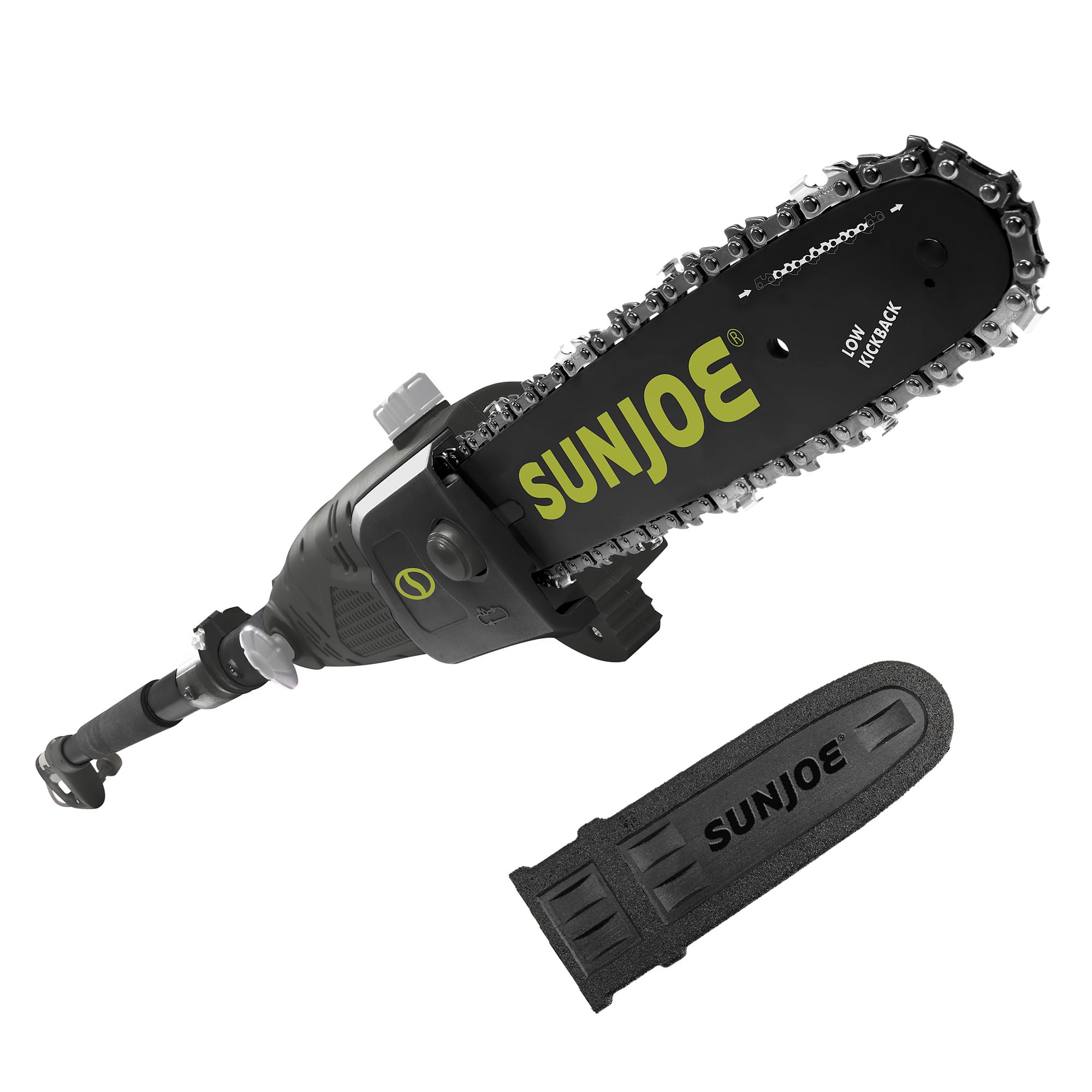
Sun Joe SWJ803E pole saw
See on Amazon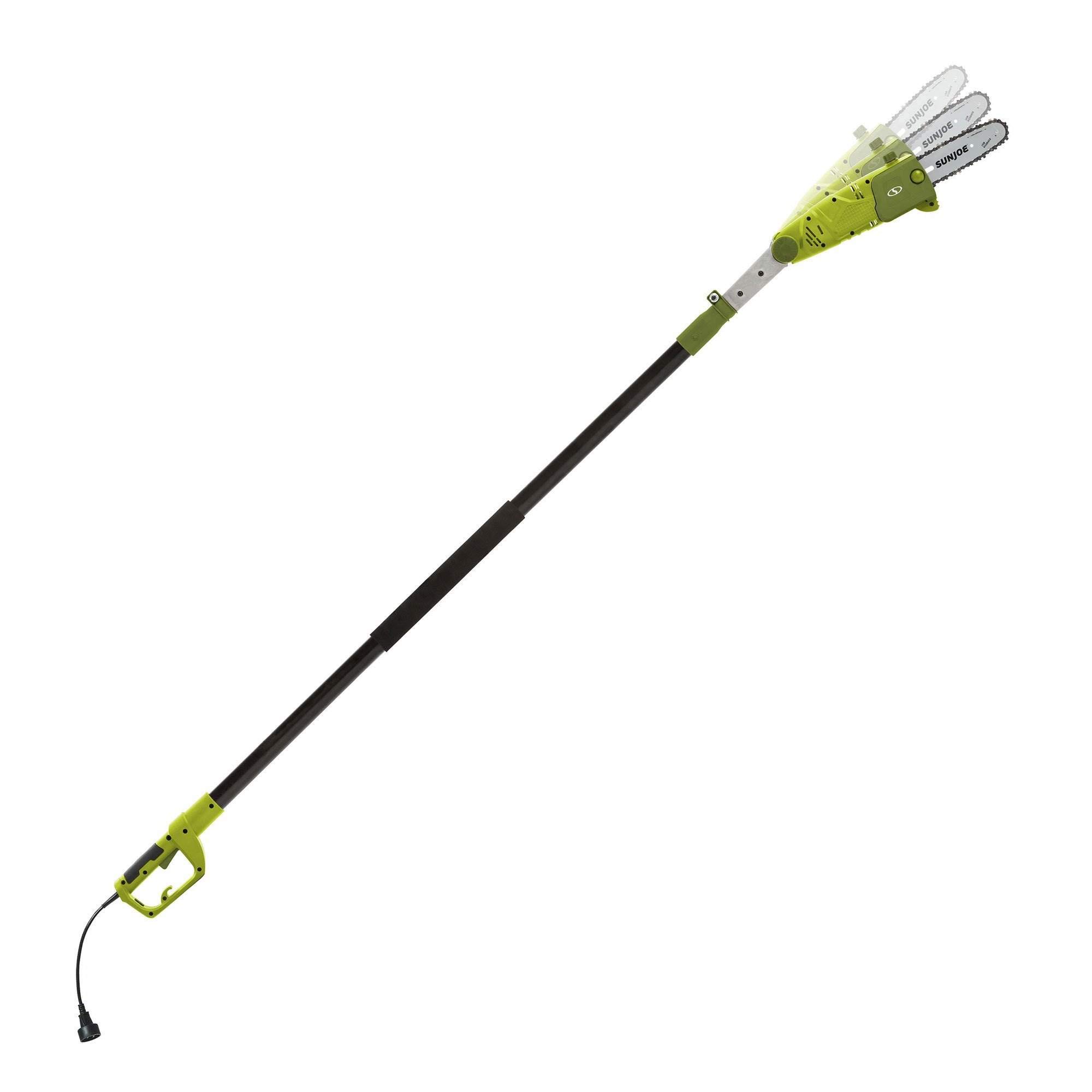
Sun Joe SWJ802E pole chain saw
See on Amazon
Scotts PS45010S pole saw
See on AmazonModel comparison
| Model | Price | Rating | Power source | Bar length | Motor current | Best for | |
|---|---|---|---|---|---|---|---|
| | Sun Joe SWJ803E pole saw | $114.99 as of 10/31 See on Amazon | ★ 4.5 (9,600+ ratings) | Corded electric | 10 in | 8 A | Buyers with an outdoor outlet and real limbs to cut get cutting capacity and an adjustable head without a battery to charge or replace. |
| | Sun Joe SWJ802E pole chain saw | $109.99 as of 10/31 See on Amazon | ★ 4.5 (3,000+ ratings) | Corded electric | not stated | 6.5 A | Corded buyers with an outlet close by and thinner branches get a lighter saw that is easier to hold up. |
| | Scotts PS45010S pole saw | Price not shown See on Amazon | ★ 4.2 (3,200+ ratings) | Corded electric | 10 in | 8 A | Warranty-led buyers and owners who tension the chain often get a 3-year limited warranty and a tool-free tensioner. |
 | WEN 4019 pole saw | $56.00 as of 10/31 See on Amazon | ★ 4.2 (4,000+ ratings) | Corded electric | 8 in | 6 A | Light-duty gardeners with small yards and small branches get the lightest 6.7-pound saw with a shoulder strap. |
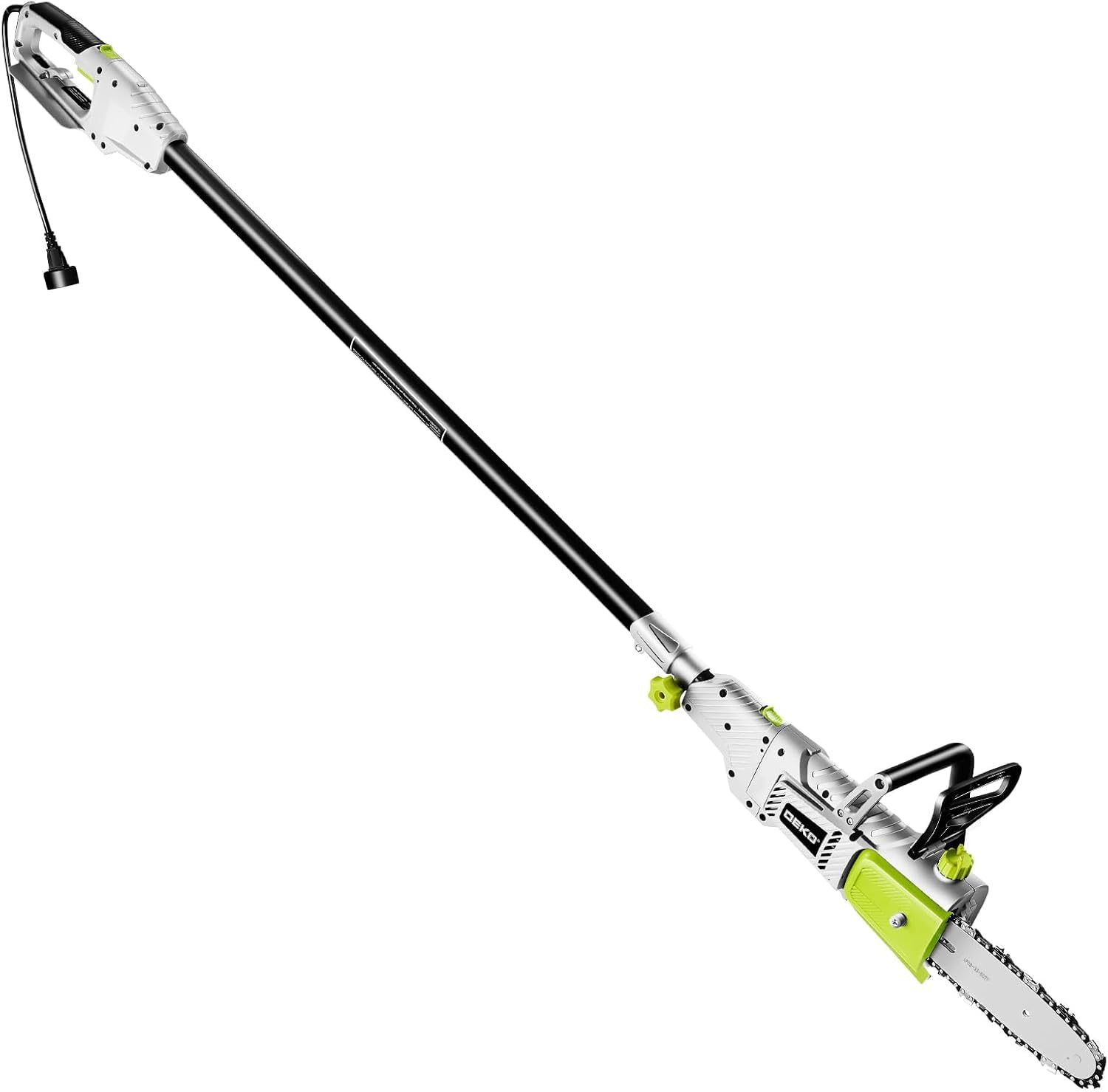 | DEKOPRO DKTR | $99.99 as of 10/31 See on Amazon | ★ 4.4 (150+ ratings) | Corded electric | 10 in | not stated | Two-tools-in-one buyers who want a pole saw and a small chainsaw get a detachable 8-Amp, 10-inch head. |
How the motor at the bottom of the pole drives the chain at the top
The mains cord enters at the rear handle, passes through a strain-relief collar or cord hook, runs up or alongside the telescoping shaft, and ends at the motor mounted directly behind the bar at the cutting head. There is no battery and no fuel tank. The motor sits at the far end of a lever arm, which is why corded heads are the lightest in the class.
The consequence is that the saw's working radius is set by the cord, not the motor. The tool ships with no extension cord. The reach from the outlet is the length of the saw's own short pigtail plus whatever extension cord you supply, minus slack. A 50 ft cord does not give 50 ft of working radius. It gives roughly 45 ft once you allow for routing around obstacles, a loop at the handle and slack at the foot of the tree.
The motor's amperage draw is fixed, so what you control is how much voltage arrives at the head. That is a cord question, and it is the one that decides whether the saw cuts cleanly or bogs.
Choosing an outdoor extension cord for a pole saw
Corded pole saws in this class draw 6 to 8 amps at 120 V. The cord must be outdoor-rated, three-conductor with a ground, and sized so voltage drop stays acceptable over the run. Match the gauge to the amps and the distance.
| Saw draw | Up to 25 ft | 25 to 50 ft | 50 to 100 ft | 100 to 150 ft |
|---|---|---|---|---|
| 6 A | 18 AWG | 16 AWG | 16 AWG | 14 AWG |
| 7 to 8 A | 16 AWG | 16 AWG | 14 AWG | 12 AWG |
A thin cord has more resistance, so on a long run the voltage at the motor sags. The motor draws more current to compensate, it heats up, it bogs in the cut, and it can trip the breaker. A 16 AWG household cord that is fine for a hedge trimmer 10 ft from the door is not fine for an 8 A saw 80 ft away.
Note that 12 AWG cord is heavy and stiff and drags on the pole. That is a real argument for siting the work near the outlet rather than buying a longer cord. Some manuals cap the maximum cord length outright, commonly at 100 ft, so follow the figure in your saw's own manual where it gives one. A cord with a worn or cracked jacket, or a plug that pulls out under load, is a fire and shock risk. Replace it, do not tape it.
Working Overhead Without Letting the Cord Catch on Branches
- Strain relief at the handle. Loop the extension cord through the saw's cord hook or restraint, or tie a loose half-hitch around the handle, so a tug on the cord pulls the knot, not the plug.
- Route it behind you, never across the drop zone. The cord should trail back from your hip toward the outlet, on the side away from where branches will fall.
- Plan the slack. Coil the surplus at the base of the tree or at the outlet, not in a pile at your feet where you will step on it or the chain will find it. A corded saw can cut its own cord, so keep the cord out of the plane of the bar.
- Move the cord, then move yourself. When working around a tree, walk the cord around rather than dragging it through the work area.
- Never let the cord cross a ladder, a roof edge or a wet patch. If the work needs a ladder, the work does not need a ladder.
- Unplug before any adjustment. Tensioning the chain, refilling oil, clearing a jam, changing the bar: pull the plug first.
What a corded pole saw can and cannot reach
The real maximum cutting height comes from shaft length, bar length and cord reach, and the three are rarely the same number.
Shaft length is the pole's extended length, measured from the handle to the head. This is the honest figure to compare between saws. Bar length is the cutting width. The bar should be at least 2 inches longer than the branch diameter to avoid the tip grabbing and kicking back, so a 10-inch bar is realistically an 8-inch branch and an 8-inch bar a 6-inch branch. Manufacturer maximum-branch figures are optimistic; treat them as a ceiling, not a target. Cord reach is the distance from the outlet, as covered above.
Then add the operator. A person holding the pole at chest height with arms raised adds roughly 2 to 3 ft of working height. So a saw with a 9 ft pole, held by a 5 ft 10 in operator, reaches branches at roughly 12 to 14 ft. That is not the 15 ft overhead reach some listings quote, which assumes a fully extended pole held at an angle and measured to the tip of the bar rather than to the cut. Compare pole length to pole length, and discount any reach figure that does not state its basis.
A corded saw stops being the right tool above roughly 14 to 15 ft, for anything that requires you to leave the ground, for work more than about 100 ft from an outlet, and for branches over about 8 inches in diameter. At that point the job needs a different tool or a professional.
Why a corded pole saw never needs charging or refuelling
Runtime is limited only by the outlet and the cord. There is no pack to run flat mid-limb, no spare battery to buy, no charger to wait on, no fuel to mix, no pull-start, no exhaust and no carburetor. The saw starts on the trigger and runs for as long as the job takes, whether that is a full Saturday of dormant pruning, a hedge line or a storm clean-up. The work pauses only to refill the bar oil tank and check chain tension.
A battery pole saw runs for a bounded number of cuts per pack and then needs a charge or a swap, and the pack degrades over years and is expensive to replace. A gas pole saw runs as long as the tank but needs fuel, mixing, a starting procedure, exhaust and more maintenance, and it is heavier at the head. The corded saw trades all of that for a cord. For a homeowner whose trees are within cord's reach of an outdoor outlet, that is a good trade, and it is the reason this category still exists.
Using a corded pole saw safely around water and wet ground
A corded pole saw is an outdoor power tool connected to mains electricity by a cord you are holding. That is the whole risk, and it is manageable.
- GFCI protection is not optional. Plug into a GFCI-protected outdoor receptacle, or use a portable in-line GFCI adapter at the outlet end of the cord. A GFCI cuts power when current leaks to earth, which is exactly what happens if the cord or the tool gets wet and you become the path.
- Keep connections off the ground. The joint between the saw's pigtail and the extension cord should hang free or be raised on a hook, not lie in wet grass or a puddle. Use a cord with a molded water-resistant connector where possible.
- Never cut in rain, snow or on wet ground with wet hands. Most manuals prohibit wet use outright. Damp grass is a reason to wait, not to be brave.
- Inspect the cord before every use for cuts, cracks, crushed spots and a loose plug. Replace, do not repair.
- Wear the right gear. Safety glasses to Z87.1, a hard hat rated for falling objects, hearing protection, gloves, close-fitting clothing and non-slip boots. Keep bystanders and pets well clear of the drop zone.
- Never work from a ladder, a roof or in the tree. Pole saws are designed to be used with both feet on the ground, and ladder falls are a leading cause of serious injury in this kind of work. If the branch cannot be reached from the ground, it is a job for a different tool or a professional.
- Stay clear of power lines. The saw is not insulated. The safe distance is measured in tens of feet, not inches, and you should never cut a branch that is touching or near a line.
Our picks by budget
The WEN 4019 is our budget pick because it puts a light 6 A saw with a shoulder strap and scabbard in your hands for small limbs and hedge-line tidying, with nothing you do not need.
The DEKOPRO DKTR is our mid-range pick because the extra money buys an 8 A motor, a 10-inch bar and a detachable head that turns the pole saw into a handheld chainsaw.
The Sun Joe SWJ803E is our premium pick because the premium goes into reach and features, not a bigger motor: the 8 ft pole, the multi-angle head and the Oregon bar and chain are what you are paying for.
Budget
Mid-range
High-end
Which corded pole saw fits your yard
The distance from your outlet to the farthest tree decides more about the right saw than any spec on the box.
The long-reach pruner
Mature trees, branches at 12 to 14 ft, awkward angles, and a tool you will use for years. The 8 ft telescoping pole, multi-angle head and Oregon bar are the reasons.
The light-duty gardener
A small yard, a few shrubs and small trees, branches under 6 inches, and a saw that stores in a shed. It is light, simple and does the job.
The two-tools-in-one buyer
You want a pole saw for the high branches and a small chainsaw for limbing and firewood on the ground, and would rather buy one tool than two. The detachable head is the whole point.
The warranty-led buyer
You want a known name, a 3-year warranty and a tool-free chain tensioner. The 10-inch Oregon bar and the oil level window are the bonuses.
The weight-conscious pruner
You want the angled-head design and a long pole but do not need a 10-inch bar. The 9 ft pole and 7.9 lb weight suit longer sessions at height.
Our verdict on the best corded electric pole saw
The corded electric pole saw is the right tool for a specific, common situation: an outdoor outlet within reach of the trees, branches under about 8 inches, work done from the ground, and a preference for unlimited runtime, light head weight and no battery to replace. For that buyer, the Sun Joe SWJ803E is the best all-round pick, with its 8 A motor, 10-inch Oregon bar, 8 ft telescoping pole, multi-angle head, automatic oiling and 2-year warranty.
The WEN 4019 is the value pick for light work, the DEKOPRO DKTR is the pick for someone who wants a pole saw and a handheld chainsaw in one box, the Scotts PS45010S is the pick for warranty and bar length, and the Sun Joe SWJ802E is the pick for a slightly lighter saw with a 9 ft pole. If the trees are more than about 100 ft from an outlet, if the ground is wet, or if the branches are over 8 inches, a corded pole saw is the wrong tool.
Detailed model analysis
Reach, bar length and head design separate these saws far more than motor size, since every one of them tops out at 8 A or less.
Sun Joe SWJ803E pole saw
The Sun Joe SWJ803E is a corded pole saw for jobs near an outlet. You plug in and cut as long as the job takes, with no battery to charge or fuel to mix.
Its 8 A motor drives a 10 in Oregon bar and chain. The pole telescopes up to 8 ft, for up to 14 ft of overhead reach, so you stay on the ground and skip the ladder.
The recommended maximum branch thickness is 8.5 in, so you can take on real limbs, not only twigs and shrubs.
The multi-angle cutting head lets you reposition the blade for tight or awkward spots. An automatic oiling system keeps the chain lubricated over longer sessions.
The main limit is weight at about 10 lb (4.55 kg), held up at the end of a pole. You also need an outlet within cord reach of the tree, so plan your extension cord route.
It suits homeowners with an outdoor outlet and thick limbs who want an adjustable head and no battery. It includes a 2-year warranty and a cutting bar sheath for storage.
- Brand: Sun Joe
- Bar length: 10 in
- Power source: Corded electric
- Motor current: 8 A
- Weight: 4.55 kg
- Overall length: 63.25 in
Sun Joe SWJ802E pole chain saw
The Sun Joe SWJ802E pole chain saw is a corded choice for thinner branches. It plugs into an outlet, so you have no battery to swap and no fuel to buy.
Its 6.5 A motor drives an 8 in Oregon bar and chain. The shorter bar fits smaller cuts better.
It weighs 7.9 lb, which means less strain when you hold the head up over your shoulders. The adjustable head changes the cutting angle for awkward branches, and it is sold as a 9 ft pole saw.
Because it is corded, runtime never limits the job as long as the cord reaches. A cutting bar sheath and a dual-tipped hex key wrench/blade screwdriver come with it, and the warranty runs 2 years.
The limits are clear. The 8 in bar and 6.5 A motor are a poor match for thick limbs, and you need an outlet close to the tree, since it is corded only with no battery option.
It suits corded buyers with an outlet close by who want a lighter saw that is easier to hold up for thinner branches.
- Brand: Sun Joe
- Power source: Corded electric
- Motor current: 6.5 A
- Bar and chain length: 8 in
- Weight: 7.9 lb
- Dimensions: 6 in long, 4 in wide and 73 in high
Scotts PS45010S pole saw
The Scotts PS45010S pole saw carries a 3 years, limited warranty. The others here carry 1 or 2 years.
Its 8 A motor is rated at 960 W and drives a 10 in Oregon bar and chain. The head adjusts to 5 angles, with a 30 degree cutting angle.
The tool-free chain tensioner lets you tighten the chain without hunting for a wrench. The automatic oiling system has an oil level window, so you can see when it needs a refill.
It weighs 7 lb, close to the WEN 4019 pole saw at 7.2 lb and well under the Sun Joe SWJ803E pole saw at about 10 lb. Runtime is unlimited as long as the cord reaches.
It is corded only, so you need an outlet, and it is a long tool, so plan storage space. It suits warranty-led buyers and owners who tension the chain often.
- Brand: Scotts
- Bar length: 10 in
- Power source: Corded electric
- Motor current: 8 A
- Extended length: 9 ft 3 in
- Weight: 7 lb
WEN 4019 pole saw
The WEN 4019 pole saw handles light pruning near an outlet. Its 6 A motor runs an 8 in chain at 36 ft per second, and the cord means no battery to charge.
The pole telescopes from 5.3 ft to 7.3 ft, set short for low branches and longer for higher ones. The saw weighs 7.2 lb, and a shoulder strap helps you carry it.
Blade changes and chain tensioning are tool-free, and an automatic oiling system keeps the chain lubricated. An ambidextrous built-in safety switch suits right or left hand.
A scabbard protects the chain and bar in storage. It is a long tool, so plan storage space for it. The warranty runs 2 years.
The 6 A motor has the lowest current rating of the saws we compare, below the 6.5 A of the Sun Joe SWJ802E pole chain saw and the 8 A of three others.
The 8 in chain keeps it to small branches, and the 7.3 ft pole is short of the 8 ft pole on the Sun Joe SWJ803E pole saw. It suits light-duty gardeners with small yards.
- Brand: Wen
- Power source: Corded electric
- Motor current: 6 A
- Bar length: 8 in
- Chain speed: 36 ft/s
- Weight: 7.2 lb
DEKOPRO DKTR
The DEKOPRO DKTR is a 2-in-1 saw. You use it on the pole for high branches, then detach it and run it as a ground-level chainsaw.
Its 8 A pure copper motor turns a 10 in bar and chain at up to 6500 rpm. The extension pole gives up to 10 ft of reach and attaches without tools.
A dual-button start system means you press two buttons at once to run the saw, which adds a safety step.
Corded power means unlimited runtime near an outlet, with no fuel and no battery pack to buy. Support promises a response within 24 hours.
The main limits are the 1-year warranty and that it is corded only, so you need an outlet within cord reach of where you work.
We see it suiting buyers who want a pole saw and a chainsaw in one tool, for high limbs and for firewood or logs on the ground.
- Brand: Dekopro
- Power source: Corded electric
- Amperage: 8 A
- Bar length: 10 in
- Speed: 6500 rpm
- Maximum reach: 10 ft
Frequently asked questions
Extension cord gauge and GFCI protection are the two answers that most often decide whether a corded pole saw works well or disappoints.
How much working radius does a 50 ft cord actually give me?
A 50 ft cord gives you roughly 45 ft of usable working radius, not 50 ft. The difference goes to the saw's own short pigtail, the loop at the handle and the slack you leave at the foot of the tree, plus any routing around obstacles. Plan your cutting positions around that shorter figure so you are not stretching the cord to reach the last branch.
What gauge extension cord do I need?
16 AWG covers a 6 A saw up to 50 ft, 14 AWG covers an 8 A saw up to 100 ft, and 12 AWG is the minimum beyond that. A thin household cord on a long run causes voltage drop, overheating and bogging.
Do I need a GFCI outlet?
Yes. It is the main protection against shock if the cord or tool gets wet, and it is required wherever the outlet is outdoors or near damp ground.
Can I use a corded pole saw in the rain?
No. Most manuals prohibit wet use, and wet ground plus a mains cord is the exact combination a GFCI exists to protect against. Wait for dry weather.