Best Lightweight Pole Saw 2026: Long Overhead Reach Without Arm Fatigue
When you buy through the Amazon links on this page, we may earn a commission at no extra cost to you. Learn more
Last updated October 31, 2026
The lightest pole saw on this page is the Black+Decker LPP120B at 6.3 pounds as a bare tool, with a center extension that gives 6.5 ft or 10 ft of usable length and up to 14 ft of overhead reach. That low quoted weight and long reach are exactly what an overhead job asks for, but the figure excludes the battery, so the ready-to-cut weight depends on which 20V MAX pack you fit.
If you have no outlet within reach, the Seesii P6 Plus at 6.5 pounds converts from handheld to pole saw without tools and runs on two supplied batteries. The WEN 4019 is the corded option at 6.7 pounds, and the Ryobi P4360 at 7.4 pounds is the bare tool for anyone already in the ONE+ system.
The best lightweight pole saws for 2026

Black+Decker LPP120B pole saw
See on Amazon
Seesii P6 Plus
See on Amazon
WEN 4019 pole saw
See on AmazonModel comparison
| Model | Price | Rating | Weight | Bar length | Power source | Best for | |
|---|---|---|---|---|---|---|---|
| | Black+Decker LPP120B pole saw | $99.00 as of 10/31 See on Amazon | ★ 4.5 (3,400+ ratings) | 6.3 lb | 8 in | not stated | Existing 20V MAX owners with thin limbs and light pruning get a cheap powered pole saw that runs on batteries they already own. |
| | Seesii P6 Plus | $89.98 as of 10/31 See on Amazon | ★ 4.4 (5,700+ ratings) | 6.5 lb | 6 in | Battery powered | Homeowners trimming low branches and overhead limbs want one 6.5-pound tool that converts from handheld saw to pole saw without tools. |
| | WEN 4019 pole saw | $56.00 as of 10/31 See on Amazon | ★ 4.2 (4,000+ ratings) | 7.2 lb | 8 in | Corded electric | Light-duty gardeners with small yards and small branches get the lightest 6.7-pound saw with a shoulder strap. |
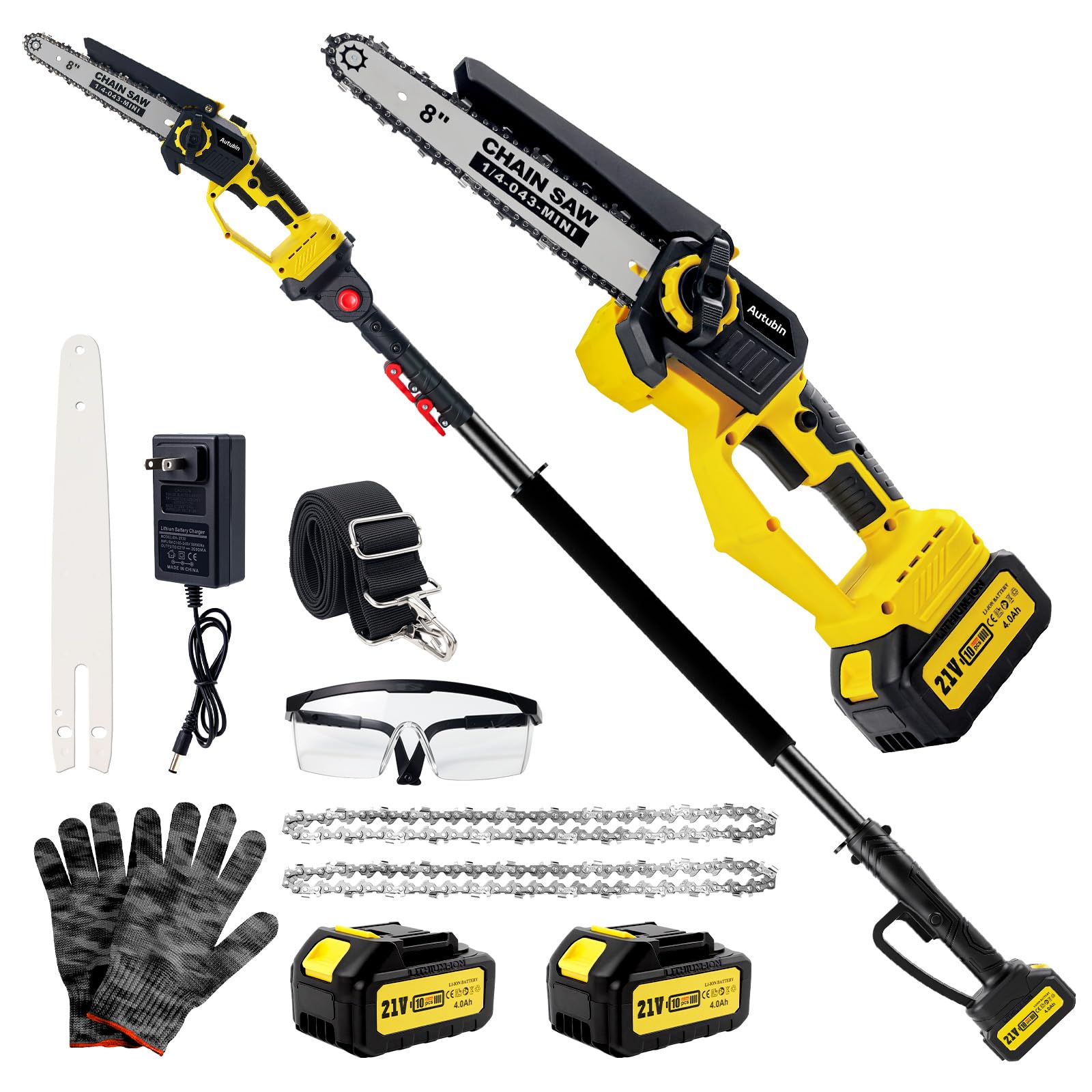 | Autubin GZJ-N2-GJ pole saw | $109.99 as of 10/31 See on Amazon | ★ 4.3 (750+ ratings) | 6.9 lb | not stated | Battery powered | Gardeners with taller trees want a brushless 2-in-1 saw reaching 16 ft with 100 minutes of cutting per charge. |
 | Ryobi P4360 pole saw | $164.49 as of 10/31 See on Amazon | ★ 4.4 (750+ ratings) | 7.4 lb | 8 in | Battery powered | Ryobi ONE+ owners adding a bare 8-inch pole saw want to share existing 18V batteries across their tools. |
How pole saw weight is measured and why the number on the box misleads
A quoted pole saw weight can mean several different things, and the word that follows the number tells you which. Bare tool or powerhead only means the saw without its battery. With battery means the pack is fitted. Dry on a gas saw often means without bar, chain, fuel and bar oil. Excluding cutting equipment means the bar and chain are left out. Net weight and product weight are the vaguest of all, and on some retail listings product weight is the shipping weight.
The practical consequence is simple: a saw quoted at a low figure without its battery can end up heavier in the hands than a saw quoted higher with everything fitted. A bare-tool figure and a ready-to-cut figure are not comparable.
A ready-to-cut figure includes the tool, the bar and the chain, plus the power source. On a battery saw that means the pack. On a corded saw it means the tool, bar and chain, plus the cord you are now dragging. On a gas saw it means the tool, bar, chain, fuel and bar oil.
Before comparing two saws, put both numbers on the same footing: bare against bare, ready against ready. If a listing does not say what the weight includes, treat the number as indicative only.
Bar and chain length change the figure too. A longer bar and chain add weight at the far end, so two versions of the same saw with different bars are not the same weight.
Where the weight sits along the pole and how that changes the effort you feel
The load your forward hand resists is the weight multiplied by its distance from that hand. A small mass far out on the pole loads the arm like a much larger mass close in. That is why a pole saw that weighs little on a scale can feel heavy after a minute overhead.
Total weight and balance are separate properties. A saw with its motor and battery mass near the grip and only the bar and chain out at the head can feel easier to hold than a lighter saw with its mass concentrated at the cutting head. A well-balanced saw often feels lighter in use than a lighter, poorly balanced one.
Posture adds its own load. Overhead work forces the neck back and loads the shoulders and upper back, so fatigue arrives in the neck and shoulders before the arms. Short sessions and a comfortable working angle matter as much as the number on the box.
- A shoulder strap or harness takes some of the load off the arms.
- Keep the hands below shoulder height where the manual allows.
- Extend the pole only as far as the branch requires.
- Take breaks before your arms tire.
- Choose a saw whose balance point sits closer to your body.
Reach versus weight trade-offs when you extend the pole
Pole length and working height are not the same thing. Working height is roughly the pole length plus your reach, so a saw advertised with a long reach does not necessarily have a long pole. Advertised reach figures often include the operator's height.
Extending the pole does not change the scale weight, but it does change the load. The same saw at full extension asks more of your arms than the same saw collapsed, because the mass has moved further from your hands. Every extra section of pole you deploy is extra length you are holding overhead.
Deploy the shortest extension that still clears the branch, cut, then collapse the pole before moving. Do not walk around with the pole fully extended.
- Fixed-length poles are the simplest and stiffest, with no adjustment.
- Sectional or center-extension poles slide a middle section out, so length is adjustable but the joint is a flex point.
- Telescoping poles are the most adjustable and flex the most at full extension.
More extension usually means more flex as well as more load. A longer bar adds reach at the head but also adds mass at the worst place for it, and a longer bar is not the same as a longer pole. Some saws accept an extension pole as an accessory, which adds reach without changing the saw, but it adds load at the handle end in exactly the way described above.
Battery and powerhead choices that keep overhead load down
A bigger battery pack gives more cuts per charge but adds mass, and where that mass sits matters. On most battery pole saws the battery sits at the base of the pole near the grip, which is the better place for it. On a few designs it sits further out.
A brushless motor is generally more efficient and can be built lighter for the same output than a brushed motor, which matters when the motor is in the cutting head. A motor in the head puts its mass at the far end. A motor at the base keeps it closer to the hands.
The power source changes the weight in predictable ways:
- Corded electric has no battery and no fuel, so it is usually the lightest powered option on the scale. You are tethered to an outlet and dragging a cord, and the cord must be kept clear of the cut.
- Battery is heavier than corded once the pack is fitted, but free of the cord and usually the best balance of weight and convenience for a homeowner.
- Gas is the heaviest class once fuel and bar oil are in, with the longest runtime and no cord. The weight penalty is the price of unlimited cutting.
- A mini chainsaw on a pole is the lightest powered configuration of all, because the saw is small and the pole is short. The trade-off is a short bar and limited reach.
If you already own batteries in a given system, buying the bare tool avoids paying for a pack you do not need and lets you choose a smaller, lighter pack for overhead work if the system offers one.
Runtime is only meaningful with the branch size it was measured on. A small pack that gives plenty of cuts on thin branches may give very few on thick ones.
Where a featherweight pole saw stops making sense for your trees
The bar should be at least a couple of inches longer than the branch diameter, so an 8-inch bar suits roughly 6-inch limbs and a 10-inch bar roughly 8-inch limbs. A light saw with a short bar is the wrong tool for limbs above its stated maximum cutting diameter.
Lighter saws generally cut more slowly, and a slow cut means the head is held overhead for longer. On thick or numerous branches that can cancel out the weight advantage. On a big limb, a heavier, more powerful saw can finish the job with less total fatigue.
A light pole is often a less stiff pole. A flexing pole makes it harder to place the bar accurately and can wobble at full extension, so for precise work at height, stiffness can matter more than a pound or two.
A light saw with a small battery is fine for a handful of cuts and wrong for an afternoon of sustained overhead work, where runtime and heat become the limit rather than weight.
Beyond the saw's working height, the answer is not a longer pole held by hand. Work near overhead power lines, work that needs a ladder, roof or climbing, and large limbs beyond the saw's stated capacity are jobs for a qualified arborist or the utility, not for a lightweight pole saw.
A light pole saw is the right tool for occasional pruning of thin-to-medium limbs at moderate height. Above that, accept more weight or call someone.
Our picks by budget
The WEN 4019 is our budget pick because it is corded, so there is no battery and no fuel to carry, and it still brings a telescoping pole, automatic oiling, a shoulder strap, a scabbard and a 2-year warranty. It asks for an outdoor-rated extension cord of the right gauge and an outlet within reach.
The Seesii P6 Plus is our mid-range pick because the step up buys cordless freedom and portability: two batteries and a charger in the box, a 2-in-1 design that converts without tools, a pivoting cutting head and a safety lock. It asks you to manage two packs and their charge, and to accept a short bar and a modest reach.
The Ryobi P4360 is our premium pick because it opens the door to a large battery system, so one set of packs runs many tools, and it adds an extension pole and a 3-year limited warranty. It asks you to buy into that system, since the bare tool needs batteries and a charger if you do not own them.
Budget
Mid-range
High-end
Which lightweight pole saw for which buyer
The right light saw depends on whether an outlet is within reach and whether you already own batteries in a given system.
Small yard, outlet nearby
You have a handful of thin-to-medium limbs and an outdoor outlet within cord reach. The corded saw is not the lightest on the scale, with no battery to manage, and you accept dragging a cord and keeping it clear of the cut.
Renter with no convenient outlet
You want one tool for both handheld and overhead trimming, and you have no outlet close to the trees. The 2-in-1 cordless saw comes with two batteries and a charger, converts without tools and has a pivoting head for awkward angles. You accept a short bar and modest reach.
Already in the ONE+ system
You own Ryobi ONE+ batteries or plan to buy several cordless tools in that line. The bare-tool pole saw runs on the packs you already have, adds an extension pole and carries a 3-year limited warranty. You accept that the bare tool needs batteries and a charger if you do not own them.
Long reach, brushless motor
You want a cordless saw with a brushless motor, a long reach and a handheld mode in one tool. The 2-in-1 body and the two 4.0Ah batteries cover trimming and light woodworking. You accept the 4 to 8 inch cutting capacity.
Lightest bare tool, longest reach
You already own 20V MAX batteries and want the lowest quoted weight with the longest overhead reach on the page. The center extension gives 6.5 ft or 10 ft of usable length and up to 14 ft of reach. You accept a 6-inch maximum cut and buying the battery and charger separately.
Our verdict on the lightest pole saws
The lightest pole saw on this page is the Black+Decker LPP120B. It is the one to choose if you already own 20V MAX packs and want the lowest quoted weight with the longest reach here.
The lightest saw is not automatically the best saw. If you have no outlet, cut away from the house, or want one tool for handheld and overhead work, the Seesii P6 Plus is the better buy even though it weighs more. If you already own batteries in a system, the Ryobi P4360 bare tool is the sensible route, and the WEN 4019 is the corded pick if the outlet reaches and the limbs are within its bar.
Light buys endurance overhead; it costs bar length, cutting speed and pole stiffness. Choose light for thin limbs and short sessions, and accept more weight for thick limbs and long sessions. No pole saw, however light, is used from a ladder, a roof or a tree, or near overhead lines.
Detailed model analysis
Weight on a pole saw is only half the story, because where the mass sits decides how heavy the saw feels once the pole is up.
Black+Decker LPP120B pole saw
The Black+Decker LPP120B pole saw suits you if arm fatigue is the worry. It weighs 6.3 lb without the battery, which helps when you hold a pole at full stretch for several minutes.
A center extension adds length so you reach up to 14 ft overhead from the ground. Leave it off and you have a shorter saw for lower limbs.
The in-line power head keeps the motor in line with the pole, so the saw is easy to steer and you can see between branches. The motor is brushless and runs at 4500 rpm.
The 8 in cutting bar handles branches up to 6 in thick. One charge gives up to 100 cuts in 1 1/2 in pine branches, which fits thin limbs and light pruning best.
This is a tool-only kit, so you buy a 20V MAX lithium-ion battery and a charger separately, and the weight goes up once a pack is fitted.
It suits owners of 20V MAX tools who want a light saw for thin overhead limbs and can share batteries they already have. A blade guard, oil bottle and wrench are included.
- Brand: Black+Decker
- Voltage: 20 V
- Bar length: 8 in
- Max reach: 14 ft
- Max cutting diameter: 6 in
- Weight: 6.3 lb
Seesii P6 Plus
The Seesii P6 Plus suits you if you want one tool for the ground and the tree. It converts from handheld saw to pole saw with a snap-and-lock design, no tools needed.
Switching takes seconds, so you can cut a fallen limb at ground level, then lift the same saw onto the pole. It weighs 6.5 lb and the pole reaches up to 10 ft high.
The kit includes two 21V batteries at 2000 mAh each, plus a charger. You need nothing extra to start cutting.
One battery lasts 20 to 30 minutes, so both together give 40 to 60 minutes of continuous use. Longer jobs mean stopping to swap and recharge packs.
The cutting head pivots, so you can angle the 6 in bar toward a branch without straining your wrists. The chain runs at 26.2 ft/s, and a safety lock prevents accidental starts.
Safety goggles and gloves also come in the kit, which helps with a first pole saw. It fits homeowners who trim low and overhead branches.
- Brand: Seesii
- Power source: Battery powered
- Power: 600 W
- Bar length: 6 in
- Chain speed: 26.2 ft/s
- Weight: 6.5 lb
WEN 4019 pole saw
The WEN 4019 is the only corded electric model in this guide. It plugs into an outlet and runs on a 6 A motor, so there is no battery to charge or swap.
Its 8 in chain moves at 36 ft/s, a higher speed than the Seesii P6 Plus and the Autubin GZJ-N2-GJ.
The pole telescopes from 5.3 ft to 7.3 ft. That caps your height, since it does not reach the height the Black+Decker LPP120B gets with its center extension.
A shoulder strap helps carry the load, and an automatic oiling system keeps the chain lubricated. Blade changes and chain tensioning need no tools. An ambidextrous safety switch is built in, and a scabbard protects the chain and bar.
The main limit is the cord: you need a power outlet nearby, and the saw cannot run on a battery. The 2-year warranty matches the Black+Decker LPP120B.
It suits gardeners with an outlet nearby and branches within a 7.3 ft pole who want steady power without batteries.
- Brand: Wen
- Power source: Corded electric
- Motor current: 6 A
- Bar length: 8 in
- Chain speed: 36 ft/s
- Weight: 7.2 lb
Autubin GZJ-N2-GJ pole saw
The Autubin GZJ-N2-GJ pole saw reaches up to 16 ft, more than the 14 ft of the Black+Decker LPP120B, so you can trim high branches from the ground instead of climbing a ladder.
Two 21V 4.0Ah batteries come with it. A full charge supports 100 minutes of continuous cutting, so a long session needs fewer stops.
The motor is brushless. A copper-core cooling system keeps it below 104°F during 2 hours of continuous use.
Like the Seesii P6 Plus, it is a 2-in-1 that works as a pole saw and as a mini chainsaw for low wood. Its chain is 8 in long and runs at 26.2 ft/s, against 6 in on the Seesii.
It weighs 6.9 lb, while the Black+Decker LPP120B is listed at 6.3 lb without its battery. It runs on batteries only, so a dead pack ends the job until you recharge.
It suits gardeners with taller trees who want a brushless 2-in-1 saw with a long run time per charge.
- Brand: Autubin
- Power: 1200 W
- Chain speed: 26.2 ft/s
- Battery capacity: 4.0 Ah
- Weight: 6.9 lb
- Power source: Battery powered
Ryobi P4360 pole saw
The Ryobi P4360 is a bare-tool pole saw for people already in the Ryobi ONE+ system. It runs on 18V ONE+ lithium-ion batteries, so a pack charged for another ONE+ tool can power it too.
The extension pole gives you up to 9.5 ft of reach. That is less than the 10 ft of the Seesii P6 Plus and the 14 ft of the Black+Decker LPP120B.
The 8 in blade is high speed steel, with 11 teeth and a straight shape. A brake is built in, and the handle is thermoplastic elastomer. At 7.4 lb, it is the heaviest of these saws.
The 3-year limited warranty is longer than the 2 years on the Black+Decker LPP120B and the WEN 4019.
The main limit is that it is a bare tool. Battery and charger are not included, so you need a ONE+ battery before you can cut.
It suits Ryobi ONE+ owners who want an 8 in pole saw that shares the batteries they already have.
- Brand: Ryobi
- Bar length: 8 in
- Voltage: 18 V
- Power source: Battery powered
- Weight: 7.4 lb
- Compatibility: Ryobi ONE+ batteries
Frequently asked questions
Weight figures, reach and safety rules are the questions that come up most before a first pole saw purchase.
What is the lightest pole saw on this page?
Compare any other saw on the same basis before deciding it is the lightest in your hands, since a bare-tool figure leaves the pack out and a with-battery figure includes it.
Does a pole saw's quoted weight include the battery?
Not always. A bare-tool figure leaves the pack out, a with-battery figure includes it, and a dry figure on a gas saw often leaves out the bar, chain, fuel and oil. Read the qualifier after the number and compare like with like.
Why does my pole saw feel heavier than its weight?
Because the load grows with distance from your forward hand, a saw whose motor and battery sit near the grip keeps that load low, while one with its mass out at the cutting head multiplies it. Overhead posture adds neck and shoulder load on top of that.
How much reach do I need?
Working height is the pole length plus your own reach, so a saw with a long advertised reach may have a shorter pole than the number suggests. Deploy the shortest extension that clears the branch and collapse the pole before you move.
Will a light pole saw wobble at full extension?
Some flex at the bar is normal on a light saw, and it shows up most at the longest setting. Stiffness trades against weight, so a saw that feels rock-solid overhead will usually weigh more. Keep the pole as short as the branch allows and take the load off your arms with a shoulder strap.
Should I buy the bare tool or the kit?
Buy the bare tool if you already own batteries in that system and want to choose a lighter pack for overhead work. Buy the kit if you do not, since the bare tool needs a battery and a charger to run.