Best Large Chainsaw 2026: Long Bars for Big Trees
When you buy through the Amazon links on this page, we may earn a commission at no extra cost to you. Learn more
Last updated October 31, 2026
The Husqvarna 460 Rancher chainsaw is our top pick, and the best choice for farm and landowners who cut firewood and take on demanding cutting jobs. It pairs 60.3 cc with a 24-inch bar and easy starting through Smart Start, while its main limit is that it is a 13.2 lb gas saw that runs on 50:1 mixed fuel.
A large chainsaw is one with a bar of 20 inches or more and enough engine displacement to pull it. That starts around 55 cc at the entry to the class and means 60 cc and up for real large-tree work. Bar length sets what the saw can reach; displacement sets whether it can pull that bar through hardwood without bogging, and the two have to match. Above roughly 20 inches of bar the class is gas-powered in practice.
Beyond Smart Start, the 460 Rancher adds LowVib, Air Injection filtration, an adjustable oil pump and side tensioning. The Husqvarna 555 is the step up for anyone cutting large wood regularly, and the Husqvarna 455 Rancher is the entry to the class.
The best large chainsaws for 2026

Husqvarna 460 Rancher chainsaw
See on Amazon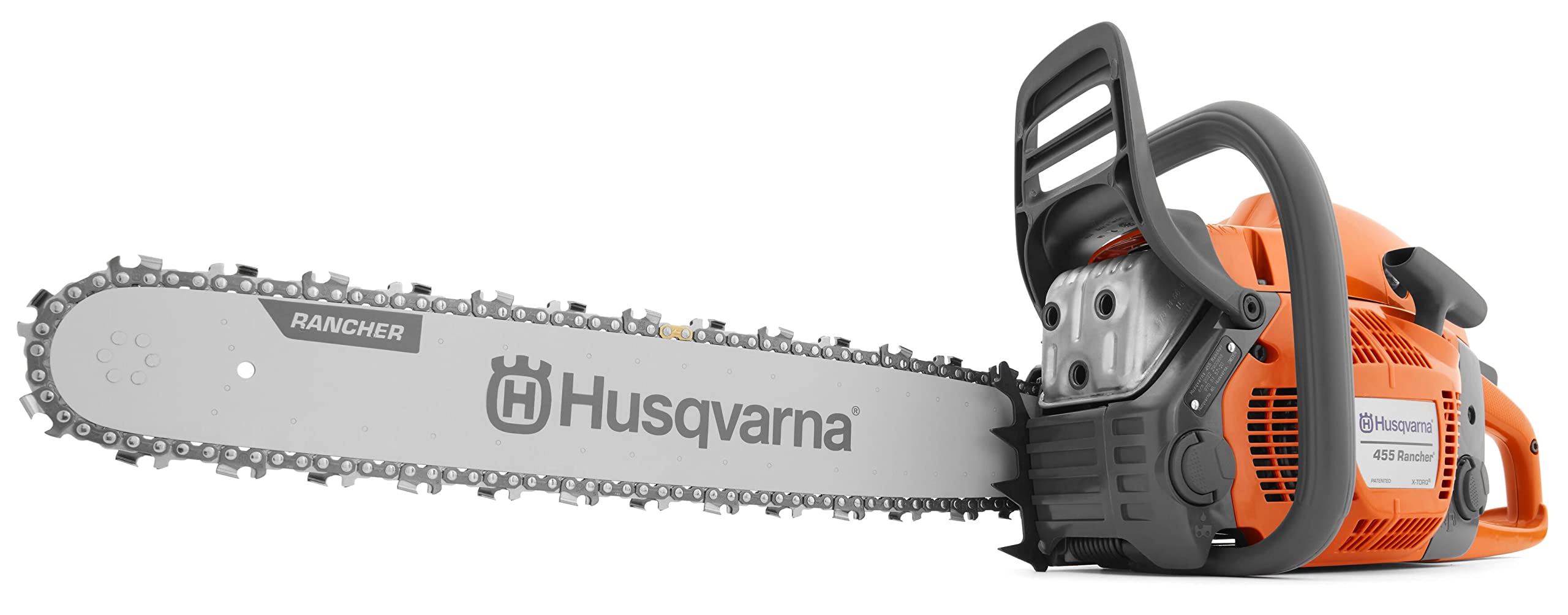
Husqvarna 455 Rancher chainsaw
See on Amazon
NEO-TEC NH872-24
See on AmazonModel comparison
| Model | Price | Rating | Weight | Power source | Power | Best for | |
|---|---|---|---|---|---|---|---|
| | Husqvarna 460 Rancher chainsaw | $649.00 as of 10/31 See on Amazon | ★ 4.5 (550+ ratings) | 13.2 lb | Gas powered | 3.6 hp | Farm and landowners cutting firewood who want a factory-rated 24-inch bar with Smart Start and LowVib comfort. |
| | Husqvarna 455 Rancher chainsaw | $589.00 as of 10/31 See on Amazon | ★ 4.4 (400+ ratings) | 13.2 lb | Gas powered | 3.5 hp | Firewood cutters with a woodlot wanting sustained power in a gas platform get a 3.5 hp X-Torq engine and Smart Start. |
| | NEO-TEC NH872-24 | $299.99 as of 10/31 See on Amazon | ★ 4.2 (350+ ratings) | 25 lb | Gas powered | not stated | Buyers felling big hardwoods who want maximum power will find 71 cc and 5.3 hp on a 24 in bar. |
 | Proyama PCS68X 68cc chainsaw | $229.00 as of 10/31 See on Amazon | ★ 4.0 (1,100+ ratings) | 17 lb | Gas powered | 4.5 hp | Buyers tackling large logs and heavy-duty woodwork who want two bars plus magnesium alloy construction and 4.5 hp. |
 | Husqvarna 555 | $799.99 as of 10/31 See on Amazon | ★ 4.2 (30+ ratings) | 13 lb | Gas powered | 4.16 hp | Professional cutters felling and bucking small to midsize trees all day get a 4.16 hp X-Torq engine, AutoTune and anti-vibration in a slim body. |
What Extra Bar Length Buys You in Reach and Cut Depth
The number printed on a bar is not the depth of wood the saw will cut. A section of bar at the powerhead end sits inside the clutch cover and never enters the wood, so the usable capacity is the bar length minus that enclosed run. That is why a saw with a 20-inch bar does not fell a 20-inch tree in one pass: the bar reaches into the trunk, but the last couple of inches at the base of the bar are buried in the saw, not in the tree.
The second point is less obvious. The same nominal bar length does not give the same usable reach on every saw, because the mount position and the distance from the drive sprocket to the bar tail differ between powerheads. A long bar mounted on a large saw sits further out from the crankcase and clears a larger diameter than the identical bar on a compact saw. Two saws can both say 24 inches on the bar and cut noticeably different sizes of trunk.
When you compare two saws, compare usable reach, not the number on the bar. And expect a long bar to buy you reach at both ends: more cutting depth in the wood, and more bar hanging out in front of you, which is weight you carry and leverage you have to control.
Why a long bar on a large chainsaw needs an engine that can keep up
Displacement and bar length are a matched pair, not two independent specs you can shop separately. A long bar presents more chain to the wood, more friction in the groove and more rotating mass to keep moving. If the powerhead cannot sustain chain speed under that load, the saw bogs in the cut, the chain runs hot and stretches, the cut slows down, and the operator starts pushing harder. That push is where kickback risk and bar wear come from.
Here is the counterintuitive part: fitting a longer bar to a given powerhead usually makes it cut slower than the shorter bar it came with, not faster. The engine is now under-geared for the load, so chain speed drops and each cutter takes a smaller bite. You paid for reach and lost speed.
That is why manufacturers publish a maximum bar length for each model, and why staying inside it matters more than chasing reach. The same logic applies to battery and corded saws, where the limiter is motor output and thermal headroom rather than displacement: a motor that cannot hold speed under a long bar heats up, and the electronics cut power or the pack drains fast.
Milling and ripping work that only a large saw handles
Milling and ripping ask something different from ordinary crosscutting. The bar is buried for the full length of the cut, at full throttle, for minutes at a time rather than seconds, and the chain is cutting along the grain, where the chip load is different and heat builds faster. A saw that crosscuts all day can still struggle here.
First, sustained torque to hold chain speed without bogging through a long, buried cut. Second, oiling capacity to keep a fully buried bar lubricated for that duration, because a dry bar in a long rip will burn its rails. Third, cooling headroom so the engine or motor does not heat-soak between cuts and lose power on the next one.
This is the work that most clearly sorts the class. A farm-and-ranch saw will crosscut large logs all day but is not built for repeated full-bar ripping. A saw that is marginal for milling shows it as burnt bar rails, stretched chain and a hot powerhead, and those are expensive symptoms.
Long-bar oiling and chain tension at full length
Oil delivery and tension both get harder as bar length grows. That is why adjustable oil pumps matter on large saws, and why a fixed low-output pump starves a long bar. The symptoms of under-oiling are easy to spot: a dry, bluish bar, a chain that runs hot, and a chain that tightens up during a cut.
On tension, chain sag is proportional to the unsupported length of bar. A long bar needs more frequent checks and is more sensitive to being set too tight, which overloads the nose sprocket and the engine, or too loose, which risks derailing the chain at speed.
Before a big cut, run a short routine. Check oil flow at the bar tip and confirm you see a spray or a line of oil thrown off. Check tension cold. Re-check after the first few minutes of cutting, when everything has warmed and settled. Then check again at each refuel, because a chain that was right at the start of the tank is rarely right at the end of it.
Our picks by budget
The Proyama PCS68X is our budget pick because it puts 68 cc, 4.5 hp and a 24-inch bar in the box with a magnesium brake and case and a second 22-inch setup, so you get large-saw capability and self-maintenance is the trade.
The Husqvarna 455 Rancher is our mid-range pick because it is a known quantity: a dealer network, a 20-inch bar, 13.2 lb, Smart Start, LowVib, Air Injection and a warranty that extends to 5 years with the qualifying pre-mixed fuel.
The Husqvarna 555 is our premium pick because AutoTune, 98% filtration, a slim 13 lb body and a warranty that covers professional use are worth paying for when you cut large wood often enough to notice the difference.
Budget
Mid-range
High-end
Which large chainsaw fits your work
The right large saw depends less on the spec sheet than on who is holding it and how often the wood is that big.
Landowner with big trees, tight budget
The PCS68X gives you 68 cc, 4.5 hp and a 24-inch bar, plus a 22-inch setup in the box, with a magnesium brake and case and air-injection filtration. The trade is 17 lb and a brand you will have to source parts for yourself.
Farm or ranch owner who wants local service
The 455 Rancher is a known brand with a dealer network, a 20-inch bar, 13.2 lb, Smart Start, LowVib, Air Injection and an automatic oiler. The 2-year warranty extends to 5 years with the qualifying pre-mixed fuel.
Buyer who wants the longest bar and a mainstream brand
The 460 Rancher pairs 60.3 cc and 3.6 hp with a 24-inch bar at 13.2 lb, and adds an adjustable oil pump and side tensioning. It is the point where bar, displacement and weight all sit in the large class.
Semi-pro cutting large wood regularly
The 555 brings 4.16 hp, a 24-inch bar, AutoTune engine management, 98% filtration, a slim body and an X-CUT chain. The 2-year warranty covers professional use, which is what you want if the saw earns money.
Buyer who wants maximum power and accepts the weight
The NH872-24 has 71 cc, 5.3 hp and a 24-inch bar, and takes Husqvarna 372XP parts. At 25 lb it is a saw you plan the day around.
Our verdict on the best large chainsaw
The Husqvarna 460 Rancher is the best all-round large chainsaw here: 60.3 cc pulling a 24-inch bar at 13.2 lb, with Smart Start, LowVib, Air Injection, an adjustable oil pump and side tensioning, from a brand with a service network. It is the point where bar length, displacement and weight are all genuinely in the large class without tipping into pro-saw weight or pro-saw price.
The Husqvarna 555 is the pick for anyone cutting large wood regularly and wanting AutoTune and a professional-use warranty. The Husqvarna 455 Rancher suits the buyer who wants a known brand at the entry to the class. The Proyama PCS68X gives the most displacement and bar for the money if you accept self-maintenance, and the Neo-Tec NH872-24 is for the buyer who wants the most power here and will carry 25 lb for it. For a single tree, renting a large saw or hiring an arborist beats buying one of these.
Detailed model analysis
A saw only belongs in this class when its bar and its displacement are both big enough to fell and buck large hardwood, and each of these five clears that bar.
Husqvarna 460 Rancher chainsaw
The 460 Rancher pairs 60.3 cc and a 24-inch bar on one powerhead. Its 2-cycle X-Torq engine makes 3.6 hp and runs on a 50:1 mix.
The side-mounted tensioning system lets you adjust chain slack without flipping the saw. The automatic adjustable oil pump feeds a 0.7 US pint (0.32 L) tank, and you can turn the flow up to keep a long bar wet.
Smart Start eases pull-starting, LowVib cuts the vibration that reaches your hands, and the ergonomic front handle gives you a grip for a long session.
Air Injection is a centrifugal air cleaning system that spins larger dust and debris out before the air filter, so the filter stays cleaner longer.
It suits farm and landowners, firewood preparation, demanding cutting jobs and tree cutting. The box holds the powerhead, bar, chain, a 2.6 oz 50:1 fuel mix, a fuel cap, a scrench, the operator's manual and a quick start guide.
The warranty is 2 years, extended to 5 years with 96 fl oz of pre-mixed fuel. At 13.2 lb with a 24-inch bar, balance and fatigue over a long bucking day are the main consideration.
- Brand: Husqvarna
- Engine displacement: 60.3 cc
- Power: 3.6 hp
- Bar length: 24 in
- Weight: 13.2 lb
- Power source: Gas powered
Husqvarna 455 Rancher chainsaw
The 455 Rancher pairs a 20-inch bar with a 55 cc, 3.5 hp X-Torq engine running on a 50:1 fuel mix. It suits you if you want a mainstream brand at the entry point of the large class.
The automatic oiler feeds a 0.7 US pint (0.32 L) oil tank, so you are not squeezing a manual button every few cuts. Side-mounted tensioning handles slack adjustments.
It weighs 13.2 lb and measures 16.7 inches long, 8.8 inches wide and 11.8 inches high. Smart Start, LowVib and the ergonomic front handle bring easier starts and less vibration.
Air Injection pulls dust and debris out before the air filter, which improves engine life and cuts down on filter cleanings. It is built for firewood, landscaping, branch trimming and storm cleanup.
The warranty is 2 years, extendable to 5 with the qualifying 96 fl oz pre-mixed fuel purchase.
The main limit is the pairing: a 20-inch bar on 55 cc makes it less capable in genuinely large timber. It is the right saw for the buyer at the edge of the class.
- Brand: Husqvarna
- Bar length: 20 in
- Power: 3.5 hp
- Engine displacement: 55 cc
- Weight: 13.2 lb
- Power source: Gas powered
NEO-TEC NH872-24
71 cc and 5.3 hp on a 24-inch bar make the NH872-24 a professional saw built for heavy-duty forestry.
That power keeps the 24-inch bar moving through a big hardwood log without the saw bogging and the chain heating up.
It is compatible with Husqvarna 372XP parts, so a replacement follows a known parts pattern rather than a one-off.
It weighs 25 lb and measures 18.3 inches long, 11.3 inches wide and 9.7 inches high. You plan around this saw, you do not carry it one-handed up a slope.
It comes as the NH872 power head only, so bar and chain are a separate consideration for you.
Our main caveat: 25 lb is a two-handed saw, and you feel that weight by the end of a long bucking session.
- Brand: Neo-Tec
- Power source: Gas powered
- Horsepower: 5.3 hp
- Weight: 25 lb
- Dimensions: 18.3 in long, 11.3 in wide and 9.7 in high
- Compatibility: Husqvarna 372XP
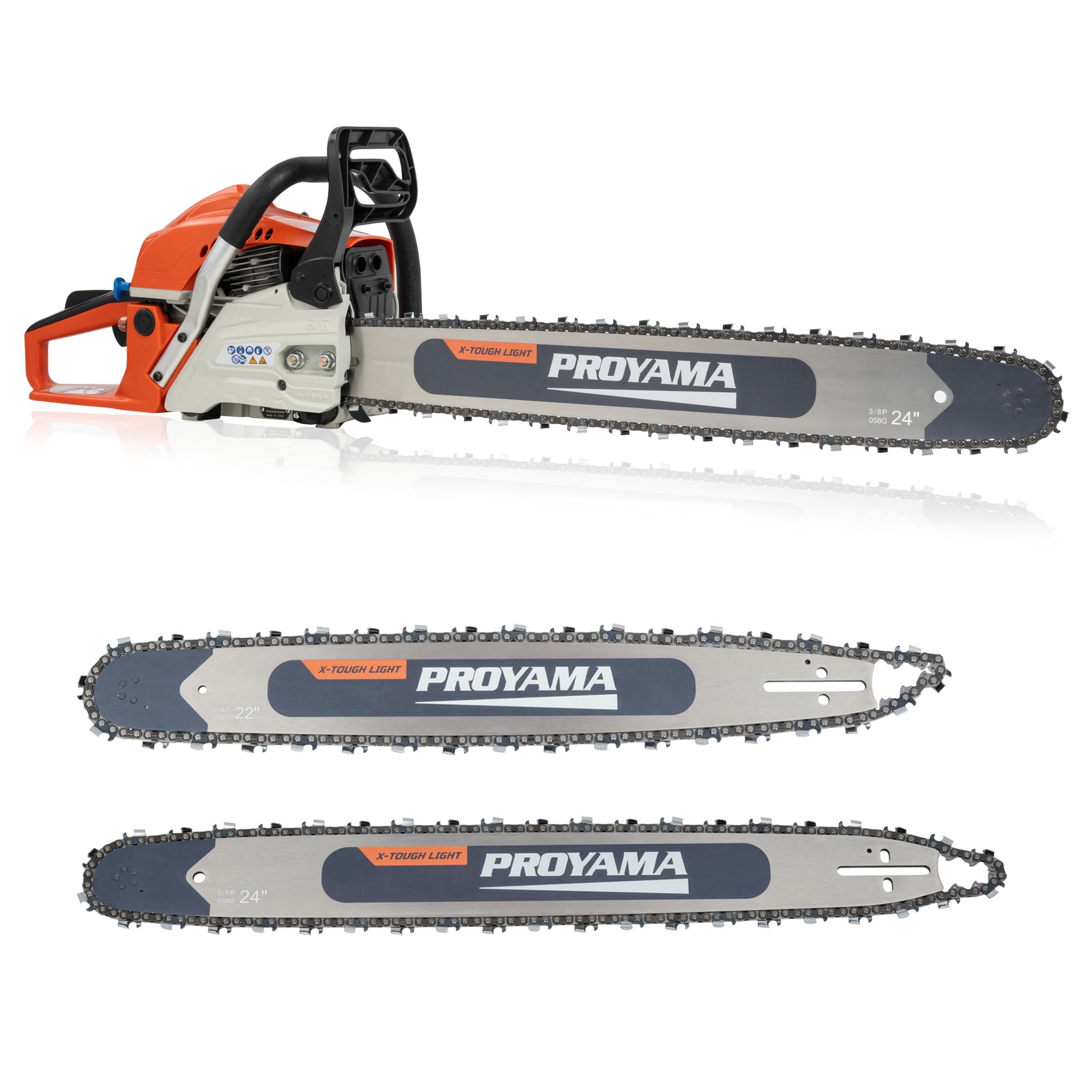
Proyama PCS68X 68cc chainsaw
The PCS68X puts 68 cc and 4.5 hp behind a 24-inch bar. Two bar-and-chain setups, a 22-inch and a 24-inch, both come in the box.
The 2-cycle engine makes 4.5 hp from 68 cc, which lets the saw hold chain speed in a long cut through hardwood.
The chain brake and the case are high-strength magnesium alloy, described as resisting deformation and wear during heavy cutting and extending service life over long-term outdoor use.
Air-injection filtration is quoted at filtering 97% of incoming sawdust, grit and dirt. Easy start takes some of the pull out of the cord.
It weighs 17 lb and measures 41 inches long, 9.4 inches wide and 11.4 inches high. Plan where it rides in the truck and how far you carry it.
It is built for wood cutting, tree trimming, large logs, thick branches and heavy-duty woodwork, as a commercial heavy-duty, low-maintenance saw.
- Brand: Proyama
- Engine displacement: 68 cc
- Power: 4.5 hp
- Power source: Gas powered
- Weight: 17 lb
- Dimensions: 41 in long, 9.4 in wide and 11.4 in high
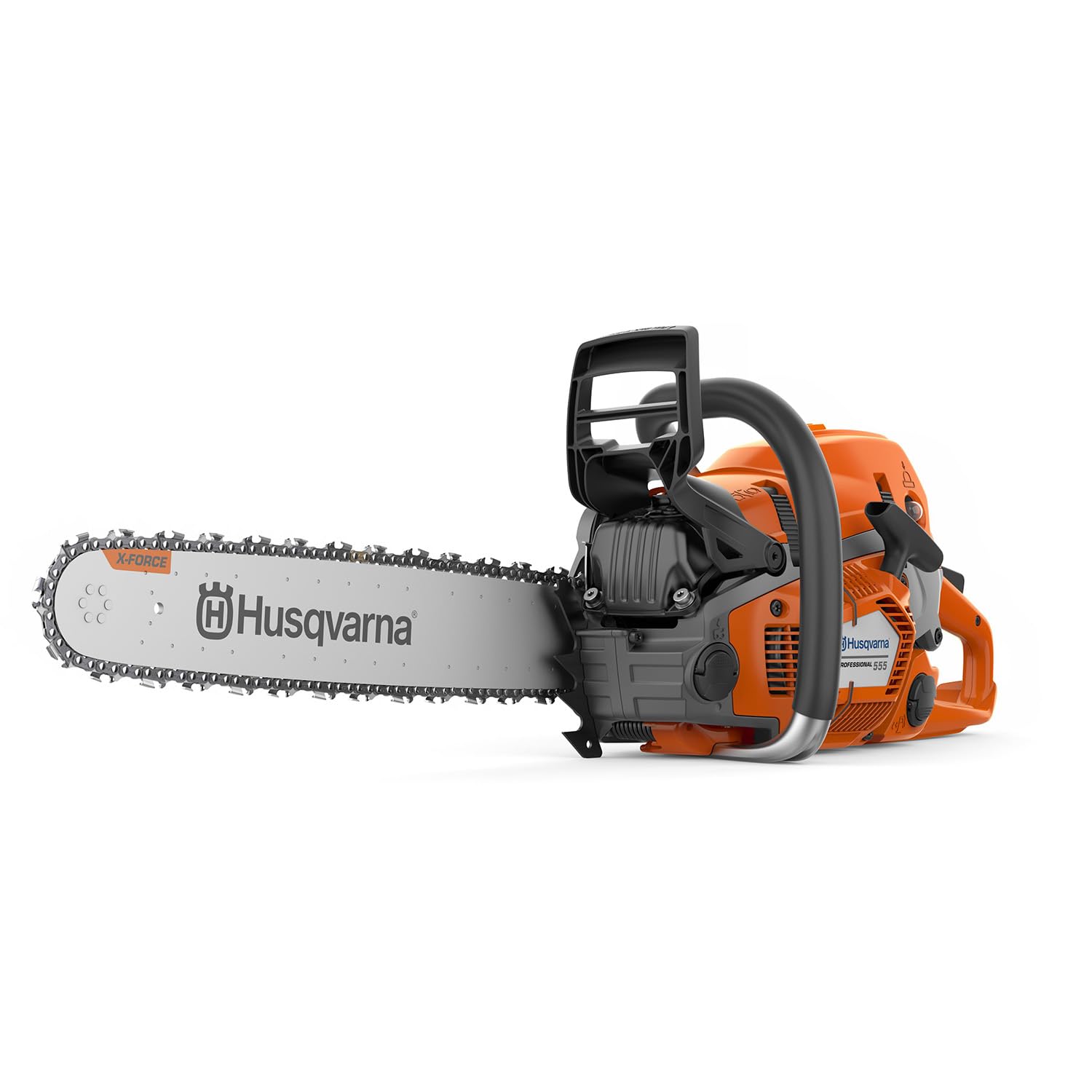
Husqvarna 555
The Husqvarna 555 pairs 4.16 hp with a 24-inch bar. Its engine management and filtration are specified for professional felling, limbing and bucking, which makes it a fit for large wood.
The X-TORQUE engine uses AutoTune to adjust the fuel mixture as altitude, temperature and fuel quality change, so you skip carburetor screws between tanks. Smart Start eases the pull.
An X-CUT chain comes in the box, and tensioning is side-mounted, so you adjust slack from the side of the powerhead. It weighs 13 lb and measures 18.2 inches long, 8.9 inches wide and 11 inches high.
The slim body and anti-vibration system mean less bulk between your hands and less buzz reaching your fingers over a long day.
Air Injection removes 98% of dust and debris before it reaches the air filter. It suits small and midsize trees, firewood cutting and log cutting.
It runs a 50:1 mix and holds 0.68 US pint (0.32 L) of bar oil. The warranty is 2 years and covers professional use.
- Brand: Husqvarna
- Power source: Gas powered
- Power: 4.16 hp
- Bar length: 24 in
- Weight: 13 lb
- Dimensions: 18.2 in long, 8.9 in wide and 11 in high
Frequently asked questions
Bar length and displacement decide what a large saw can do, and getting the pair wrong is the most common and most expensive mistake in this class.
What counts as a large chainsaw?
A large chainsaw needs a minimum bar length of 20 inches and an engine matched to it: around 55 cc is the entry to the class, and 60 cc and up is what real large-tree work in hardwood calls for. The limit is practical rather than official, and an under-powered saw on a long bar bogs and cuts slower than a shorter one would.
Is a 20-inch chainsaw enough for large trees?
It is the entry to the class. A 20-inch bar handles large limbs and medium trunks well, but it is not the saw for mature hardwood, where you need more bar and more displacement together.
Do large saws need more bar oil?
Yes. Check flow at the bar tip before a big cut and re-check chain tension once everything is warm.
Can a battery chainsaw handle large trees?
Battery saws exist at this bar length, but sustained full-bar cutting is limited by motor output and heat, and the pack drains fast in a long buried cut. The large class is gas-powered in practice.
When should I rent a large saw or hire an arborist instead of buying one?
For a single tree, renting is cheaper than buying. For anything taller than you are, structurally decayed, close to a building or a line, or beyond about 36 inches across, hire a certified arborist.